Botanical species
Silene gallica
L.
Small-flowered Catchfly
Description
Morphological description
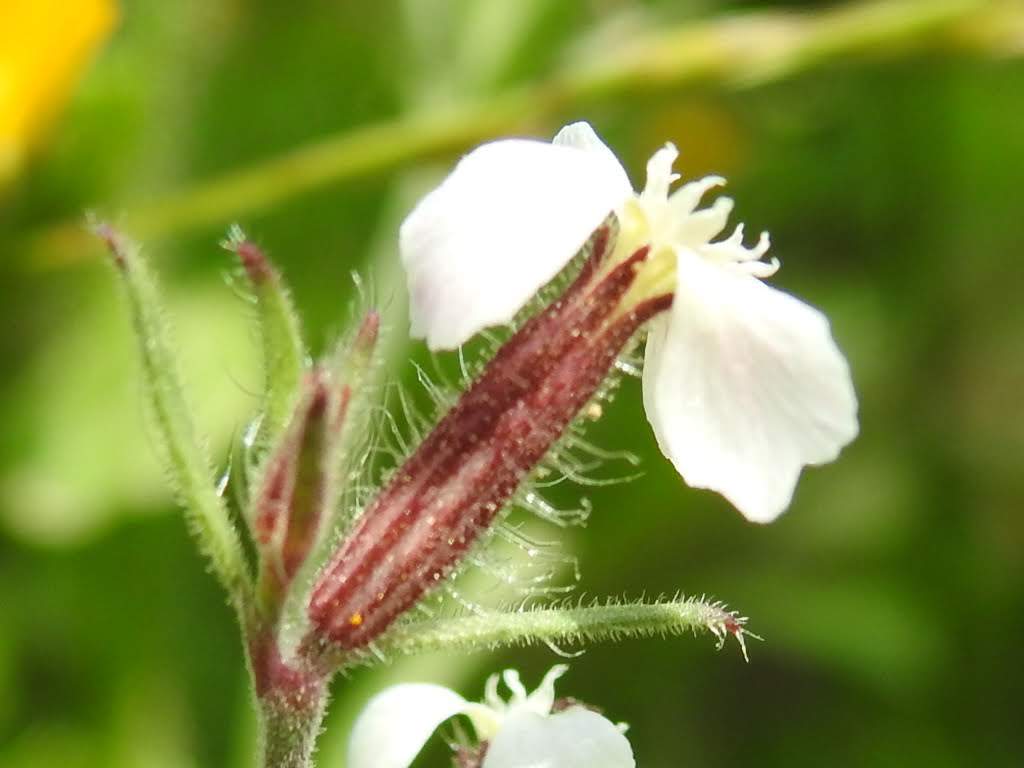
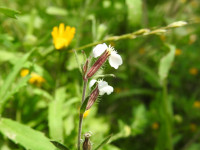
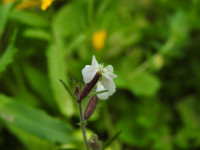
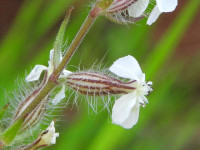
Annual herbaceous plant that can reach a variable height from 8 to 45 cm. The habit is erect or ascending, with simple or sparsely branched stems, generally pubescent in the lower part and viscid-glandular in the upper part. The stem is covered with long and often curled hairs, associated with a shorter and denser pubescence, with patent bristles about 2-3 mm especially on the calyx veins.
The leaves are arranged oppositely and sessile, with variable shapes along the plant: the basal and lower leaves are broad and spatulate or oblanceolate, up to 30 mm long and about 8 mm wide, while the upper ones become narrower and lanceolate, up to 25 mm long and 2-4 mm wide. The leaf surfaces are herbaceous, with ascending hairs and more or less rough bristles, often with glandular hairs especially in the upper part.
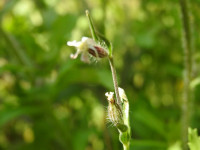
The inflorescence is a monochasial raceme, that is with flowers arranged mainly on one side of the flowering branch, comprising from 7 to 15 flowers, sometimes up to 20. The flower peduncles are short, generally between 2 and 5 mm, with linear-lanceolate bracts 7-10 mm long reaching the apex of the calyx.
The calyx is pyriform, 7-10 mm long and 3-5 mm wide, with 10 well-marked, parallel and non-anastomosing veins, and denticulate margins. The surface is dense with patent bristles up to 2-3 mm long, mixed with glandular hairs, with lanceolate and acute calyx teeth about 2 mm long. In fruiting state, the calyx can remain erect or lean, especially in late flowering.
The flowers have five white or pale pink petals, sometimes with a crimson or dark red spot, which can extend over the entire petal surface (variety quinquevulnera). The petals are up to 7 mm long, with an elliptic or obovate limb, entire or slightly crenulate, and equipped with two appendages (paracorolla scales) lanceolate in shape and about 1-1.5 mm long. The stamens are ten, with filaments bearded at the base, of variable length and partly included in the calyx.
The ovary is superior, with three styles included in the calyx, and a very short and pubescent carpophore, less than 1 mm. The fruit is a pyriform capsule, 6-9 mm long, which opens through six narrow and triangular recurved teeth to release numerous dark, reniform, finely tuberculate seeds with a rough surface.
The root system consists of a thin main root, typical of annual plants adapted to well-drained soils.
Habitat and distribution
Eurymediterranean and subcosmopolitan species, it is widespread throughout the Mediterranean basin, including the Italian Peninsula, Liguria, Sardinia, Sicily, Corsica and other minor islands. In Italy it is also sporadically present in valley mountain environments, such as in the Alpine valleys of Piedmont (up to Ivrea), in the Adige basin (Trento) and in the Isarco Valley. However, it is absent in the Po plain.
It prefers open environments such as uncultivated land, cultivated fields, pastures and meadows, with a preference for siliceous substrates. It is a thermophilic species that grows from sea level up to about 1000 meters altitude, also adapting to dry mountain environments. Exposure is generally sunny, in areas with well-drained and often nutrient-poor soils.
Flowering period
Flowering mainly extends from April to July, with possible geographical variations related to altitude and local climate. In some areas, especially mountainous or with late flowering, the flowers may have inclined calyces and paler or almost white petals.
Ecology and pollination
The species is pollinated by pollinating insects, favoring entomophilous pollination thanks to medium-small sized but conspicuously colored flowers (white or pink with dark spots), which attract bees, bumblebees and other diurnal-active pollinating insects. The flowers lack a strong scent and open during the day.
Seed dispersal occurs through capsule dehiscence which opens with six recurved teeth, facilitating seed fall to the ground. The seeds, reniform and with tuberculate surface, are probably adapted to barochory (gravity dispersal) and can also be transported by small ground movements or animals.
Curiosities and traditional uses
In the past, this species was used in folk medicine as a remedy against viper bites, probably due to its astringent or hemostatic properties linked to active principles contained in the plant. No traditional food uses or particular folkloric references are documented for this species.
Etymology
The genus name "Silene" probably derives from the Greek “sialon”, meaning “saliva”, referring to the stickiness of plants of this genus, whose surface can appear covered by saliva-like secretions. Another interpretation links the name to the mythological figure of the satyr Silenus, companion of Dionysus, known for his swollen belly, like the swollen calyx of some Silene.
The specific epithet "gallica" means “of Gaul” (ancient France), referring to the original distribution or the species’ chorotype.
The Italian common name, Small-flowered Catchfly, is simply the transposition of the scientific name, while in other languages the species is known as "Silène de France" (French), "Small-flowered Catchfly" (English) or "Carmentilla" (Spanish).
Sources
- Prof. S. Pignatti, "Flora d'Italia"
- Acta Plantarum - Flora delle regioni italiane (scheda di Anja Michelucci)
- World Flora Online (WFO)
Characteristics
Scheda botanica
| Famiglia | Caryophyllaceae |
|---|---|
| Fioritura | aprile – luglio |
| Forma biologica | Scapose |
| Habitat | with white flowers, with pink flowers, annual plant |
Domande frequenti
- Quando fiorisce Small-flowered Catchfly?
- Small-flowered Catchfly fiorisce aprile – luglio.
- Che tipo di pianta è Small-flowered Catchfly?
- Small-flowered Catchfly è una Therophytes (Scapose) secondo la classificazione di Raunkiaer.
- A quale famiglia appartiene Small-flowered Catchfly?
- Small-flowered Catchfly appartiene alla famiglia botanica Caryophyllaceae.
Where I found it (14 sightings)
Classification
- Kingdom
- Plantae
- Family
- Caryophyllaceae
- Full name
- Silene gallica L.
- Synonyms
- Silene lusitanica L.
- Life form
- Therophytes scapose
Similar species
Search for species with similar characteristicsNoticed an error in the identification? Write to me
Other species of the same family
Caryophyllaceae
Explore
Other species of Caryophyllaceae