Botanical species
Petrorhagia prolifera
(L.) P.W.Ball & Heywood
Proliferous Pink
Description
Morphological description
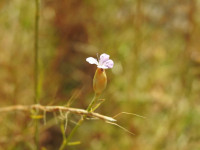
Annual herbaceous plant generally 10 to 40 cm tall, but occasionally reaching 50 cm. It has erect stems, simple or slightly branched at the base, glabrous or with rare short hairs, with internodes generally free of pubescence. The stem has a smooth surface and erect habit, supporting a scapose floral axis, often leafless along the stem itself.
The leaves are arranged oppositely, without stipules, linear in shape and 10 to 45 mm long, about 1-3 mm wide. They are clasping, with sheaths that wrap around the stem and are about as long as wide (about 1 cm), with denticulate or slightly ciliate margins and a rough or slightly rough surface. The base of the sheath is fused with a short portion of a few millimeters.
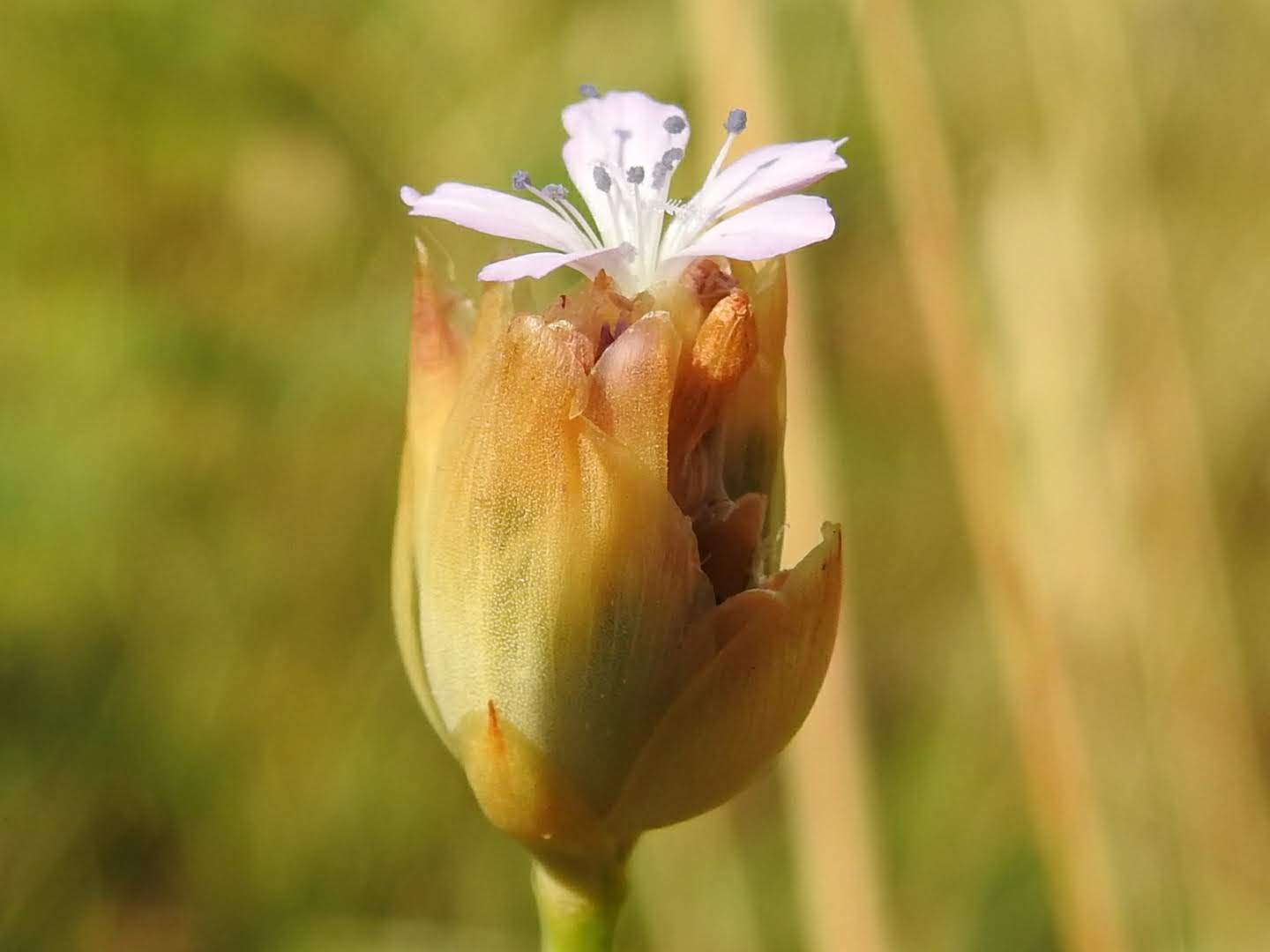
The flowers, hermaphroditic, are gathered in compact apical cymose inflorescences, usually composed of 2 to 12 flowers, but sometimes solitary. The flowers are subsessile and open one at a time. The calyx is gamosepalous, tubular, cylindrical or campanulate in shape, 8-13 mm long, glabrous, with five well-marked angles. Around the calyx there is an involucre of scarious, appressed bracts, straw-brown in color, broadly ovate and obtuse, often completely enveloping the calyx and without evident veins; the outer bracts may be mucronate.
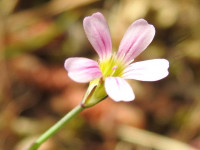
The corolla is dialypetalous and composed of five obcordate or emarginate petals, 10 to 15 mm long, pale pink or purplish in color, rarely white, without dark spots or scales at the base. The petals have a long and slender claw. There are 10 stamens, 2 styles, and the ovary is superior.
The fruit is an ovoid or club-shaped capsule, about 7-10 mm long, opening by four teeth (dehiscent), without a carpophore. The seeds are numerous, compressed, ovoid or shield-shaped, up to 1.9-2.3 mm long, with a reticulate surface and black in color at maturity. The root system consists of a main taproot.
Habitat and distribution
The Proliferous Pink is a species typical of Mediterranean environments, with a range extending from southern and central Europe to western Asia and North Africa. In Italy it is present throughout the territory, preferring coastal and inland areas up to 1400 meters altitude. It grows on calcareous soils, in habitats characterized by wastelands, dry and ruderal meadows, disturbed spaces, and dry sunny places.
It prefers sunny exposures and well-drained soil conditions, often on poor and rocky substrates typical of hilly and lower mountain areas, but can also adapt to subalpine altitudes.
Flowering period
Flowering extends from late spring (May) to early autumn (September-October), with a higher concentration of flowers in the summer months, from June to September. The period may vary slightly depending on latitude and altitude, occurring earlier in warmer regions and later in cooler or higher areas.
Ecology and pollination
The species is mainly pollinated by pollinating insects attracted by the pale pink color of the flowers. The corolla, lacking dark spots or scales at the base, is homochromatic, suggesting a uniform visual attraction strategy for various pollinating insects. The flowers open progressively one at a time, facilitating cross-pollination.
Seed dispersal occurs through the dehiscence of the capsule which releases the seeds onto the surrounding soil. The reticulate and compressed surface of the seeds allows some adherence to the substrate, favoring germination in the immediate vicinity of the mother plant.
Curiosities and traditional uses
No specific medicinal, food, or folkloric uses are documented for this species. However, the common name "Proliferous Pink" recalls the resemblance to carnations, plants traditionally appreciated for their beauty and ornamental use. The presence of this species in ruderal and dry environments makes it an indicator of well-preserved Mediterranean habitats.
Etymology
The genus name derives from the Greek “petros” (stone) and “rhagas” (crack), referring to the typical growth of the genus in rocky crevices and stony environments. The specific epithet “prolifera” derives from the Latin “prolifer,” meaning “producing offspring,” alluding to the particular inflorescence with numerous flowers grouped and contained within the bracts. The Italian common name “Proliferous Pink” highlights the annual nature of the plant and its aesthetic affinity with carnations (genus Dianthus).
Sources
- Prof. S. Pignatti, "Flora d'Italia"
- Acta Plantarum - Flora delle regioni italiane (scheda di Anja Michelucci)
- Tela Botanica / H. Coste, "Flore descriptive et illustrée de la France"
- World Flora Online (WFO)
Characteristics
Scheda botanica
| Famiglia | Caryophyllaceae |
|---|---|
| Fioritura | maggio – settembre |
| Forma biologica | Scapose |
| Habitat | with pink flowers, annual plant, plant with a scapose habit |
Domande frequenti
- Quando fiorisce Proliferous Pink?
- Proliferous Pink fiorisce maggio – settembre.
- Che tipo di pianta è Proliferous Pink?
- Proliferous Pink è una Therophytes (Scapose) secondo la classificazione di Raunkiaer.
- A quale famiglia appartiene Proliferous Pink?
- Proliferous Pink appartiene alla famiglia botanica Caryophyllaceae.
Where I found it (3 sightings)
Classification
- Kingdom
- Plantae
- Family
- Caryophyllaceae
- Full name
- Petrorhagia prolifera (L.) P.W.Ball & Heywood
- Synonyms
- Dianthus prolifer L.; Tunica prolifera (L.) Scop.
- Life form
- Therophytes scapose
Similar species
Search for species with similar characteristicsFurther reading
Noticed an error in the identification? Write to me
Other species of the same family
Caryophyllaceae
Explore
Other species of Caryophyllaceae