Botanical species
Saponaria ocymoides
L.
Rock Soapwort
Description
Morphological description
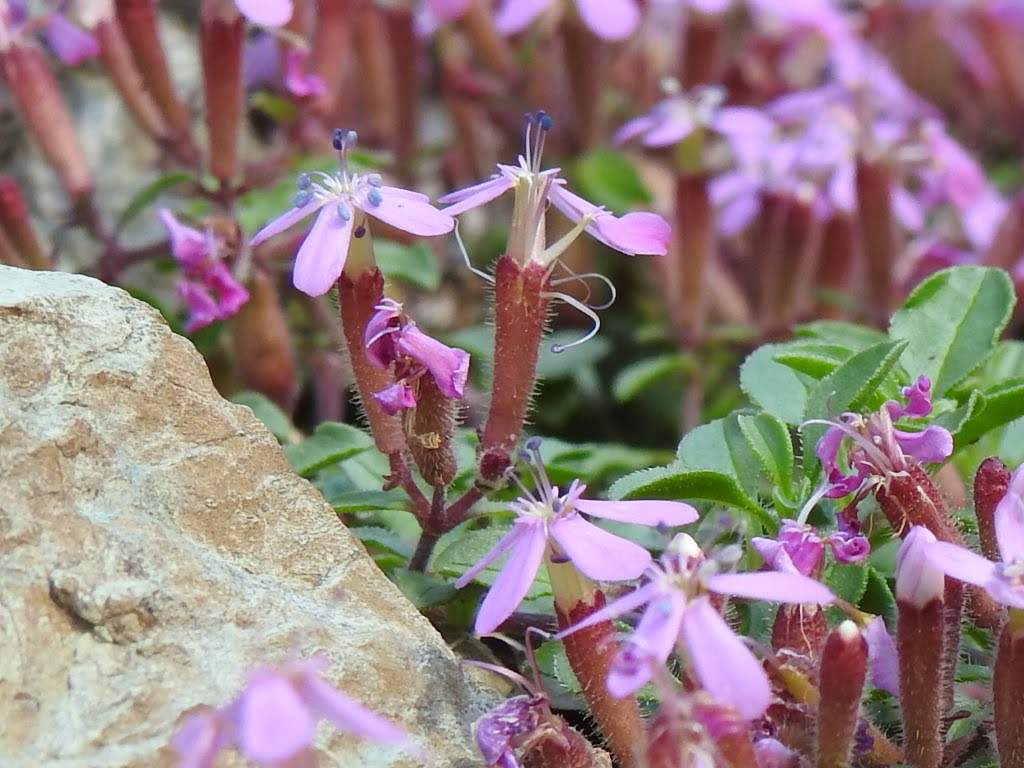
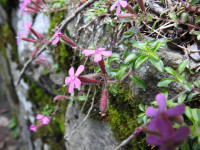
Perennial plant with a prostrate-ascending habit, Rock Soapwort develops forming dense and ground-covering bushes, with branched stems, woody at the base and generally between 10 and 40 cm long. The stems are covered with a dense glandular pubescence, which makes them rough or tomentose, with spreading hairs and scattered glands, giving a hirsute to tomentose surface. This characteristic pubescence extends to the base of the stem.
The leaves are sessile, lanceolate or ovate-lanceolate, of variable size but generally 15-17 mm long and 4-5 mm wide, with a single vein (uninerved). The cauline leaves are more lanceolate and acute, while the basal ones tend to be obtuse and obovate. The leaves are slightly ciliate and attached directly to the stem without an evident petiole.
The flowers are gathered in short, lax cymes, located in the axils of the upper leaves. Each flower is borne on a peduncle 2-6 mm long, which has a pair of short bracts at half its length. The calyx is cylindrical, about 8-10 mm long, green with reddish-violet hues, densely pubescent and covered with glands, with a dentate margin at the apex.
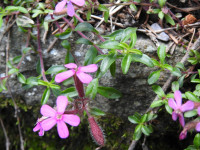
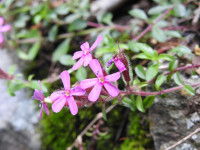
The corolla consists of five spatulate petals, bright pink-fuchsia or wine-red in color, with a limb about 8-15 mm long and a claw about 9 mm long. The petals are often retuse and sometimes show a slight bilobation. The flowers have 10 stamens and 2 styles, and sometimes possess a coronula (a small crown at the base of the corolla).
The fruit is a pyriform or ovoid capsule, about 6-9 mm long, included in the calyx, which opens apically by four teeth (dentate capsule). The seeds are reniform, brown-blackish, laterally compressed, 1.5-2 mm long and characterized by a finely tuberculate head with a lateral hilum.
The root system is composed of a well-developed main root accompanied by less robust secondary roots, which favors anchorage to rocky and gravelly substrates.
Habitat and distribution
Rock Soapwort is a typically orophilous species, mainly distributed in southwestern Europe, with a range extending from the Iberian Peninsula to the French Massif Central and the northern and central Alps and Apennines. In Italy it is mainly present in the alpine and northern Apennine regions, while it is rare or absent in the true plains. In Sardinia, a more slender subspecies with less dense inflorescences is found.
It prefers calcareous, rocky, and gravelly habitats, such as sun-exposed slopes, garrigues, rock gardens, and landslide areas. It grows up to about 1500 meters altitude, in sunny exposure conditions and well-drained soils, typical of hilly and submontane areas. It is adapted to poor and dry substrates, often colonizing rubble and riverbeds.
Flowering period
Flowering generally occurs from May to August (months 5-8), with peak flowering in the warmer months. No marked variations in the flowering period are reported between different distribution areas, but flowering may start slightly earlier in lower and sunnier zones.
Ecology and pollination
The species is pollinated by pollinating insects attracted by the bright pink-fuchsia color of the flowers, such as bees and other hymenopterans, which visit the flowers in search of nectar and pollen. The presence of a coronula in the corolla may facilitate nectar collection by pollinating insects.
Seed dispersal occurs through the dentate capsule which opens releasing the seeds, which are small and light, favoring limited dispersal by falling or transport by abiotic agents such as wind or water in gravelly and rocky environments.
Curiosities and traditional uses
The genus name derives from the presence of saponins in the roots, substances that were used in the past as natural detergents, hence the name "Saponaria" (from the Latin sapo, soap). However, no specific medicinal or food uses for Saponaria ocymoides are reported here.
In Mediterranean folklore and ethnobotany, plants belonging to the genus Saponaria have sometimes been associated with traditional uses as detergents or folk remedies, but for Rock Soapwort in particular no detailed documentation of uses is recorded.
Etymology
The scientific name Saponaria ocymoides derives from two elements: Saponaria, referring to the roots' ability to produce a soap-like substance (saponins), and ocymoides, meaning "similar to Ocimum" (basil), recalling the similarity of the leaves to those of common basil (Ocimum basilicum).
The Italian common name “Saponaria rossa” refers both to the characteristic presence of saponins and to the intense red-fuchsia color of the flowers, which represent one of the most distinctive traits of the species.
Sources
- Prof. S. Pignatti, Flora d'Italia
- Acta Plantarum - Flora delle regioni italiane (scheda di Giuliano Salvai)
- World Flora Online (WFO)
Characteristics
Scheda botanica
| Famiglia | Caryophyllaceae |
|---|---|
| Fioritura | maggio – agosto |
| Forma biologica | Tufted |
| Habitat | with fuchsia flowers, creeping plant, plant with a prostrate-ascending habit |
Domande frequenti
- Quando fiorisce Rock Soapwort?
- Rock Soapwort fiorisce maggio – agosto.
- Che tipo di pianta è Rock Soapwort?
- Rock Soapwort è una Hemicryptophytes (Tufted) secondo la classificazione di Raunkiaer.
- A quale famiglia appartiene Rock Soapwort?
- Rock Soapwort appartiene alla famiglia botanica Caryophyllaceae.
Where I found it (8 sightings)
Classification
- Kingdom
- Plantae
- Family
- Caryophyllaceae
- Full name
- Saponaria ocymoides L.
- Life form
- Hemicryptophytes tufted
Similar species
Search for species with similar characteristicsFurther reading
Noticed an error in the identification? Write to me
Other species of the same family
Caryophyllaceae
Explore
Other species of Caryophyllaceae