Botanical species
Cerastium glomeratum
Thuill.
Sticky Mouse-Ear
Description
Morphological description
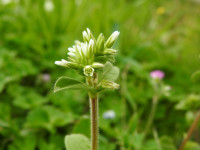
Annual herbaceous plant, generally 5 to 30 cm tall, with erect or ascending stems, often dichotomous and highly branched at the base. The stem is densely covered with stellate and glandular hairs, especially in the upper part, giving the plant a sticky and hairy surface. The supporting structure is scapose, with an elongated floral axis generally leafless.
The leaves are opposite, sessile, and variable in shape between ovate, elliptical, subspatulate, or lanceolate, with an obtuse or acute apex and entire margins. The size generally varies from 4-6 mm in width and 10-16 mm in length, with basal leaves slightly larger (up to 20 mm). They are covered with long, silky hairs on both surfaces, giving a soft texture.
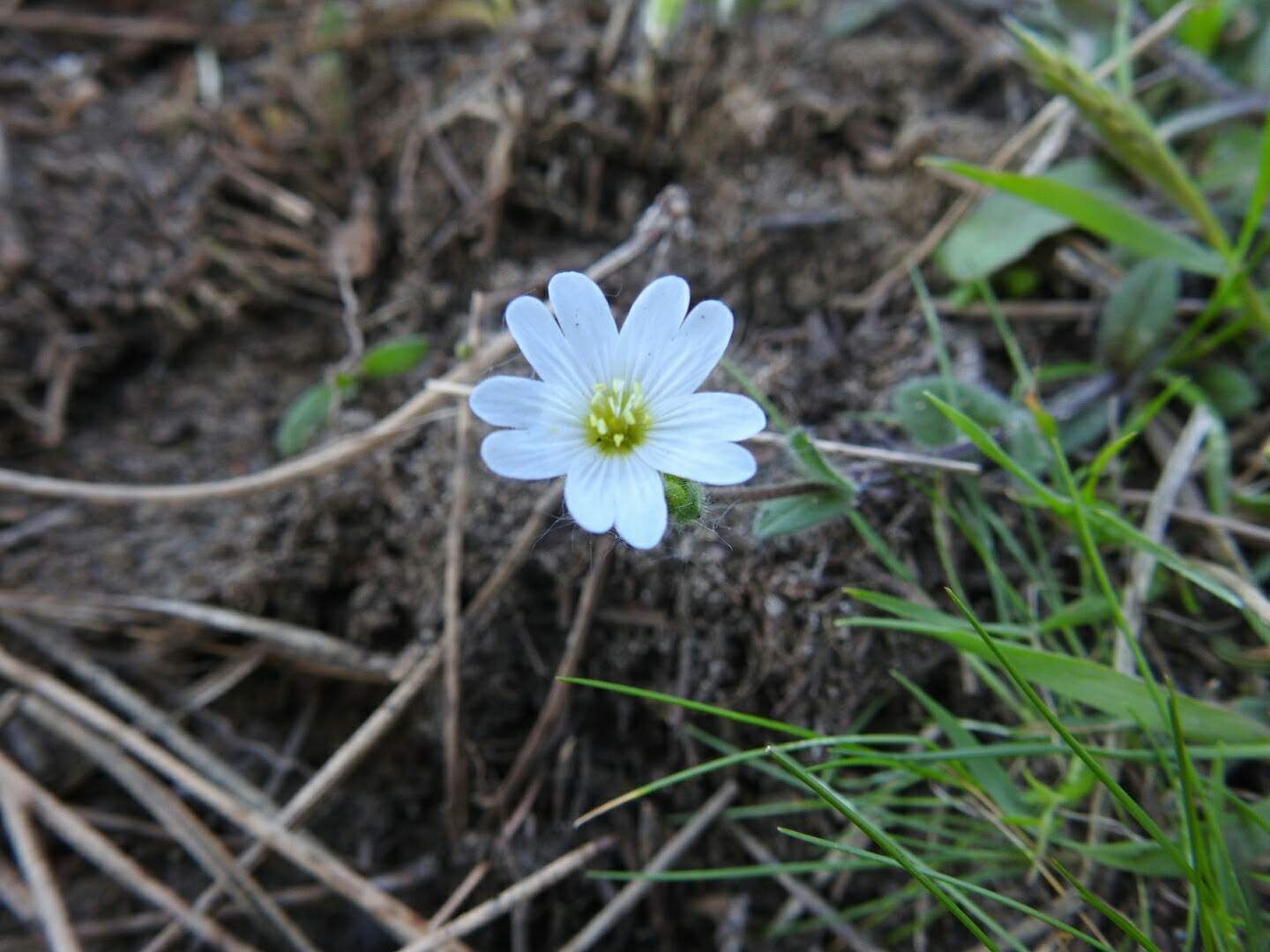
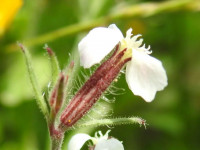
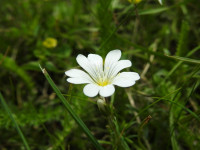
The flowers are white, small, and grouped in compact terminal glomeruli inflorescences, often formed by repeatedly branched dichotomous cymes. Each inflorescence is placed between two opposite sessile leaves, with very short peduncles (1-5 mm), sometimes glandular and hairy. The calyx has five lanceolate, acute, and hairy sepals, with scarious (thin and membranous) margins and often glandular externally; the sepals are about 3-5 mm long. The petals, also five, are white, slightly bilobed (with incision about a quarter of the length), often ciliate at the base and slightly shorter or equal in length to the sepals. Some individuals may show reduced or absent petals, a phenomenon linked more to ecological conditions than to genetic variations.
The stamens number ten (sometimes only five), shorter than the petals, with glabrous filaments and small anthers (0.2-0.45 mm). The style is about 0.5-1 mm long, with five free styles. The fruit is a cylindrical capsule, 7-8 mm long, slightly curved, dehiscing apically through 10 obtuse teeth. The seeds are numerous, small (0.3-0.75 mm in diameter), light brown in color, with a finely tuberculate surface covered by minute warts.
The root system is not described in detail, but as an annual plant with erect stems it is presumably composed of fibrous roots of modest depth.
Habitat and distribution
This species is widely distributed in Italy, present in all regions including the major islands. In the Mediterranean basin it is found in similar habitats, extending into many European areas, including continental France and Corsica, and beyond, with an almost cosmopolitan distribution.
It grows mainly in anthropized environments such as cultivated and uncultivated fields, vineyards, road and path edges, showing high ecological plasticity. It inhabits soils of various types, from plains up to submontane elevations of about 1400 m, generally in sunny or semi-shaded exposures.
The species prefers well-drained soils, often disturbed by agricultural activity or urbanization, adapting to poor or moderately fertile substrates.
Flowering period
Flowering extends from early spring to late autumn, with the highest concentration of flowers between April and June. In some regions and environmental conditions, flowering can continue until December, especially in milder climates or at lower elevations.
Ecology and pollination
Sticky Mouse-Ear reproduces mainly by entomogamous pollination, involving pollinating insects attracted by the white flowers and their aggregated arrangement. The compact structure of the floral glomeruli facilitates simultaneous visits to multiple flowers by pollinating insects.
The species shows some variability in the presence and size of petals, which can sometimes be reduced or absent: this phenomenon is probably linked to ecological conditions and does not represent a stable genetic difference.
Seed dispersal occurs through the dehiscent capsule that releases numerous tuberculate seeds, promoting propagation in disturbed environments. The curved shape of the capsule resembles a small horn, a typical characteristic of the genus Cerastium.
Curiosities and traditional uses
No significant ethnobotanical applications or medicinal uses are known for this species. Traditionally, Sticky Mouse-Ears have not been particularly used in phytotherapy or as food plants, probably due to their modest size and widespread occurrence as weeds.
The common name "Sticky Mouse-Ear" may refer to its frequent presence in cultivated fields, where it sometimes behaves as a weed, but without particular agronomic importance.
Etymology
The genus name Cerastium derives from the Greek "keras," meaning "horn," referring to the curved shape of the seed capsules, which resemble small horns or cornettes. The specific epithet glomeratum derives from the Latin "glomeratus," meaning "aggregated, clustered," referring to the arrangement of the flowers in compact glomeruli.
The Italian common name "Sticky Mouse-Ear" recalls its distribution in agricultural environments and uncultivated soils, where the plant often appears in dense and visible clusters.
Sources
- Prof. S. Pignatti, "Flora d'Italia"
- Acta Plantarum - Flora delle regioni italiane (scheda di Mirna Medri)
- Tela Botanica / H. Coste, "Flore descriptive et illustrée de la France"
- World Flora Online (WFO)
Characteristics
Scheda botanica
| Famiglia | Caryophyllaceae |
|---|---|
| Fioritura | tutto l'anno |
| Forma biologica | Scapose |
| Habitat | with white flowers, annual plant, plant with a scapose habit |
Domande frequenti
- Quando fiorisce Sticky Mouse-Ear?
- Sticky Mouse-Ear fiorisce tutto l'anno.
- Che tipo di pianta è Sticky Mouse-Ear?
- Sticky Mouse-Ear è una Therophytes (Scapose) secondo la classificazione di Raunkiaer.
- A quale famiglia appartiene Sticky Mouse-Ear?
- Sticky Mouse-Ear appartiene alla famiglia botanica Caryophyllaceae.
Where I found it (5 sightings)
Classification
- Kingdom
- Plantae
- Family
- Caryophyllaceae
- Full name
- Cerastium glomeratum Thuill.
- Life form
- Therophytes scapose
Similar species
Search for species with similar characteristicsFurther reading
Noticed an error in the identification? Write to me
Other species of the same family
Caryophyllaceae
Explore
Other species of Caryophyllaceae