Botanical species
Dianthus sylvestris
Wulfen
Woodland Pink
Description
Morphological description
The Woodland Pink is a perennial plant between 10 and 30 cm tall, with a scapose habit that can be simple or branched in the upper part. The stem is glabrous and supported at the base by sterile, dense, and compact rosettes. The leaves are arranged oppositely, linear in shape, with a prominent central keel; they are acute and have slightly rough margins to the touch.
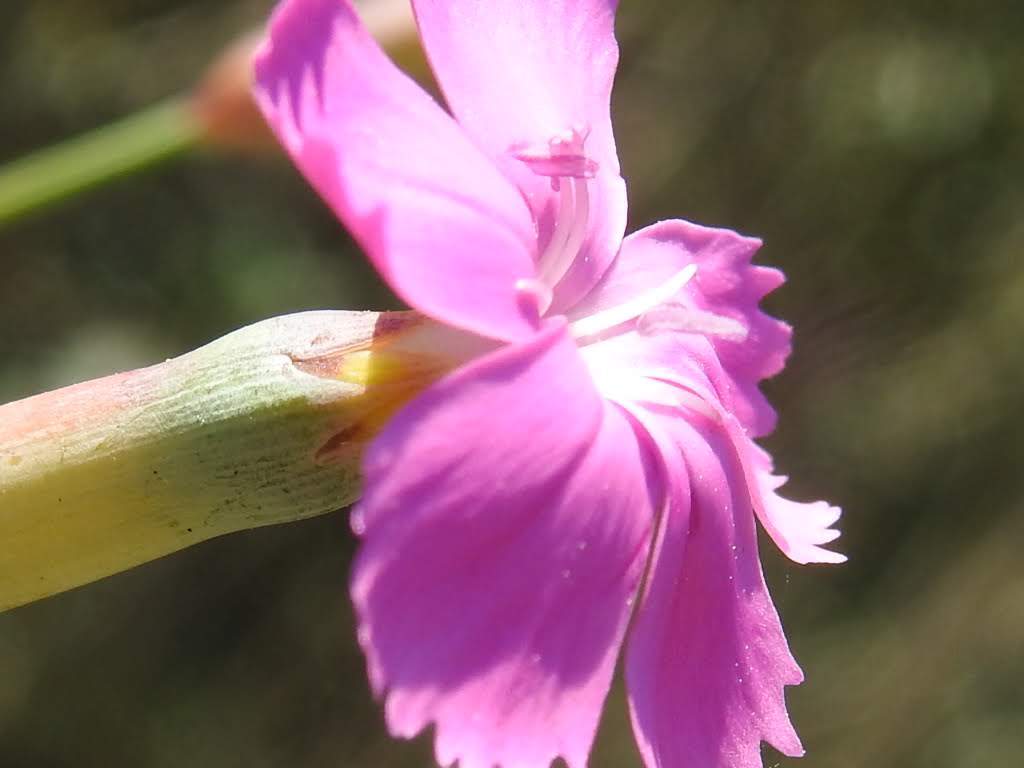
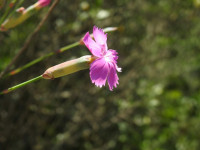
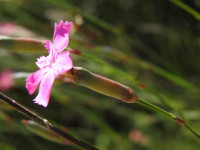
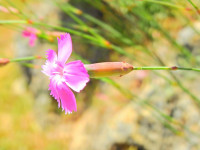
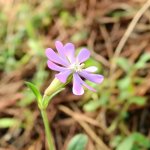
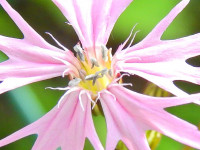
The flowers are solitary and terminal, located at the apex of the stems and branches, generally pink-fuchsia in color. Each flower has five petals, whose distal part is between 8 and 15 mm wide and has a slightly dentate margin. The petals are glabrous, with a broad shape but with faint dentations. The calyx is tubular, 15 to 20 mm long, with two oval scales ending in a short, sharp point. The fruit capsule is similar in size to the calyx and opens by four teeth, allowing seed dispersal.
In general, this species is characterized by fragrant flowers but with a weak or almost absent scent. The epicalyx scales are short and envelop the calyx, often truncated at the top and ending with a short mucro.
Habitat and distribution
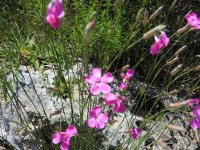
The Woodland Pink mainly grows in mountainous environments, preferring dry pastures, rocky slopes, and garrigues. It favors sunny exposures and well-drained soils, often calcareous or stony, in contexts of high light and low humidity.
In Italy it is mainly present in the alpine and pre-alpine regions, with reliable reports in areas such as Valtournanche and Val Susa. Its presence is also documented in some areas of the western alpine arc, with a range extending to neighboring regions of the western Mediterranean. The species shows notable geographic variability, with several local races recognized especially in southern Italy and the major islands such as Sicily, Sardinia, and Corsica. Some of these populations differ in morphological characteristics such as the shape of the calyx scales and flower size.
The growth altitude generally lies in the hilly and subalpine belt, with documented occurrences between about 600 and 2200 meters. It is adapted to xeric conditions typical of sunny mountainous environments.
Flowering period
Flowering typically extends from May to August, with possible temporal variation related to altitude and latitude. In more northern and higher-altitude territories, flowering may start later and end earlier compared to lower or more southern areas.
Ecology and pollination
The Woodland Pink reproduces through pollinating insects, which visit the individual solitary flowers to collect nectar or pollen. The flower structure, with dentate-margined petals and bright colors, favors the attraction of pollinators, although the scent is weak.
Seed dispersal occurs through the capsule that opens with four teeth, facilitating the release and subsequent spread of seeds on the surrounding soil. No particularly specialized dispersal strategies are known, but the elevated position of the fruits favors dispersal by gravity and wind action.
Curiosities and traditional uses
No specific information is available regarding traditional, medicinal, or food uses of the Woodland Pink. However, the genus Dianthus in general is known for its ornamental properties and use in perfumery, thanks to the typical scent of some cultivated species. The notable variability and the spread of ornamental selections of Dianthus sylvestris and related species have contributed to the creation of numerous cultivated varieties of carnations.
Etymology
The genus name Dianthus derives from Greek and means "flower of Zeus" or "divine flower," referring to the beauty and delicacy of the flowers. The specific epithet sylvestris indicates the wild nature of the plant, often found in natural, uncultivated habitats. The Italian common name "garofano selvatico" reflects precisely this characteristic of a spontaneous species, distinct from the cultivated carnation, widely known and used in gardens and floriculture.
Sources
- Prof. S. Pignatti, "Flora d'Italia"
- World Flora Online (WFO)
Characteristics
Scheda botanica
| Famiglia | Caryophyllaceae |
|---|---|
| Fioritura | maggio – agosto |
| Forma biologica | Scapose |
| Habitat | with fuchsia flowers, Perennial plant, with fragrant flowers |
Domande frequenti
- Quando fiorisce Woodland Pink?
- Woodland Pink fiorisce maggio – agosto.
- Che tipo di pianta è Woodland Pink?
- Woodland Pink è una Hemicryptophytes (Scapose) secondo la classificazione di Raunkiaer.
- A quale famiglia appartiene Woodland Pink?
- Woodland Pink appartiene alla famiglia botanica Caryophyllaceae.
Where I found it (14 sightings)
Classification
- Kingdom
- Plantae
- Family
- Caryophyllaceae
- Full name
- Dianthus sylvestris Wulfen
- Synonyms
- Dianthus caryophyllus L. subsp. sylvestris (Wulfen) Rouy & Foucaud
- Life form
- Hemicryptophytes scapose
Similar species
Search for species with similar characteristicsNoticed an error in the identification? Write to me
Other species of the same family
Caryophyllaceae
Explore
Other species of Caryophyllaceae