Botanical species
Stellaria graminea
L.
Lesser Stitchwort
Description
Morphological description
Perennial herbaceous plant belonging to the Caryophyllaceae family, characterized by a scapose habit with ascending or decumbent stems, highly branched, with variable length between 10 and 70 cm. The stems are thin, fragile, quadrangular in section (tetragonal) and completely glabrous, lacking roughness on the angles. The plant develops from a horizontal stoloniferous rhizome that allows perennation and spreading at ground level.
The leaves are opposite, sessile, linear-lanceolate in shape, acute at the apex, with entire and smooth margins, sometimes ciliate at the base; they generally measure from 8 up to 30-45 mm in length and 2-5 mm in width, slightly widening towards the base. The upper leaves often bear a sterile shoot in the axil.
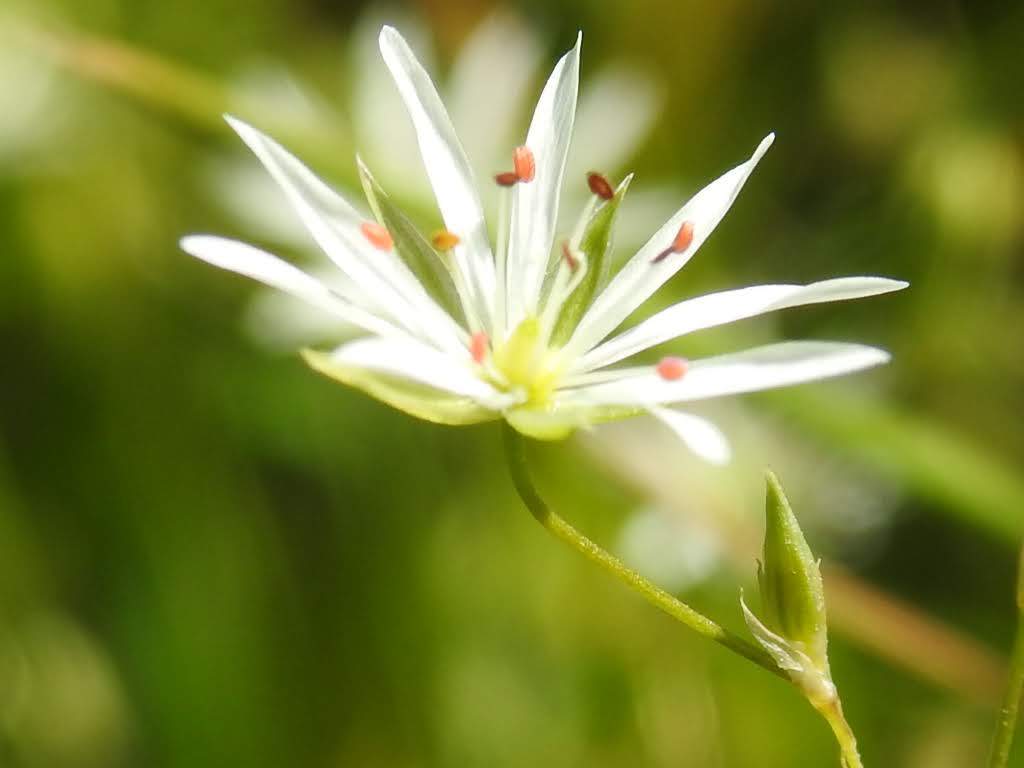
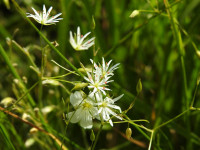
The inflorescence consists of open terminal cymes with multiple flowers, which can include more than ten small flowers, normally about 9 mm in diameter. The flowers are white, with five petals divided almost to the base into two narrow and close lobes, slightly longer than the sepals. The sepals, five in number, are linear-acute, 3-7 mm long, with three well-visible veins and scarious margins, often ciliate. The flower peduncles are glabrous, 8 to 30 mm long, and tend to reflex during the fruiting stage.
The flower is hermaphroditic, with ten stamens arranged in two whorls; the anthers are brownish in color. The ovary is superior and syncarpous, with three filiform and ascending styles about 3 mm long. The fruit is an oblong or narrowly ovoid capsule, 5 to 7 mm long, longer than the calyx, dehiscing by six valves (opening through three fissures). It contains reniform seeds, about 0.8-1 mm in diameter, dark brown-reddish in color, with a finely wrinkled surface in concentric circles.
Habitat and distribution
The species is widespread throughout most of Europe and western Asia up to India, with an extensive presence in the Eurasian area. In Italy it is common especially in mesophilous and heliophilous environments, such as rich and moist meadows, forest clearings, forest edges, and hedges. It prefers substrates with variable pH, often slightly acidic, and generally grows from 200 up to 2000 meters of altitude, with a peak presence especially between 1000 and 2000 meters.
In Mediterranean environments it tends to be rarer, mainly found in cooler and shaded areas, such as broadleaf forests and submontane clearings. The species shows good adaptability to variable light conditions, but prefers sunny or partially shaded exposures.
Flowering period
Flowering occurs mainly between May and August, with a peak in June and July. In some areas and at higher altitudes flowering may start slightly later, extending until late summer. The duration and intensity of flowering can vary depending on altitude and local climatic conditions.
Ecology and pollination
The plant is entomogamous, i.e., pollinated by insects, which are attracted by the white flowers and the open arrangement of the inflorescence. Pollination is favored by the presence of numerous stamens and divided petals that facilitate access for pollinating insects.
Seed dispersal occurs by barochory, i.e., by direct fall of mature capsules that open spontaneously, releasing seeds near the mother plant. This strategy favors colonization of nearby areas, particularly in favorable habitats such as grassy clearings and forest edges.
Curiosities and traditional uses
The Italian common name "Lesser Stitchwort" refers to the similarity of its leaves to those of grasses and to the spreading habit similar to that of a couch grass. Traditionally, Lesser Stitchwort is not known for significant medicinal or food uses, but like many Stellaria species it has sometimes been used in popular phytotherapy for mild anti-inflammatory or soothing properties, although with scarce specific documentation.
The genus name refers to the star-shaped form of the flowers, visible when fully open, while the specific epithet "graminea" emphasizes the narrow and linear shape of the leaves, similar to those of grasses (Poaceae).
Etymology
The genus name derives from the Latin "stella," referring to the star shape of the flower, which appears as a small open white star. The specific epithet "graminea" derives from "gramen," the Latin term for "grass," indicating the similarity of the leaves to those of grasses, characterized by narrow and linear shapes.
The Italian common name "Lesser Stitchwort" recalls the similarity in habit and leaves to couch grass, a very common weed in meadows and fields, while "centocchio" is a historical term associated with some Stellaria species for their delicate and widespread appearance.
Sources
- Prof. S. Pignatti, Flora d'Italia
- Acta Plantarum - Flora delle regioni italiane (scheda di Anja Michelucci)
- Tela Botanica / H. Coste, Flore descriptive et illustrée de la France
- World Flora Online (WFO)
Characteristics
Scheda botanica
| Famiglia | Caryophyllaceae |
|---|---|
| Fioritura | maggio – agosto |
| Forma biologica | Scapose |
| Habitat | with white flowers, Perennial plant, plant with a scapose habit |
Domande frequenti
- Quando fiorisce Lesser Stitchwort?
- Lesser Stitchwort fiorisce maggio – agosto.
- Che tipo di pianta è Lesser Stitchwort?
- Lesser Stitchwort è una Hemicryptophytes (Scapose) secondo la classificazione di Raunkiaer.
- A quale famiglia appartiene Lesser Stitchwort?
- Lesser Stitchwort appartiene alla famiglia botanica Caryophyllaceae.
Where I found it (5 sightings)
Classification
- Kingdom
- Plantae
- Family
- Caryophyllaceae
- Full name
- Stellaria graminea L.
- Life form
- Hemicryptophytes scapose
Similar species
Search for species with similar characteristicsFurther reading
Noticed an error in the identification? Write to me
Other species of the same family
Caryophyllaceae
Explore
Other species of Caryophyllaceae