Botanical species
Crepis sancta
(L.) Bornm.
Hawk's-beard
Description
Morphological description
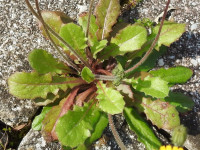
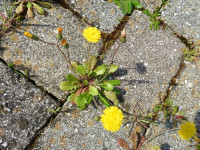
Annual herbaceous plant reaching a height between 5 and 30 cm, with an erect habit thanks to a simple or sometimes branched stem, characterized by a subglabrous surface, i.e., almost hairless. The basal leaves form a rosette, oblanceolate-spatulate in shape, 2 to 10 cm long and 0.5 to 2 cm wide, with a margin varying from dentate to pinnatifid, with an irregular petiole. The cauline leaves are reduced and scale-like, almost like a ladder, tending to disappear along the stem.
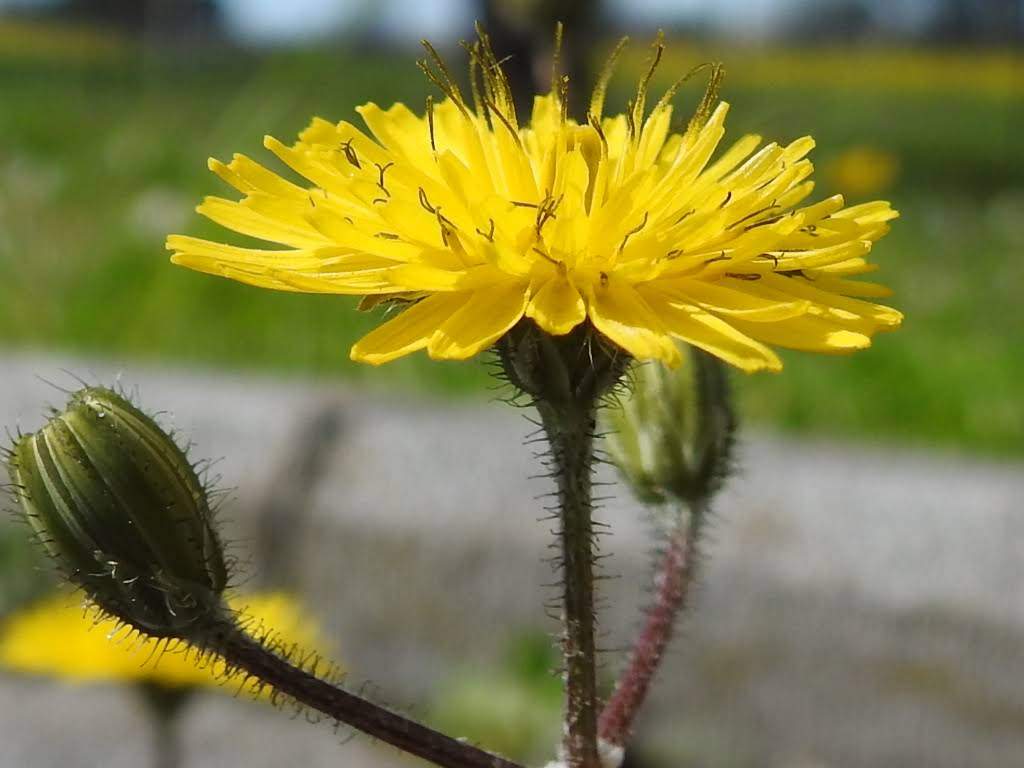
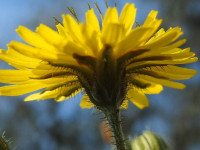
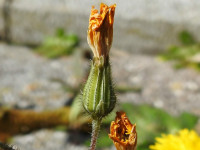
The capitula appear singly or grouped in corymbose inflorescences, typically composed of 5-6 flowers, each with an average size between 2 and 2.5 cm in diameter. The flowers are bright yellow with reddish shades on the outer part of the ligules, which are numerous and symmetrically arranged (actinomorphic). The involucre is formed by bracts arranged in several series; the outer bracts are short and oval-shaped, up to 11 mm long, while the inner ones are longer and lanceolate.
The fruit is an achene of three distinct types: the peripheral ones are narrow, slightly compressed, and equipped with three wings (two lateral ones of 5-7 mm) that limit their dispersal capacity; the intermediate ones are fusiform and bear an awn; the central ones are fusiform but smooth. The pappus, white and bristly, facilitates seed dispersal, especially for the central achenes which can reach greater distances compared to the outer achenes.
The root system is typical of annual herbaceous species, with fibrous roots that support the plant in dry and poor soils where it grows.
Habitat and distribution
It grows in open environments such as uncultivated lands, dry meadows, ruins, edges of roads and paths, preferring well-drained soils often calcareous or rocky. The species is found from the plains up to 1000 meters of altitude. Its presence is particularly widespread in the Mediterranean area, with a range extending from the Mediterranean basin to the desert and sub-desert areas of Central Asia, with a clear prevalence in regions with a Mediterranean-Turanian climate.
In Italy it is mainly present in the central-southern regions, with historical reports from Tuscany, where it was probably introduced in the 19th century in Livorno and from there spread especially in olive-cultivated areas. It is considered a weed species, often included among the weeds in agricultural areas.
Flowering period
Flowering occurs in spring, mainly between March and May. In some milder climate areas flowering can start early in March, while in cooler areas it tends to extend until May, always within the first part of the warm season.
Ecology and pollination
The yellow, ligulate, and corymbose flowers attract various pollinating insects, including bees and other hymenopterans, which facilitate entomogamous pollination. The ligulate structure and bright coloration favor the attraction of pollinating insects.
Seed dispersal mainly occurs through the bristly pappus that acts like a parachute, allowing the central seeds to reach greater distances. The outer achenes, equipped with wings, have a more limited dispersal capacity, probably as an ecological adaptation to maintain a stable local population.
Curiosities and traditional uses
The young basal rosette of the plant is edible and traditionally consumed, often boiled together with other wild herbs in mixed salads. In popular use, species of this plant have been used for their anti-inflammatory properties, particularly for treating urinary tract inflammations.
Historically, some species of the genus Crepis were cultivated as early as the 18th century for ornamental purposes in the so-called "luxury gardens". The species is still considered a weed in some crops, especially in Tuscan olive groves, where it has been widespread for over a century.
Etymology
The generic name "Crepis" derives from the ancient Greek "κρηπίς" (krēpís), meaning "slipper" or "house shoe", alluding to the particular shape of the fruits, whose involucre narrowed in the middle resembles the shape of a shoe. Another ancient use of the term "crepis" indicated sandalwood, but it is unclear which of the two meanings inspired the scientific name of the genus.
The specific epithet "sancta" recalls the particularly common distribution of the species in the Holy Land, hence the Italian common name "Hawk's-beard".
Sources
- Acta Plantarum - Flora delle regioni italiane (actaplantarum.org)
- Acta Plantarum - Flora delle regioni italiane (scheda di Nino Messina)
Characteristics
Where I found it (9 sightings)
Classification
- Kingdom
- Plantae
- Family
- Asteraceae
- Full name
- Crepis sancta (L.) Bornm.
- Life form
- Terofite scapose
Similar species
Search for species with similar characteristicsNoticed an error in the identification? Write to me
Other species of the same family
Asteraceae

Explore
Other species of Asteraceae