Botanical species
Centaurea cyanus
L.
Cornflower
Description
Morphological description
Annual herbaceous plant, Cornflower reaches a height between 30 and 100 cm. The stem is erect, simple or branched especially towards the apex, rigid, striated and covered by a fine cobwebby-tomentose whitish pubescence. The plant has a taproot system that is slender.
The basal leaves are petiolate, lyrate in shape with a lanceolate outline and equipped with 2-4 lobes; the terminal lobe is larger than the others. They generally measure from 3 to 7 cm in length and from 0.3 to 0.8 cm in width. The upper surface is covered by a fine down, while the lower surface is cottony. The cauline leaves are sessile, linear-lanceolate, narrow, small in size (2-3 cm), with entire margins and attenuated base, and are not decurrent along the stem.
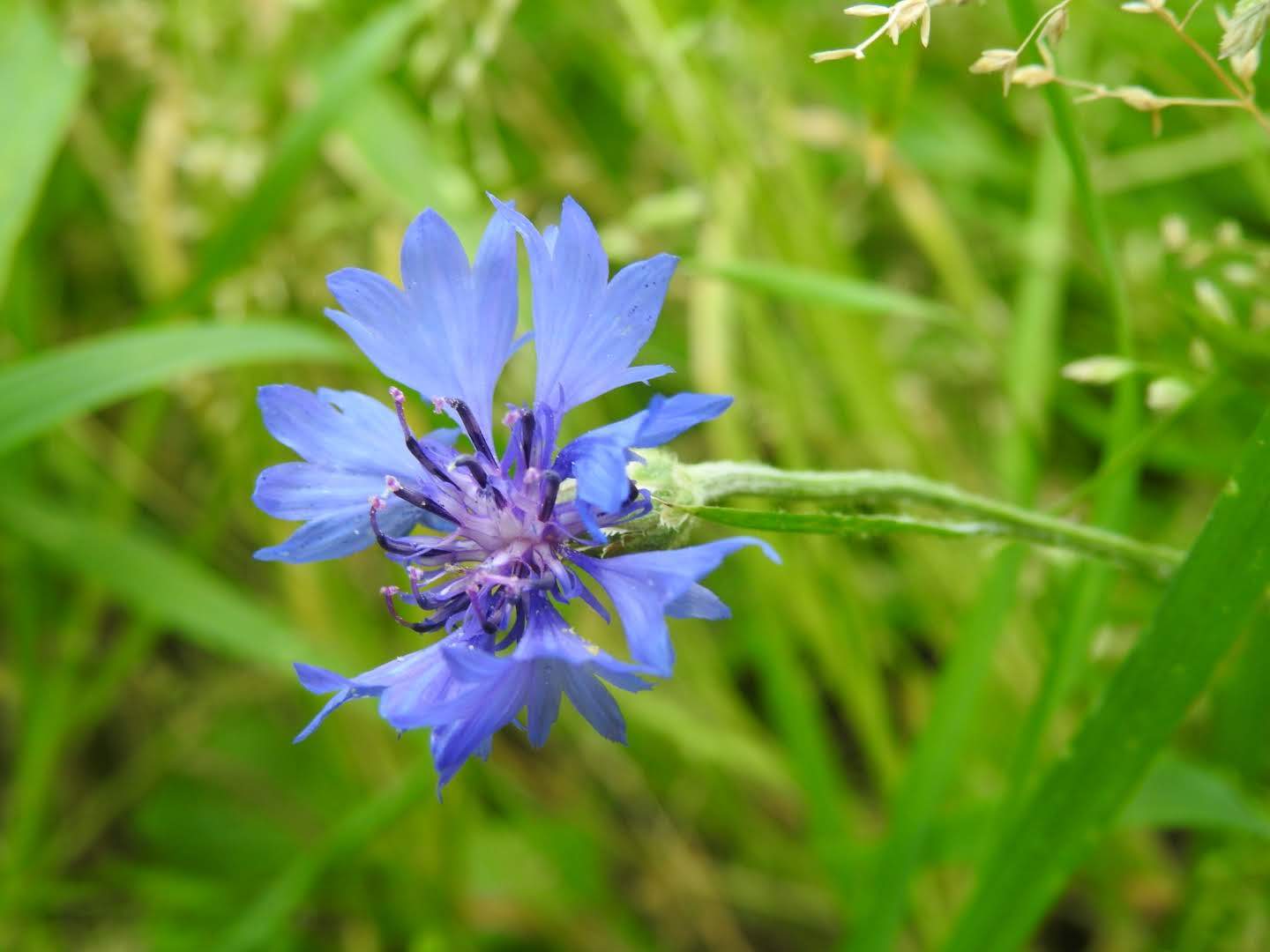
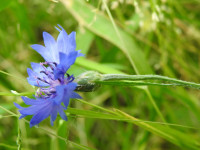
The inflorescence is composed of solitary heads or grouped in rare corymbs, each 2-3 cm in diameter, supported by leafless erect and elongated branches. The involucre is campanulate-pyriform, 9-16.5 mm long and 4-9 mm wide, formed by outer bracts dark green with tomentose surface and dark brown, scarious appendages fringed with thin cilia about 0.3 mm long, and longer inner bracts with a denticulate apex about 1 mm. The bracts are spineless.
The flowers are all tubular and blue-violet in color (sometimes they can vary towards white or purple). The corollas are divided into five lobes; the outer ones, sterile, are radiate and larger (20-25 mm), while the inner flowers, hermaphroditic, are smaller (10-15 mm). The ovary is inferior. The fruit is an obovate achene, 3-5 mm long, gray-brown in color, covered with scattered fine hairs. It is equipped with a reddish pappus formed by biseriate bristles, the outer ones as long as the achene, the inner ones shorter (1-2 mm).
Habitat and distribution
Cornflower is widespread in Italy and much of the Mediterranean area, with a range that extends mainly in coastal and mountainous zones up to about 1500 meters altitude. It is typical of agricultural soils, particularly cereal fields, and is commonly found in tilled soils, meadows, and uncultivated places with nitrogen presence in the soil. It prefers sunny exposures, with well-drained and medium-textured soils.
In Italy the species is still quite widespread, but its presence is declining due to the intensive use of selected seeds and herbicides in cereal crops. However, it is preserved in some protected areas, such as the Monti Sibillini Park, where it can form extensive carpets of blue flowers in plains and field margins.
Flowering period
The flowering of Cornflower extends from April to August, with a peak that varies slightly depending on altitude and latitude. In mountainous areas flowering can shift towards the summer months, while in lower and temperate zones it starts early in spring.
Ecology and pollination
The plant is pollinated by pollinating insects, mainly bees and butterflies, attracted by the bright color and nectar of the tubular flowers. The blue-violet corolla, with sterile but showy outer flowers, has an attractive function for pollinators. Cornflower presents a reproductive strategy that combines sterile radiate flowers and fertile inner flowers, thus maximizing visibility and pollination efficiency.
Seed dispersal occurs through achenes equipped with a bristly pappus, which facilitates wind transport over short distances. Furthermore, the presence in agricultural habitats favors accidental dispersal through machinery and human activities.
Curiosities and traditional uses
Cornflower is a medicinal species with numerous traditional uses. In folk medicine it is used in decoctions for the treatment of conjunctivitis, edema, gout, rheumatism, and stye, as well as a cough remedy. It contains glucosides, including “cyanine”, an anthocyanic glucoside also used as a natural dye, sesquiterpenic flavonoids, tannins, potassium salts, and mucilages.
In homeopathy, it is used to treat flu attacks, menstrual cycle disorders, constipation problems, and liver disorders. In cooking, the leaves are a source of a natural dye mainly used to decorate sweets.
Curiously, although it is a dye, cyanine is not used to dye fabrics because it degrades easily in light and in the presence of acids. In floriculture, several ornamental varieties with larger flowers and variable shades from dark blue to pink and purple have been selected.
Etymology
The genus name derives from the Greek κέντρον (kéntron), meaning "goad" or "spur", probably referring to the pointed shape of the bud, or from the myth of the centaur Chiron, master of medicine and sciences, from the Latin centaureum. The specific epithet cyanus derives from the Greek κύανος (kýanos), meaning "blue", referring to the typical color of the corollas.
The Italian common name "fiordaliso" refers to the delicate shape and bright color of the flower, often associated with the simple beauty of cultivated fields.
Sources
- Acta Plantarum - Flora delle regioni italiane (actaplantarum.org)
- Acta Plantarum - Scheda di Nino Messina
- World Flora Online (WFO)
Characteristics
Scheda botanica
| Famiglia | Asteraceae |
|---|---|
| Fioritura | aprile – agosto |
| Forma biologica | Scapose |
| Habitat | with blue flowers, annual plant, with blue-purple flowers |
| Uso officinale | Pianta officinale |
Domande frequenti
- Quando fiorisce Cornflower?
- Cornflower fiorisce aprile – agosto.
- Che tipo di pianta è Cornflower?
- Cornflower è una Therophytes (Scapose) secondo la classificazione di Raunkiaer.
- A quale famiglia appartiene Cornflower?
- Cornflower appartiene alla famiglia botanica Asteraceae.
Where I found it (5 sightings)
Classification
- Kingdom
- Plantae
- Family
- Asteraceae
- Full name
- Centaurea cyanus L.
- Synonyms
- Cyanus segetum Hill
- Life form
- Therophytes scapose
Similar species
Search for species with similar characteristicsFurther reading
Noticed an error in the identification? Write to me
Other species of the same family
Asteraceae
Explore
Other species of Asteraceae