Botanical species
Achillea maritima
(L.) Ehrend. & Y.P.Guo
Cottonweed
Description
Morphological description
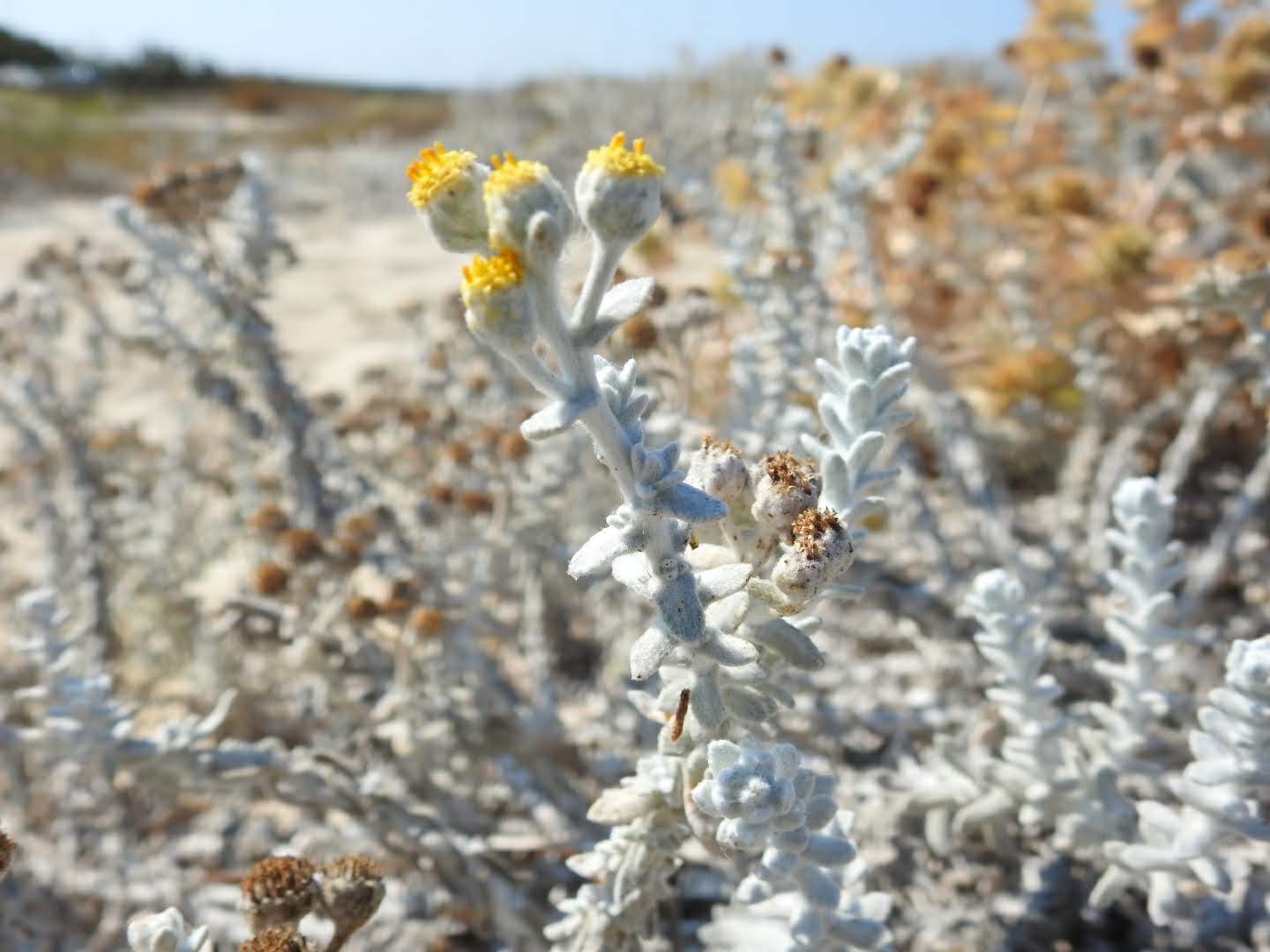
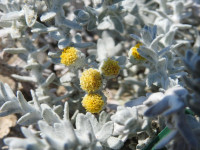
It is a suffruticose plant, meaning with woody stems only at the base, of limited height, generally between 20 and 40 cm. The habit is tufted, with thick stems that can be either erect or prostrate-ascending: they are often simple or shortly branched and form a loose cushion at the base. The entire plant is densely covered by a thick white tomentum, made up of thick and felted hairs, giving a woolly and almost cottony appearance.
The leaves are alternate, sessile and semi-amplexicaul (partially clasping the stem). They have an oblanceolate shape, about 4-5 mm wide and 9-12 mm long, with an entire or slightly crenulate margin. The apex is obtuse and the blade is patent, that is, arranged in an open and spread manner.
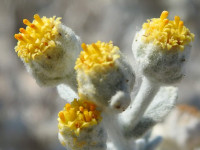
The inflorescence consists of a few small and subglobose capitula, about 10 mm in diameter, gathered in a dense terminal corymb. The capitula are shortly pedunculated and have an imbricate involucre with ovate, obtuse, white-cottony scales with scarious margins. The flowers, all tubular and hermaphroditic, are intense golden yellow and are entirely enclosed within the involucre. The corolla tube is laterally compressed and has two wings at the base, persistent around the fruit.
The receptacle is equipped with spatulate chaff with ciliate margins, while the fruit is an oblong, angular cypsela, lacking a pappus, of white-brownish color.
The root system is rhizomatous, allowing the plant to anchor firmly in sandy substrates and to expand forming dense bushes.
Habitat and distribution
A typical species of dunes and marine sands, it mainly lives in Mediterranean and Atlantic coastal environments, with particular distribution in the Italian coastal regions. It grows on psammophilous substrates, that is sandy and well-drained, often in pioneer zones of mobile or stabilized dunes. It is a xerophilous plant, adapted to conditions of high salt exposure and poor soils, with high tolerance to summer drought.
Its growth altitude is practically limited to the coastal belt, where it can colonize both sandy beaches and more inland dunes. In Italy it is present along the Mediterranean coasts, but its distribution also extends to the Atlantic coasts and some inland penetrations in habitats with similar characteristics.
Flowering period
Flowering mainly occurs between June and August, with possible local variation linked to climatic and environmental conditions. During this period the plant produces the characteristic golden-yellow capitula, visible in dense corymbs.
Ecology and pollination
The plant is hermaphroditic and relies on entomogamous pollination, that is mediated by pollinating insects, which are attracted by the vivid color and scent of the flowers. The tubular flowers favor pollination by long-tongued insects, such as bees and butterflies, which can reach the nectar inside the corollas.
Seed dispersal occurs through a cypsela lacking a pappus, thus presumably by falling and rough mechanical transport, possibly facilitated by wind or by the action of animals frequenting the dunes.
Curiosities and traditional uses
The genus name Achillea is a tribute to the mythical Achilles, who according to tradition used this plant to heal soldiers' wounds during the siege of Troy, indicating an ancient medicinal use linked to cicatrizing or anti-inflammatory properties.
Its coastal habitat and its ability to colonize sandy substrates make it a species of great interest for the conservation of dune ecosystems, which are often threatened by urbanization and beach tourism.
Etymology
The scientific name "Achillea maritima" derives from two elements: "Achillea", in honor of Achilles, a hero of Greek mythology associated with traditional medicine, and "maritima", from the Latin adjective meaning "maritime", referring to the typical habitat of the species on marine coasts.
The Italian common name "Cottonweed" highlights the woolly appearance and the resemblance to plants of the genus Santolina, as well as emphasizing the typical growth habitat, that is beaches and sandy dunes.
Sources
- Acta Plantarum - Flora delle regioni italiane (actaplantarum.org)
- Acta Plantarum - Flora delle regioni italiane (scheda di Anja Michelucci)
- Tela Botanica / H. Coste, "Flore descriptive et illustrée de la France"
Characteristics
Scheda botanica
| Famiglia | Asteraceae |
|---|---|
| Fioritura | giugno – agosto |
| Forma biologica | Suffruticose |
| Habitat | with yellow flowers, psammophilous plant, Perennial plant |
Domande frequenti
- Quando fiorisce Cottonweed?
- Cottonweed fiorisce giugno – agosto.
- Che tipo di pianta è Cottonweed?
- Cottonweed è una Chamaephyte (Suffruticose) secondo la classificazione di Raunkiaer.
- A quale famiglia appartiene Cottonweed?
- Cottonweed appartiene alla famiglia botanica Asteraceae.
Where I found it (10 sightings)
Classification
- Kingdom
- Plantae
- Family
- Asteraceae
- Full name
- Achillea maritima (L.) Ehrend. & Y.P.Guo
- Synonyms
- Diotis candidissima Desf., nom. illeg.; Diotis maritima (L.) Cass.; Filago maritima L.; Otanthus maritimus (L.) Hoffmanns. & Link
- Life form
- Chamaephyte suffruticose
Similar species
Search for species with similar characteristicsFurther reading
Noticed an error in the identification? Write to me
Other species of the same family
Asteraceae
Explore
Other species of Asteraceae