Botanical species
Crupina crupinastrum
(Moris) Vis.
False Saw-wort
Description
Morphological description
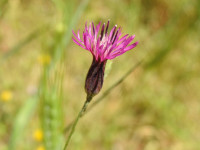
Annual herbaceous plant belonging to the family Asteraceae, with a height generally ranging between 30 and 50 cm. The habit is erect, with robust and branched stems, which become corymbose in the upper part. The stem is branched-ascending and has a scapose habit, meaning with an elongated floral axis often devoid of leaves.
The basal leaves are obovate-spatulate, entire, small in size (about 8 x 20 mm), and tend to disappear during flowering. The cauline leaves are sessile, pinnatisect, with the blade completely divided into narrow and linear lobes, slightly woolly on the upper surface and with rough, denticulate-spinulose margins.
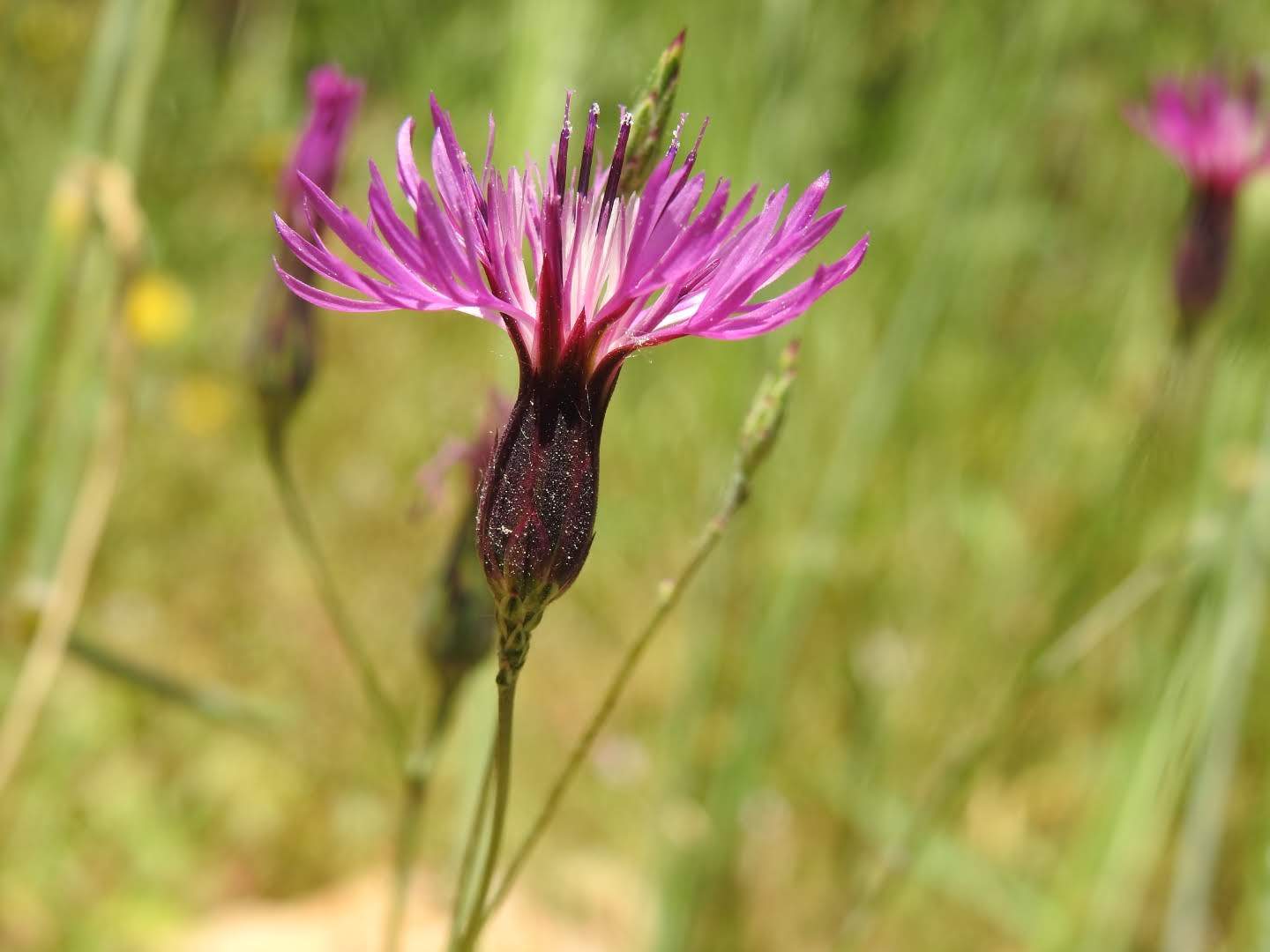
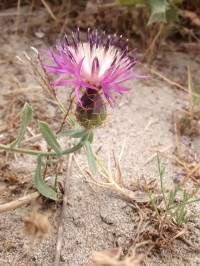
The capitula, characterized by a scapose habit, are arranged in a loose panicle and contain from 9 to 15 purplish-fuchsia flowers. All the flowers are tubular; the inner ones are hermaphroditic, while the outer ones are sterile and larger. The corolla tube is equipped with smooth hairs. The involucre is cylindrical-campanulate, 1 to 2 cm long, rounded at the base, formed by imbricated, unequal scales, often reddish and with scarious margins.
The receptacle is provided with laciniate chaff scales, typical of the family. The fruit is a cypsela (achene) dark brown in color, 4-5 mm long, compressed at the base. The pappus consists of a series of very short outer hairs, elongated, rigid, brown-black internal bristles, and central triangular scales about 1 mm long. The hilum (seed attachment point) is sublateral and linear in shape.
No detailed descriptions of the root system are available for this species.
Habitat and distribution
This species is typical of Mediterranean regions, with a range limited to Mediterranean coasts, particularly in the olive scrub area, hence the common name "False Saw-wort". In Italy, it is mainly found in garrigues and dry pastures on siliceous substrates.
It grows at altitudes between 0 and 1400 meters above sea level, preferring sunny exposures typical of arid Mediterranean environments. Its presence is therefore linked to xerophilous habitats, characterized by poor and well-drained soils.
Flowering period
Flowering extends approximately from March to June. No significant variations in the flowering period are reported throughout its Mediterranean range.
Ecology and pollination
The purplish tubular flowers are adapted to entomogamous pollination, particularly by pollinating insects that visit the inflorescences to collect nectar and pollen. The presence of larger sterile outer flowers may facilitate the attraction of pollinators.
Seed dispersal occurs thanks to the pappus composed of rigid hairs and scales, which presumably favor transport by wind (anemochory), thus allowing colonization of new habitats.
Curiosities and traditional uses
No specific data are available regarding medicinal, food, or folkloric uses attributed to this species. The absence of ethnobotanical information suggests that it has not been subject to significant traditional uses.
Etymology
The genus name "Crupina" has uncertain origins, probably deriving from a Flemish vernacular term. The specific epithet "crupinastrum" contains the Latin pejorative suffix "-astrum", indicating a "false Crupina", highlighting the similarity with other species of the genus.
The Italian common name "False Saw-wort" reflects both the belonging to the genus Crupina and the typically Mediterranean distribution of the species.
Sources
- Acta Plantarum - Flora delle regioni italiane (actaplantarum.org)
- Acta Plantarum - Flora delle regioni italiane (scheda di Anja Michelucci)
Characteristics
Where I found it (10 sightings)
Classification
- Kingdom
- Plantae
- Family
- Asteraceae
- Full name
- Crupina crupinastrum (Moris) Vis.
- Synonyms
- Centaurea crupinastrum Moris; Crupina morisii Boreau, nom. illeg.; Crupina vulgaris Cass. subsp. crupinastrum (Moris) Arcang.
- Life form
- Terofite scapose
Similar species
Search for species with similar characteristicsNoticed an error in the identification? Write to me
Other species of the same family
Asteraceae
Explore
Other species of Asteraceae