Botanical species
Galinsoga quadriradiata
Ruiz & Pav.
Hairy Galinsoga
Description
Morphological description
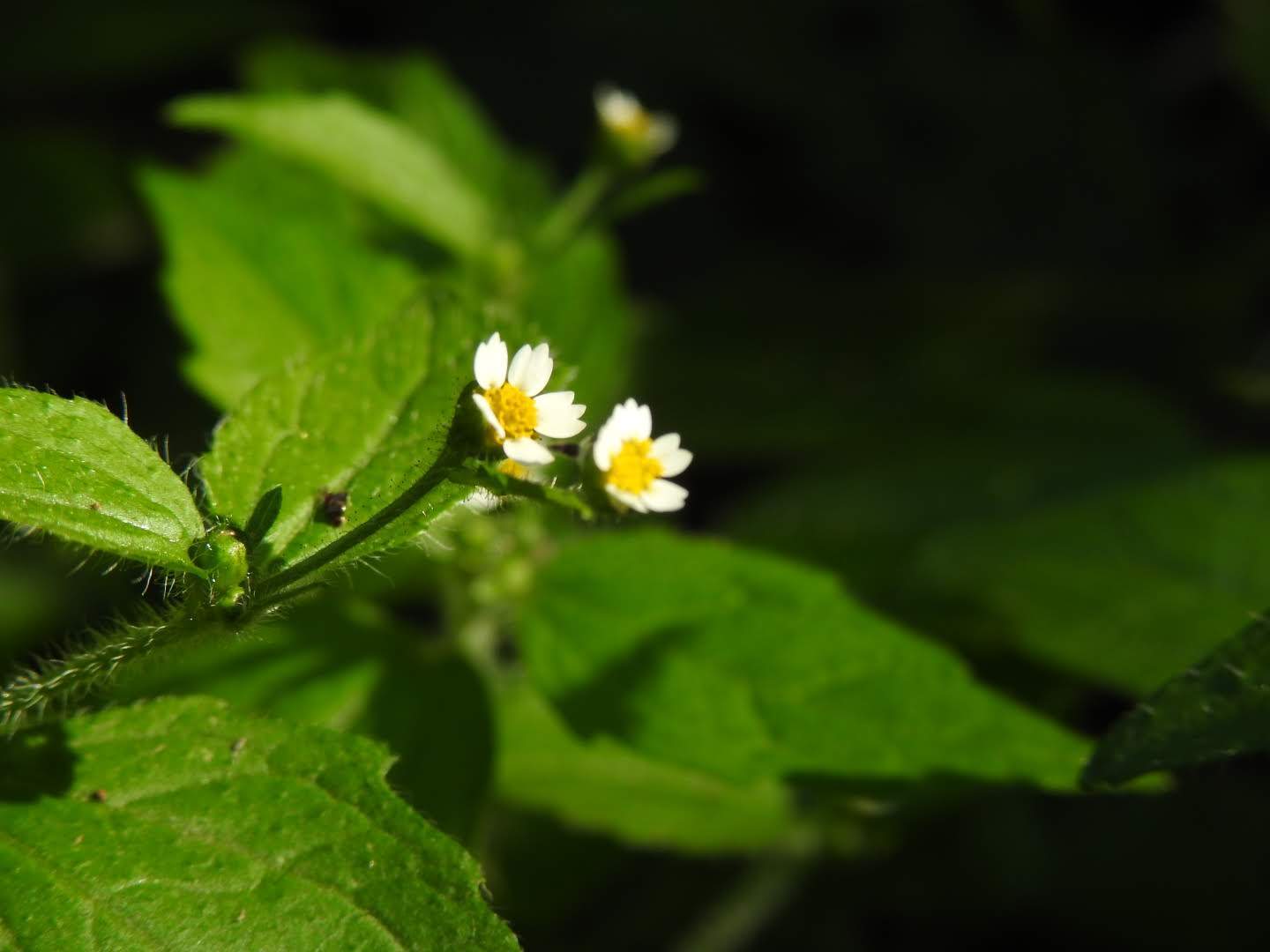
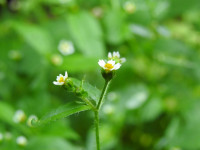
Annual herbaceous plant, Hairy Galinsoga presents an erect and branched habit from the base, reaching a height between 10 and 60 cm. The stem is striated, pubescent and tomentose, covered with numerous whitish hairs, both simple and glandular, particularly dense in the upper part. These hairs give the plant a rough and velvety appearance.
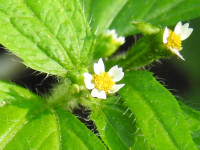
The leaves are opposite, petiolate, ovate-lanceolate to ovate-triangular in shape, with an acuminate apex and rounded base. They generally measure between 1 and 6 cm in length and 1-3 cm in width. The leaf surface is covered by a widespread pubescence, especially on the upper side and along the margins, which are coarsely dentate. The main veins are three, well evident.
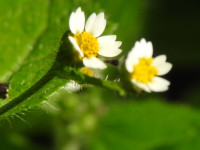
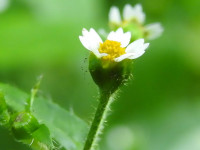
The flowers are gathered in subspherical capitula 4-7 mm in diameter, solitary or grouped in small terminal clusters. Each capitulum is composed of 15-30 yellow tubular flowers (disk flowers) in the center, surrounded by 4-6 white ligulate flowers with trilobed ligules, 0.9-2.8 mm long and 0.7-2.5 mm wide. The peduncles supporting the capitula are short, strigose pubescent and often equipped with glandular hairs. The involucre consists of two series of bracts, the outer ones striated and often glandular, the inner ones more scarious.
The fruits are black achenes, thinly covered with hairs (strigose), about 1-1.5 mm long. The achene of the peripheral flowers falls together with the bracts that surround it, while the central ones remain attached. The pappus is formed by few up to 15 ciliate scales, thin and membranous.
The root system is fasciculate, typical of annual plants, and not particularly deep.
Habitat and distribution
Native to America, Hairy Galinsoga is a neophyte species widely naturalized in Italy and the Mediterranean basin, where it has spread mainly in anthropized environments. It commonly grows in disturbed areas such as cultivated lands, gardens, uncultivated areas, roadside edges and urban areas. It is present from the plains up to about 800-1150 m altitude, preferring fertile and well-drained soils, often rich in nutrients, with sunny or partially shaded exposure. Its adaptability makes it a frequent weed species in crops and disturbed soils.
Flowering period
Flowering mainly extends from July to October, with local variations that can lead to the presence of flowers already from April up to September or December in some areas. The long flowering season contributes to its ability to spread rapidly.
Ecology and pollination
Hairy Galinsoga behaves as a weed species, with a reproductive strategy based on abundant seed production. The flowers, small but numerous, attract various pollinating insects, including bees, flies and other generalist pollinators, attracted both by the white ligulate flowers and the yellow tubular ones, which contain nectar and pollen. Pollination is therefore entomogamous, contributing to good fertility of the capitula.
Seed dispersal occurs mainly by wind, thanks to the pappus formed by ciliate scales that facilitate short-distance transport. Moreover, human activity and the passage of domestic or wild animals favor seed dispersal over longer distances.
Curiosities and traditional uses
No widespread ethnobotanical traditions or food uses are known for Galinsoga quadriradiata in Italy. However, species of the genus Galinsoga in other regions of the world are used as edible plants or in phytotherapy, for their presumed anti-inflammatory and depurative properties. The species is however mainly considered a weed in crops and gardens.
Etymology
The genus name Galinsoga is a tribute to José de Galinsoga y Galindo, an 18th-century Spanish physician and botanist, known for his contribution to botany. The specific name “quadriradiata” derives from the Latin "quattuor" (four) and "radius" (ray), probably referring to the number of white ligulate flowers that form the “ray” of the capitulum, usually four or five. The Italian common name “Galinsoga ispida” recalls the hairy and rough appearance of the plant.
Sources
- Acta Plantarum - Flora delle regioni italiane (scheda di Marinella Zepigi)
- World Flora Online (WFO)
Characteristics
Scheda botanica
| Famiglia | Asteraceae |
|---|---|
| Fioritura | luglio – ottobre |
| Forma biologica | Scapose |
| Habitat | with white flowers, with yellow flowers |
Domande frequenti
- Quando fiorisce Hairy Galinsoga?
- Hairy Galinsoga fiorisce luglio – ottobre.
- Che tipo di pianta è Hairy Galinsoga?
- Hairy Galinsoga è una Therophytes (Scapose) secondo la classificazione di Raunkiaer.
- A quale famiglia appartiene Hairy Galinsoga?
- Hairy Galinsoga appartiene alla famiglia botanica Asteraceae.
Where I found it (9 sightings)
Classification
- Kingdom
- Plantae
- Family
- Asteraceae
- Full name
- Galinsoga quadriradiata Ruiz & Pav.
- Synonyms
- Adventina ciliata Raf.; Galinsoga aristulata E.P.Bicknell; Galinsoga ciliata (Raf.) S.F.Blake; Galinsoga hispida (DC.) Hieron., non Benth., nom. illeg.; Galinsoga hispida Benth.; Galinsoga parviflora Cav. subsp. quadriradiata (Ruiz. & Pav.) Pers.
- Life form
- Therophytes scapose
Similar species
Search for species with similar characteristicsNoticed an error in the identification? Write to me
Other species of the same family
Asteraceae
Explore
Other species of Asteraceae