Botanical species
Brassica rapa
L.
Field Mustard
Description
Morphological description
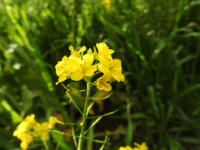
Annual or biennial herbaceous plant, generally 30 to 150 cm tall, with an erect and branched habit. The stem is glabrous, often glaucous in the upper part, and appears branched in an ascending manner. The surface of the stem may appear slightly waxy, giving a green-grayish tone.
The basal leaves are petiolate, varying in size between 4 and 8 cm, lyrate-pinnatisect in shape with the apical segment subrounded and 1 to 3 pairs of dentate or lobed lateral segments. The texture is herbaceous and the surface may be slightly rough or silky in the basal part. The cauline leaves, smaller (about 5-8 cm), are lanceolate, subentire or slightly dentate, completely clasping the stem at their base, and generally glabrous and glaucescent.
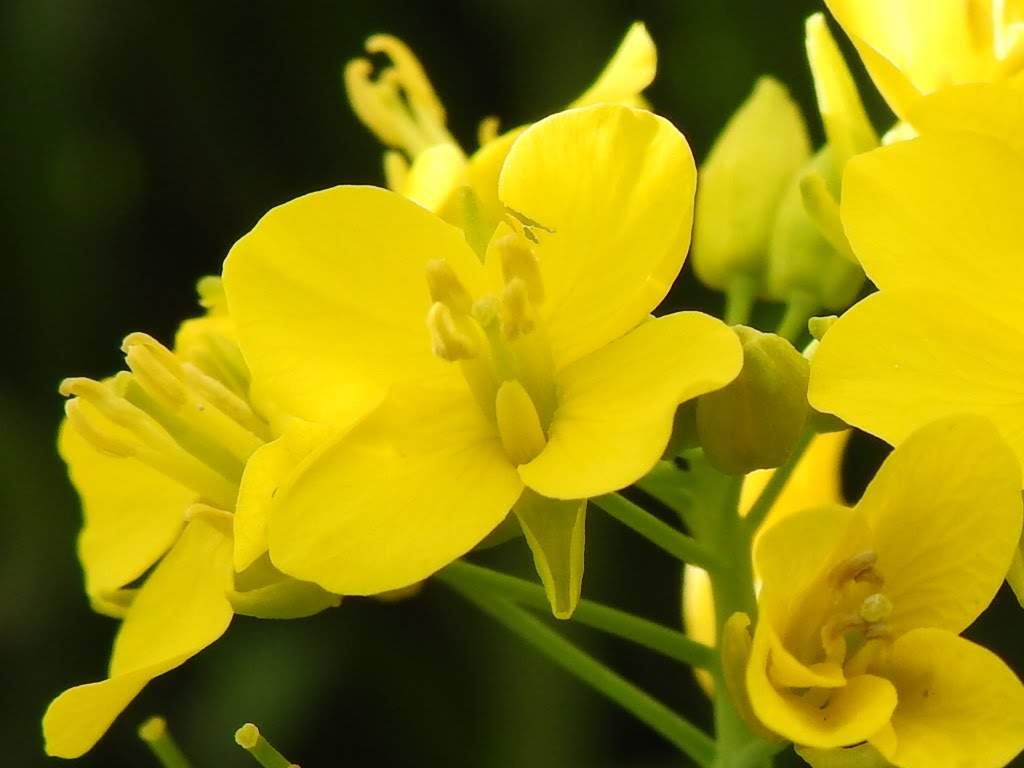
The flowers are grouped in short and dense racemes during flowering, with the open flowers protruding above the buds. The petals are four, bright yellow, obovate and 6 to 10 mm long, with a claw (narrow basal part) 3-6 mm long. The sepals are patent, about 3-6 mm long. The stamens are six, with the outer ones slightly shorter than the inner ones. The ovary is superior and bicarpellary.
The fruit is a linear siliqua, 3.5 to 8 cm long, with a wedge-shaped beak of 0.5-3.5 cm, and tapers at the apex. The valves are swollen due to the presence of seeds, with a well-marked central vein and a network of secondary veins. The siliquae elongate at the time of fruiting and the raceme becomes more extended compared to flowering. The seeds are about 8-15 per locule, ovoid in shape, smooth, dark-colored with a reticulated seed coat, and measure 1.2-1.8 mm in diameter.
The plant has a taproot that can be thin or enlarged and tuberous, fleshy in texture, from which the common name “Field Mustard” derives. This root is edible and constitutes one of the main organs used in cultivation as a vegetable.
Habitat and distribution
Brassica rapa is a species native to the Mediterranean region and Eurasia, widely cultivated and naturalized in many temperate areas of the world, including Italy. In Italy it grows spontaneously and as a ruderal plant in anthropized environments such as uncultivated lands, roadsides, abandoned cultivated fields, and disturbed areas.
The species adapts to a wide range of altitudes, from sea level up to about 1000-1200 meters, preferring sunny exposures. It grows on soils of various types, often well-drained and medium-textured, although it is common in cultivated lands and poor or human-altered soils.
Flowering period
Flowering generally extends from March to October, with a higher concentration between April and June. In some Mediterranean and mild climate regions it can be anticipated or prolonged, while in more northern or mountainous areas it tends to be concentrated in the spring months.
Ecology and pollination
The yellow flowers, medium-sized and well visible, attract a variety of pollinating insects, particularly bees and other hymenoptera, which promote entomophilous pollination. The flower structure, with well-exposed petals and stamens differentiated in length, facilitates pollen deposition and collection.
Seed dispersal occurs mainly through dehiscence of the siliquae which, opening, release the seeds onto the surrounding soil. The plant can thus rapidly colonize disturbed or cultivated environments. Reproduction is predominantly sexual, although in cultivation selection is practiced for particular agronomic traits.
Curiosities and traditional uses
Field Mustard is one of the oldest Brassicaceae cultivated by humans, used both for the tuberous root and as forage and leafy vegetable. The cultivated subspecies is appreciated in cooking for its slightly sweet flavor and crunchy texture, used in soups, broths, and as a side dish.
Rapeseed, which includes some subspecies of Brassica rapa, is also one of the main sources of vegetable oil worldwide, used both in food and industrial fields.
In the past, these plants were also used in folk medicine for their medicinal properties, as depurative and digestive remedies, although today medicinal use is marginal compared to food use.
The name “rapa” derives from the Greek “ràpys” (contraction of “rìza” root and “pus” foot), indicating precisely the characteristic tuberous root.
Etymology
The genus name Brassica is of Latin origin and generally indicates “cabbage”, a term appearing since antiquity in texts by Latin authors such as Plautus. The origin of the term is uncertain, with possible Greek or Celtic roots, but without definitive certainty.
The specific name “rapa” refers to the typical tuberous root of the plant, deriving from ancient Greek “ràpys”. The Italian common name “rapa” highlights precisely this distinctive morphological characteristic.
Sources
- Prof. S. Pignatti, "Flora d'Italia"
- Acta Plantarum - Flora delle regioni italiane (scheda di Marinella Zepigi)
- Tela Botanica / H. Coste, "Flore descriptive et illustrée de la France"
- World Flora Online (WFO)
Characteristics
Scheda botanica
| Famiglia | Brassicaceae |
|---|---|
| Fioritura | marzo – ottobre |
| Forma biologica | Scapose |
| Habitat | edible plant, with yellow flowers |
| Uso alimentare | Commestibile |
Domande frequenti
- Quando fiorisce Field Mustard?
- Field Mustard fiorisce marzo – ottobre.
- È commestibile Field Mustard?
- Field Mustard è considerata commestibile. Verifica sempre le parti eduli e la preparazione corretta prima del consumo.
- Che tipo di pianta è Field Mustard?
- Field Mustard è una Therophytes (Scapose) secondo la classificazione di Raunkiaer.
- A quale famiglia appartiene Field Mustard?
- Field Mustard appartiene alla famiglia botanica Brassicaceae.
Where I found it (6 sightings)
Classification
- Kingdom
- Plantae
- Family
- Brassicaceae
- Full name
- Brassica rapa L.
- Life form
- Therophytes scapose
Similar species
Search for species with similar characteristicsFurther reading
Noticed an error in the identification? Write to me
Other species of the same family
Brassicaceae
Explore
Other species of Brassicaceae