Botanical species
Cakile maritima
Scop.
Sea Rocket
Description
Morphological description
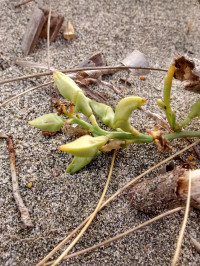
Annual herbaceous plant belonging to the Brassicaceae family, characterized by a prostrate-ascending or erect-spreading habit, with flexible, fleshy, glabrous stems branched from the base. The height generally varies between 15 and 50 cm. The root system is deep and creeping, suitable for stabilizing the plant in mobile sandy substrates.
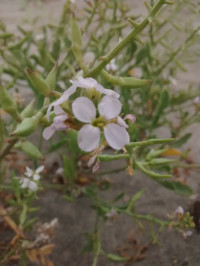
The leaves are fleshy and succulent, a functional adaptation to limit water loss and resist salinity. They have an alternate arrangement, are petiolate, and present an imparipinnate structure with sinuately toothed or pinnatifid lobes, with irregularly shaped segments. The margin is generally entire or sometimes slightly toothed, while the texture is fleshy. The succulence of the leaves helps the plant withstand arid and saline conditions typical of coastal environments.
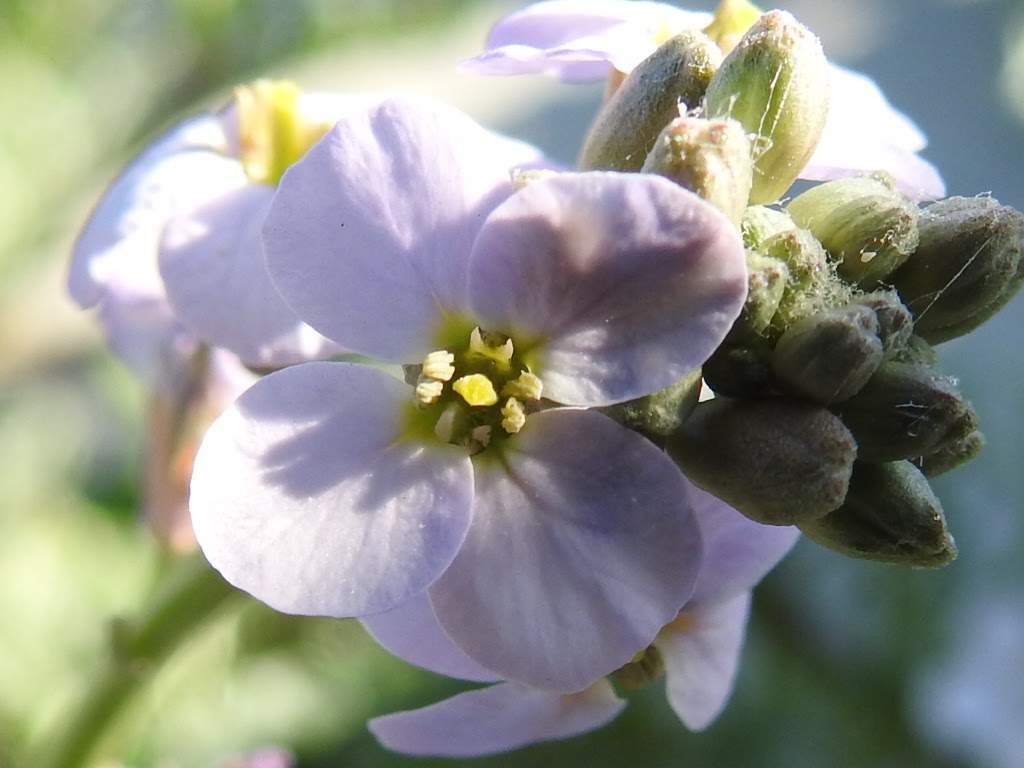
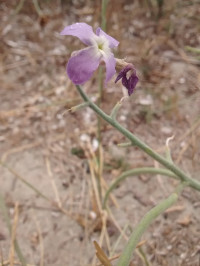
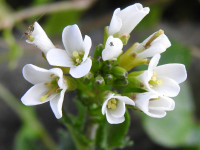
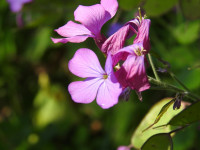
The inflorescence consists of short and dense racemes at the beginning, which lengthen considerably during fruiting. The flowers, about 1 cm in diameter, are pedicellate and have a corolla with four spatulate petals, about 4 mm long, with a claw and limb varying from white to pink and lilac, giving a delicately colored appearance. The sepals are yellow-green, membranous laterally and slightly gibbous at the base.
The fruit is a coriaceous, hard, indehiscent silique, formed by two superimposed articles with distinct characteristics: the upper article is larger, tetragonal and compressed, beaked and deciduous with an erect seed; the lower article is inverted conical in shape, with two slightly pronounced horns, persistent and with a pendulous and oblong seed. This fruit structure is fundamental for seed dispersal.
Habitat and distribution
A typical species of marine sandy coasts, it prefers the strandline zone and coastal dunes, environments characterized by sandy soils, arid, poor in organic matter and subjected to high salinity and mechanical actions of wind and storms. It is a psammophilous plant, i.e. adapted to live on sandy substrates, and behaves as a true pioneer in the colonization of beaches.
In Italy it is widespread along all regional coasts and major islands, although its presence may be localized in some areas. Its distribution extends along the Mediterranean and Atlantic coasts of Europe, with penetrations also inland in subsaline ruderal environments rich in nitrates. Globally, it is also present in Western Asia, North Africa, and Australia.
The plant grows at very low altitudes, typically at sea level, in habitats exposed to sun and wind, where other plant species struggle to establish.
Flowering period
The flowering period extends from May to October, with possible variability linked to local climatic and geographic conditions. Flowering can start early in spring and continue until autumn, accompanied by the elongation of the racemes during fruit maturation.
Ecology and pollination
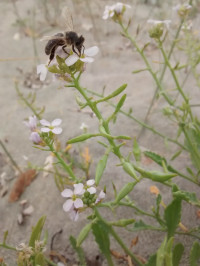
The species presents a reproductive strategy adapted to harsh coastal environments: the plant produces flowers with four petals of variable colors between white, pink, and lilac, which attract pollinating insects. However, its ability to colonize large sandy areas can also be facilitated by mechanisms of self-pollination or wind pollination.
Seed dispersal occurs mainly through hydrochory: the floating fruits are transported by tides and wave motion along the beaches, facilitating the colonization of new coastal areas. This is a fundamental adaptation for survival in dynamic environments such as marine coasts.
Curiosities and traditional uses
Sea Rocket is recognized as an edible plant with medicinal properties. Traditionally, it has been used as an antiscorbutic thanks to its high content of iron, ascorbic acid (vitamin C), and iodine. The tender leaves, with a salty and slightly bitter taste, are used in mixed salads or boiled and sautéed as a side dish for white meats.
The flowers are used to garnish dishes and salads, while the seeds are used in aromatic sauces, for example in the preparation of mustard-like condiments.
From a medicinal point of view, the plant has aperitive, digestive, carminative, and diuretic properties. The infusion obtained is considered a tonic for oily skin and used as an anti-dandruff treatment after shampooing. However, all medicinal or food uses should be considered for informational purposes only, with caution and under expert supervision.
Etymology
The genus name Cakile probably derives from the Arabic term “Kakeleh,” referring to the plant itself. The specific epithet maritima clearly indicates the marine coastal habitat in which this species develops. The Italian common name “ravastrello marittimo” highlights the growth environment and the local tradition linked to the plant.
Sources
- Prof. S. Pignatti, "Flora d'Italia"
- Acta Plantarum - Flora delle regioni italiane (scheda di Mirna Medri)
- Tela Botanica / H. Coste, "Flore descriptive et illustrée de la France"
- World Flora Online (WFO)
Characteristics
Scheda botanica
| Famiglia | Brassicaceae |
|---|---|
| Fioritura | tutto l'anno |
| Forma biologica | Scapose |
| Habitat | edible plant, succulent plant, with pink flowers |
| Uso alimentare | Commestibile |
Domande frequenti
- Quando fiorisce Sea Rocket?
- Sea Rocket fiorisce tutto l'anno.
- È commestibile Sea Rocket?
- Sea Rocket è considerata commestibile. Verifica sempre le parti eduli e la preparazione corretta prima del consumo.
- Che tipo di pianta è Sea Rocket?
- Sea Rocket è una Therophytes (Scapose) secondo la classificazione di Raunkiaer.
- A quale famiglia appartiene Sea Rocket?
- Sea Rocket appartiene alla famiglia botanica Brassicaceae.
Where I found it (13 sightings)
Classification
- Kingdom
- Plantae
- Family
- Brassicaceae
- Full name
- Cakile maritima Scop.
- Synonyms
- Cakile maritima Scop. subsp. aegyptiaca (Willd.) Nyman
- Life form
- Therophytes scapose
Similar species
Search for species with similar characteristicsFurther reading
Noticed an error in the identification? Write to me
Other species of the same family
Brassicaceae
Explore
Other species of Brassicaceae