Botanical species
Lunaria annua
L.
Honesty
Description
Morphological description
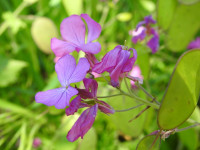
Biennial herbaceous plant, occasionally annual or perennial, with an erect and robust habit, which can reach a height between 30 and 100 cm. The stem is cylindrical, erect, woody at the base, and has a surface ranging from glabrous to slightly rough or wrinkled due to the presence of simple hairs, often descending and appressed.
The leaves are distinguished into lower, middle, and upper. The lower and middle leaves are opposite, long-petiolate (petiole 10-15 cm long), with a triangular or hastate blade, up to 10-15 cm wide, with a coarsely and irregularly toothed margin without aristate teeth. The texture is herbaceous and the leaf surface is generally pubescent with appressed simple hairs. The upper leaves are sessile or subsessile, arranged alternately or subalternately, smaller in size compared to the lower ones, with a similar but smaller shape.
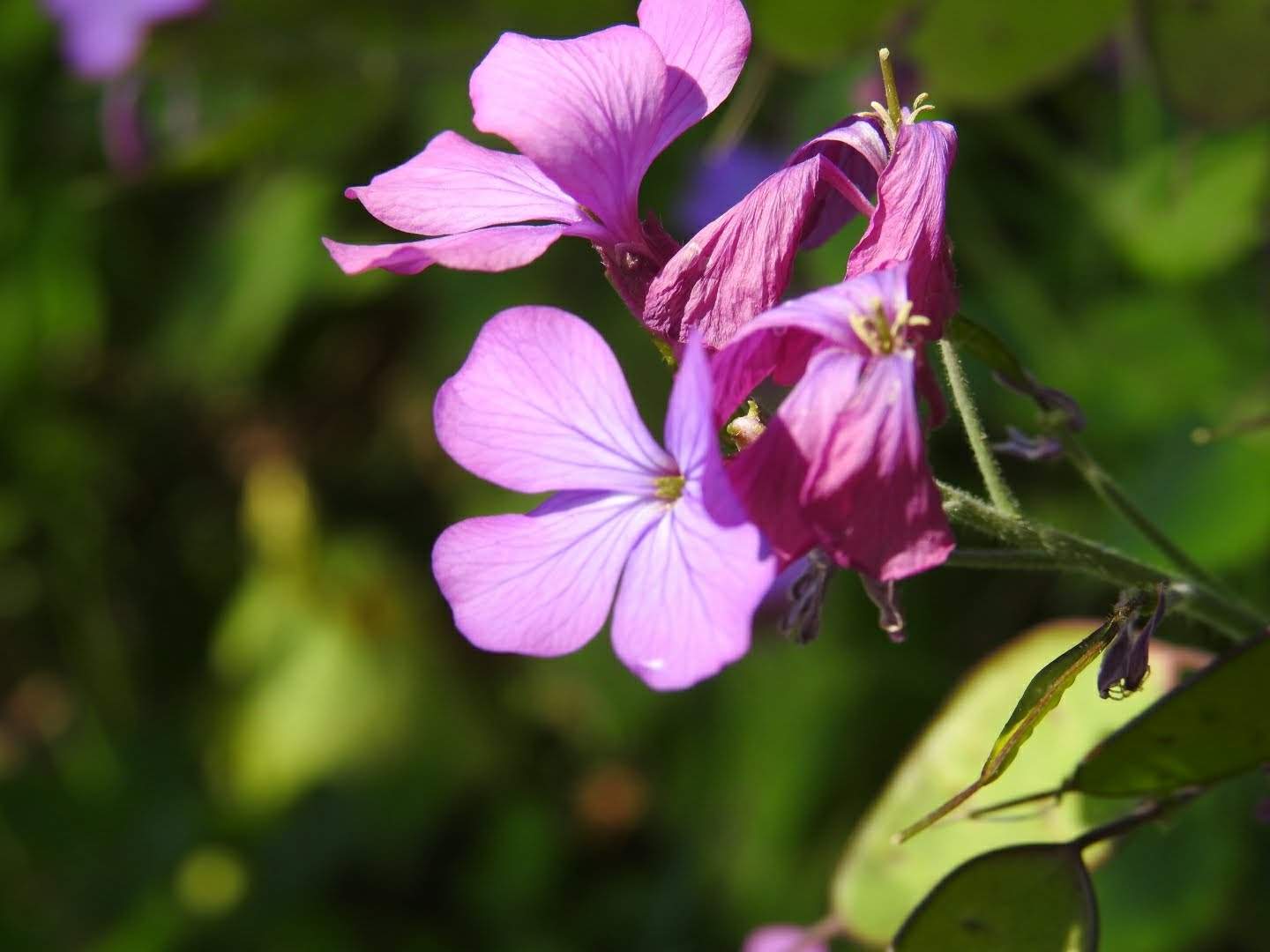
The flowers are hermaphroditic, actinomorphic and dialypetalous, gathered in terminal and axillary racemes, without bracts. The corolla consists of 4 large, spreading petals, obovate-spatulate in shape, about 15-30 mm long and 8-10 mm wide, with color varying from violet, purple, pink to rarely white. The sepals are 4, violet, 8-12 mm long, with the lateral ones having a saccate base. The androecium is tetradynamous with 8-10 stamens, bearing anthers 2.5-3 mm long. The ovary is superior and bicarpellate.
The fruits are siliques broadly elliptical, almost orbicular, measuring from 2 to 6 cm in length and 2-2.5 cm in width, with rounded ends. They are flattened, erect or slightly pendulous, initially greenish in color evolving towards a shiny silvery, very characteristic. The fruit valves are membranous and transparent, without evident veins, allowing the rounded, winged seeds to be seen, uniformly winged (with wings about 1 mm wide). The central septum of the fruit, once the valves are removed, remains as a transparent and silvery plate, highly valued for ornamental purposes.
The root system is typical of herbaceous plants, with taproots allowing good anchorage and absorption even in humus-rich soils.
Habitat and distribution
It is a typical species of southern Europe and the Mediterranean basin, widespread in Italy up to about 1000 meters altitude. It prefers woodland habitats but also adapts well to fields, roadsides, hedges, wet meadows, and banks of watercourses such as canals and streams.
It grows on siliceous and humus-rich soils, with exposure ranging from partial shade to full sun. It can be found in both cultivated and semi-wild environments, sometimes naturalized. It therefore prefers fresh and well-drained soils, with some moisture that facilitates its development.
Flowering period
Flowering mainly occurs between April and June, with some geographical variations related to the local climate. In milder climates and at lower altitudes, flowering can start as early as April, while in mountainous or cooler areas it tends to shift towards May-June.
Ecology and pollination
Lunaria annua is mainly pollinated by pollinating insects, including bees and bumblebees, attracted by the large colorful flowers and the lateral nectaries present. The reproductive strategy is based on abundant seed production at the end of the vegetative cycle, with dispersal facilitated by the flattened and winged structure of the seeds themselves, which can be carried by wind or flowing water.
The inflorescences are often multiple, with flowers arranged in loose racemes and without bracts, favoring wide exposure and accessibility to pollinating insects.
Curiosities and traditional uses
Lunaria annua is also known as “Silver herb” or “Pope’s money” for the particular silvery shine of its fruits, which resemble silver coins or the full moon. This characteristic has given rise to numerous popular beliefs attributing magical properties to the plant, such as bringing wealth and protecting against evil spirits.
From an ethnobotanical point of view, the leaves and roots of the plant were traditionally consumed in salads for their diuretic properties. The plant is edible, although today it is more frequently cultivated for ornamental purposes for its bright flowers and especially for the dried fruits, used in bouquets and floral arrangements.
Etymology
The genus name derives from the Latin word luna (moon), probably referring to the round and shiny shape of the fruits, similar to silver coins or the full moon reflected in the darkness of the night. The Italian common name “lunaria” directly recalls this resemblance. The specific name “annua” indicates its mainly biennial or annual nature, although under some conditions it can behave as perennial.
Sources
- Prof. S. Pignatti, "Flora d'Italia"
- Acta Plantarum - Flora delle regioni italiane (scheda di Giuliano Salvai)
- Tela Botanica / H. Coste, "Flore descriptive et illustrée de la France"
- World Flora Online (WFO)
Characteristics
Where I found it (8 sightings)
Classification
- Kingdom
- Plantae
- Family
- Brassicaceae
- Full name
- Lunaria annua L.
- Synonyms
- Lunaria annua L. subsp. pachyrhiza (Borbás) Hayek; Lunaria pachyrhiza Borbás
- Life form
- Emicriptofite scapose
Similar species
Search for species with similar characteristicsFurther reading
Noticed an error in the identification? Write to me
Other species of the same family
Brassicaceae
Explore
Other species of Brassicaceae