Botanical species
Antirrhinum majus
L.
Garden Snapdragon
Description
Morphological description
Perennial herbaceous plant with an erect habit, height generally ranging between 30 and 80 cm. The stem is simple or slightly branched, glabrous in the basal part and progressively covered by dense glandular hairs in the upper part, giving it a pubescent and glandular surface. The leaves are arranged oppositely in the lower portions of the stem and sometimes alternately towards the top, with a lanceolate or ovate-lanceolate shape, entire margin, and herbaceous texture. Leaf size varies from 5 to 10 mm in width and 18 to 55 mm in length; the upper leaves tend to be narrower and linear.
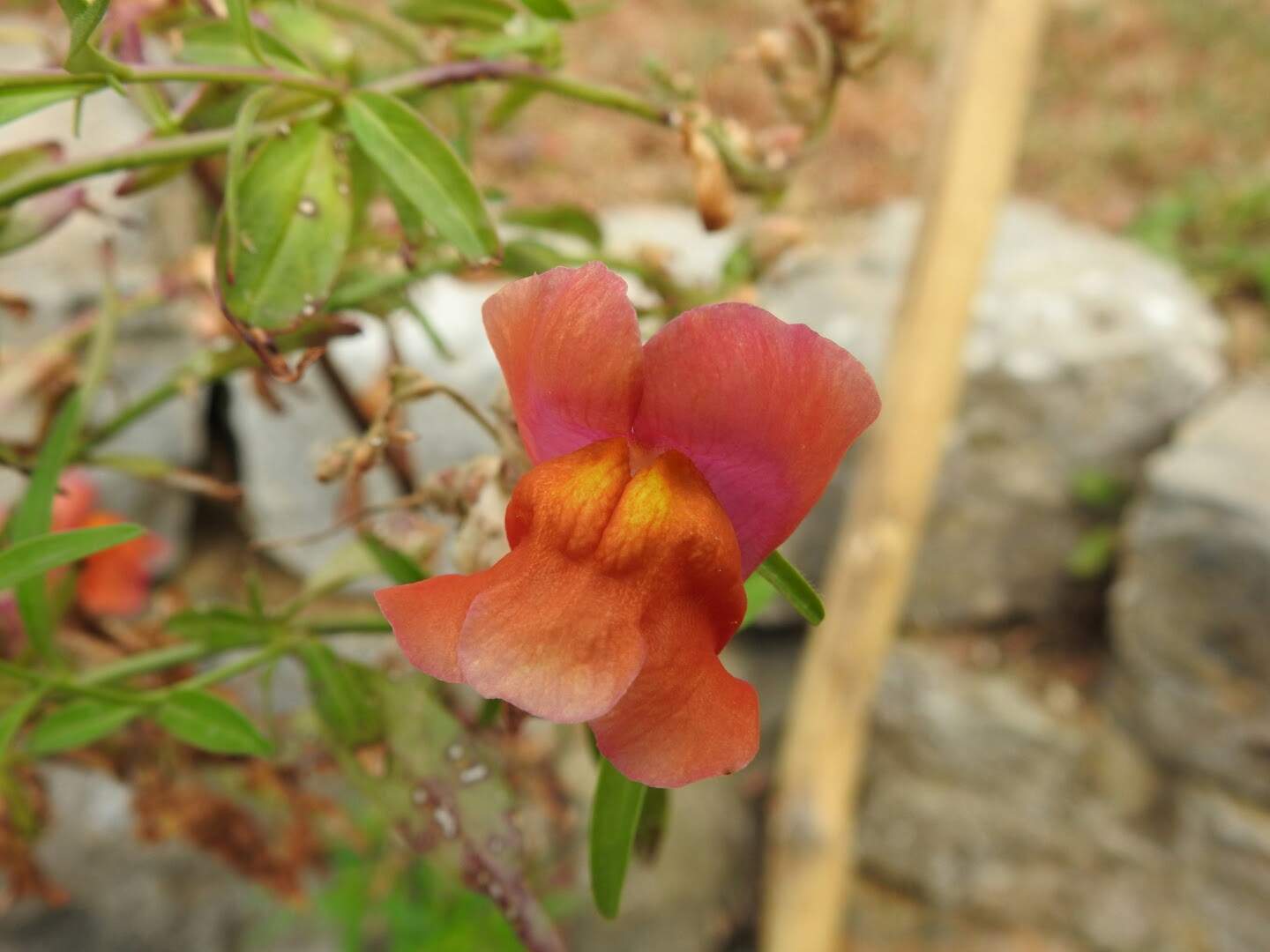
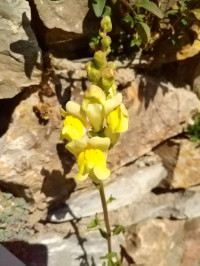
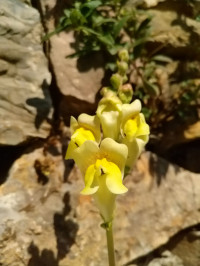
The inflorescence consists of a dense terminal raceme, with flowers close and contiguous. The peduncles are short, from 1 to 12 mm, often equal to or slightly longer than the calyx. The calyx is formed by oval, obtuse lobes, almost completely divided and about 4-8 mm long; it is covered with hairs, especially in the upper part. The corolla, 3 to 4.5 cm long, is bilabiate and has a gibbous base (a protuberance) that closes the flower throat. The corolla tube is swollen at the base, replacing the presence of a spur. The corolla color is very variable, ranging from purplish (violet), to pink, red, white, or yellow, often with a purple throat accompanied by two yellow spots. The corolla is often slightly pubescent on the outside.
The fruit is an ellipsoid, oblique capsule, about 1-1.2 cm long and covered with glandular hairs. The capsules open through 2-3 lateral pores and contain numerous seeds (polysporous). The root system is typically taprooted, as in many Mediterranean perennial plants, but it is not described in detail in the sources.
Habitat and distribution
This species is native to the Mediterranean region and is found wild in much of southern Europe, western Asia, and North Africa. In Italy it is mainly present in the central-southern regions and along the coasts, but it can also be observed in hilly and mountainous environments up to medium altitudes. It prefers sunny and thermophilic habitats, such as rocks, old walls, dry slopes, and rocky coasts, where it grows on well-drained soils often poor in organic matter. It can naturalize in anthropized environments, such as gardens and urban areas.
Flowering period
Flowering mainly extends from May to September, with possible variations depending on altitude and local climatic conditions. In warmer and temperate environments, it can start as early as late spring and continue throughout summer until early autumn.
Ecology and pollination
Garden Snapdragon is mainly pollinated by pollinating insects, particularly bees and bumblebees, attracted by the bilabiate shape of the flowers and the yellow spots placed on the throat that act as visual guides. The corolla structure, with the gibbous base that closes the throat, favors visits by pollinating insects ensuring effective pollen deposition. Seed dispersal occurs mainly by direct fall from the capsule which opens through pores, but some secondary transport by external agents such as wind or small animals is also possible.
Curiosities and traditional uses
Garden Snapdragon has long been known for its ornamental value, thanks to its showy and colorful flowers. In the past, some parts of the plant were used in traditional medicine for their emollient and anti-inflammatory properties, although there are no recent data confirming therapeutic efficacy. The common name derives from the characteristic shape of the flowers, which resemble a wide-open mouth similar to that of a lion.
Etymology
The scientific name "Antirrhinum" derives from the ancient Greek ἀντίρρινον (antirrhinon), meaning "nose upside down," referring to the flower shape that resembles a closed snout or nose. The specific name "majus" means "greater" or "larger," probably referring to the larger flower size compared to other species of the genus. The Italian common name "bocca di leone" visually describes the bilabiate and protuberant shape of the corolla, which indeed resembles a wide-open mouth.
Sources
- Prof. S. Pignatti, "Flora d'Italia"
- Tela Botanica / H. Coste, "Flore descriptive et illustrée de la France"
- World Flora Online (WFO)
Characteristics
Scheda botanica
| Famiglia | Plantaginaceae |
|---|---|
| Fioritura | febbraio – novembre |
| Forma biologica | Fruticose |
| Habitat | with white flowers, with yellow flowers, with red flowers |
Domande frequenti
- Quando fiorisce Garden Snapdragon?
- Garden Snapdragon fiorisce febbraio – novembre.
- Che tipo di pianta è Garden Snapdragon?
- Garden Snapdragon è una Chamaephyte (Fruticose) secondo la classificazione di Raunkiaer.
- A quale famiglia appartiene Garden Snapdragon?
- Garden Snapdragon appartiene alla famiglia botanica Plantaginaceae.
Where I found it (7 sightings)
Classification
- Kingdom
- Plantae
- Family
- Plantaginaceae
- Full name
- Antirrhinum majus L.
- Synonyms
- Orontium majus (L.) Pers.; Termontis racemosa Raf., nom. illeg.
- Life form
- Chamaephyte fruticose
Similar species
Search for species with similar characteristicsFurther reading
Noticed an error in the identification? Write to me
Other species of the same family
Plantaginaceae
Explore
Other species of Plantaginaceae