Botanical species
Cymbalaria muralis
G.Gaertn., B.Mey. & Scherb.
Ivy-leaved Toadflax


Description
Morphological description
The Ivy-leaved Toadflax is a perennial herbaceous plant belonging to the Plantaginaceae family, characterized by a creeping, climbing or pendulous habit, with slender, filiform stems generally between 10 and 40 cm long. The stems are glabrous or slightly hairy and root easily at the nodes, allowing the plant to rapidly spread over walls, rocks, and various substrates. The base of the stem tends to lignify slightly with age.
The leaves are alternate (rarely the lower ones may be opposite), borne on a relatively long petiole (2-4 cm), often longer than the leaf blade. The blade is fleshy, glossy, light green in color, but often with a reddish underside. The shape is reniform or semicircular, sometimes suborbicular, with a size ranging from 14-40 mm in length and 10-30 mm in width. The leaf margin has 5 to 9 rounded or ovate-acuminate lobes, generally mucronate, with the central lobes larger than the lateral ones; in some lower leaves the lobes are obtuse. The underside can take on reddish hues.
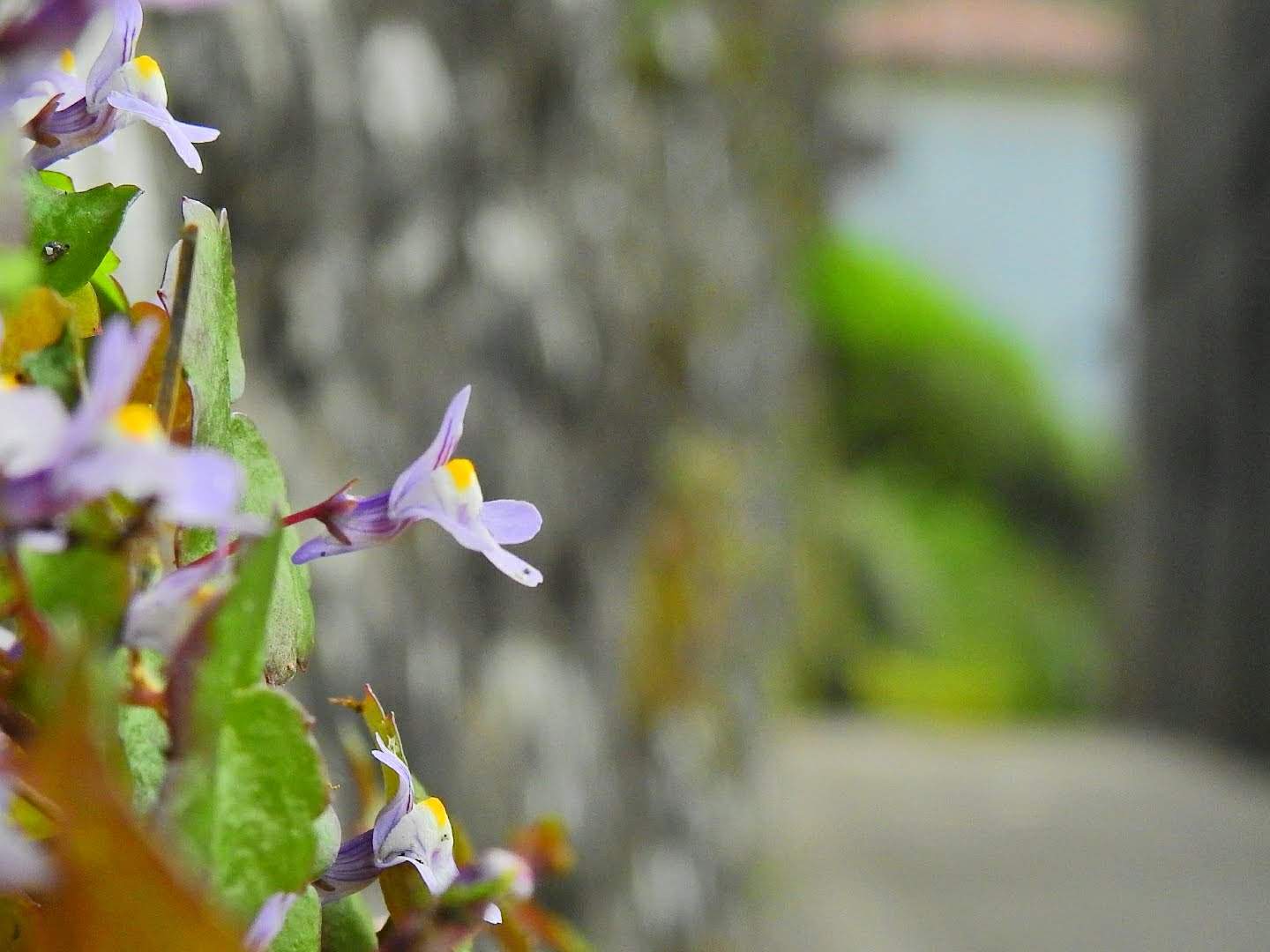
The flowers, hermaphroditic and zygomorphic, are solitary or grouped in pairs in the leaf axils, borne on long and slender peduncles. The corolla, about 8-10 mm long (excluding the spur), is bilabiate with a color varying from white to light lilac-purple, often with darker veins. The upper lip is divided into two light violet lobes with darker veins at the base, while the lower lip is swollen and presents two yellow humps (palate) that close the throat, a distinctive characteristic of the species. The spur, conical and obtuse, about 1.5-3 mm long, is generally violet or whitish in color and measures about half the length of the corolla. The calyx is glabrous or slightly hairy, divided into four lanceolate and acute lobes, 2-2.5 mm long.
The fruit is a glabrous, globose capsule that slightly protrudes beyond the calyx lobes. The capsule opens through three apical openings for seed dispersal. The seeds are black, globose or ovoid, with a rugose-keeled or sometimes tuberculate surface.
The root system is rhizomatous-stoloniferous, with rooting at the nodes of creeping stems, allowing the plant to quickly colonize vertical or horizontal surfaces.
Habitat and distribution
The Ivy-leaved Toadflax is native to Eurasia but has widely naturalized in many regions of the world. In Italy it is widespread throughout the territory, present from sea level up to about 1500 meters altitude. It typically grows on calcareous substrates, in cool and humid environments, preferring shady or semi-shady exposures.
Typical habitats include walls, rocks, cracks in buildings, roadside edges, gardens, and wet meadows, where it adapts well to shallow soil conditions and poor substrates, often in anthropized or semi-natural environments.
In the Mediterranean basin it is particularly common in temperate and sub-Mediterranean areas, where it exploits cool and humid microenvironments, often in anthropic or semi-rustic settings.
Flowering period
The flowering of the Ivy-leaved Toadflax generally extends from March to October, with variations related to altitude and local climate. In milder climates, flowering can begin as early as late winter and continue until late autumn. In colder climates or at higher altitudes, the flowering period is mainly concentrated between spring and summer.
Ecology and pollination
The plant is mainly pollinated by pollinating insects attracted by the bright colors of the corolla and the presence of the yellow palate, which acts as a visual signal and guide for access to nectar. Among the main pollinators are small hymenopterans such as wild bees and bumblebees.
The reproductive strategy includes both seed production, dispersed mainly by falling from the capsules and subsequent mechanical transport or by small animals, and vegetative multiplication thanks to rooting stolons. This combination allows rapid expansion in favorable environments.
The flowering and fruiting peduncles are often reflexed downward, facilitating seed dispersal through contact with the substrate.
Curiosities and traditional uses
The Ivy-leaved Toadflax has traditionally been used in phytotherapy for its medicinal properties. Its fresh leaves were applied locally on wounds as a hemostatic and healing agent. The flowers were used in infusion to treat kidney stones due to their diuretic properties. The plant is also attributed anti-inflammatory, antiscorbutic, astringent, and anti-hemorrhoidal effects.
These therapeutic uses, although known in popular contexts, always require medical supervision for any pharmaceutical applications.
From an ethnobotanical point of view, the species is also appreciated for its ornamental value in cultivation on walls and rock gardens, thanks to its ability to cover vertical surfaces with a carpet of delicate leaves and flowers.
Etymology
The genus name, Cymbalaria, derives from the Latin cymbalum or the Greek kymbalon, which referred to a percussion musical instrument similar to a tambourine. This denomination alludes to the concave shape of the leaves, which indeed resemble small cymbala or little plates.
The specific epithet muralis refers to the typical habitat of the plant, which commonly grows on walls and rocky cliffs.
The Italian common name “ciombolino” probably recalls the shape and delicacy of the flowers and leaves, as well as their spread in urban and rural contexts, often on wall surfaces.
Sources
- Prof. S. Pignatti, "Flora d'Italia"
- Acta Plantarum - Flora delle regioni italiane (scheda di Giuliano Salvai)
- Tela Botanica / H. Coste, "Flore descriptive et illustrée de la France"
- World Flora Online (WFO)
Characteristics
Scheda botanica
| Famiglia | Plantaginaceae |
|---|---|
| Fioritura | marzo – ottobre |
| Forma biologica | Scapose |
| Habitat | with white flowers, with lilac flowers, creeping plant |
Domande frequenti
- Quando fiorisce Ivy-leaved Toadflax?
- Ivy-leaved Toadflax fiorisce marzo – ottobre.
- Che tipo di pianta è Ivy-leaved Toadflax?
- Ivy-leaved Toadflax è una Hemicryptophytes (Scapose) secondo la classificazione di Raunkiaer.
- A quale famiglia appartiene Ivy-leaved Toadflax?
- Ivy-leaved Toadflax appartiene alla famiglia botanica Plantaginaceae.
Where I found it (3 sightings)
Classification
- Kingdom
- Plantae
- Family
- Plantaginaceae
- Full name
- Cymbalaria muralis G.Gaertn., B.Mey. & Scherb.
- Synonyms
- Linaria muralis (L.) Mill.
- Life form
- Hemicryptophytes scapose
Similar species
Search for species with similar characteristicsFurther reading
Noticed an error in the identification? Write to me
Other species of the same family
Plantaginaceae

Explore
Other species of Plantaginaceae