Botanical species
Digitalis lutea
L.
Straw Foxglove
Description
Morphological description
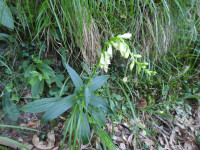
Perennial herbaceous plant belonging to the Plantaginaceae family, characterized by a scapose habit with an erect and unbranched floral scape reaching a height between 50 and 100 cm. The stem is glabrous, solid, finely striated and bears alternately arranged leaves. The basal leaves are ovate-lanceolate, rather large (up to 15 cm long and 2-3 cm wide), with a coarsely dentate margin and herbaceous texture, tapering at the base into a short petiole. The cauline leaves are smaller, sessile, lanceolate with a rounded base and acute apex.
The root system consists of a woody horizontal rhizome, brown in color, which allows the plant to overwinter.
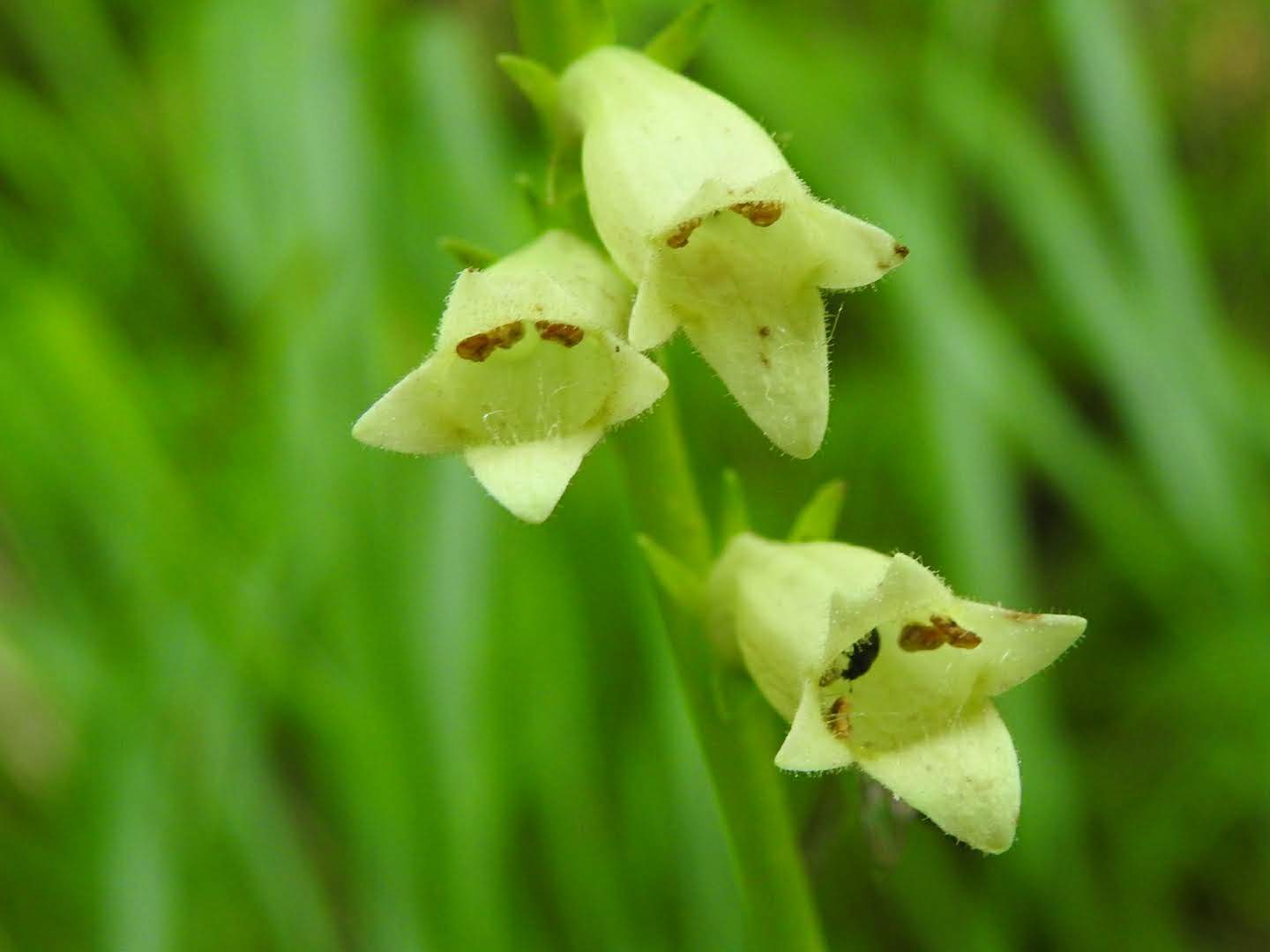
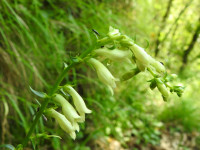
The flowers are gathered in long leafy racemes, generally arranged unilaterally along the inflorescence axis, with most flowers facing the same direction and few in the opposite direction. The corolla, bell-shaped and tubular, measures between 1.5 and 2.5 cm in length and 0.5-0.8 cm in width; the color varies from whitish-yellow to pale yellow-green. The outer surface is glabrous with sparse hairs inside, while the upper lip is divided into two erect lobes, the lateral ones are divergent and the lower one larger, oval and acute. Inside the corolla tube there are small spots and stripes that function as a lure and guide for pollinating insects, especially hornets. The stamens are clearly visible and protrude beyond the corolla. The calyx is composed of five ovate-lanceolate lobes, about 9 mm long, divided and slightly overlapping at the base.
The fruit is a conical two-lobed capsule, pale brown in color, slightly longer than the persistent calyx, with a surface scattered with glands; it opens by two valves releasing small light brown kidney-shaped seeds.
Habitat and distribution
Straw Foxglove is widespread in Western Europe, with a subatlantic distribution extending from Scandinavia to the Iberian Peninsula. In Italy it is mainly present in the eastern and central-northern Alps, with reports up to the Merano-Valle Isarco line, Valle di Fiemme, Asiago, Colli Berici and Euganei. Its presence in Friuli is more sporadic and needs confirmation. Towards the south it generally stops at the southern foothills of the Tuscan Apennines, with residual presences in the Volterra and Terni areas.
It prefers fresh and shady woodland environments, from hill plains up to about 1500 m altitude, frequenting sparse woods, shrublands and path margins. It favors calcareous soils, often rocky, with exposure from partial shade to more open but not too exposed places. It grows on rocky slopes and in subalpine-hill habitats, generally preferring substrates with neutral or basic pH.
Flowering period
The flowering period extends from June to July, with geographical variations linked to altitude and latitude. The flowers open progressively from the bottom to the top of the inflorescence, ensuring a long flowering duration and a continuous supply of pollen and nectar for pollinators.
Ecology and pollination
The species presents a reproductive strategy well adapted to entomophilous pollination, mainly by hornets and other large hymenopterans. The spots and small hairy structures inside the corolla tube act as visual and tactile signals to guide insects towards the nectar, thus ensuring effective pollination. The unilateral inflorescence facilitates insect access, which land on the downward-facing flowers.
Seed dispersal occurs through the opening of the two-valved two-lobed capsules, which release small light seeds, probably dispersed by gravity and partly by wind.
Curiosities and traditional uses
Straw Foxglove is a medicinal species known for the presence of highly toxic cardiotonic glycosides such as digitalin, digitoxin, gitoxin and gitaloxin, concentrated mainly in the leaves of the second year of life before flowering. These compounds act by slowing the heart rate and modifying blood pressure, finding use in cardiac therapy for the treatment of arrhythmias and heart failure.
However, the plant is highly poisonous: ingestion of only 10 grams of dried leaves or 40 grams of fresh leaves can be lethal. For this reason, improper use must be avoided and handled with caution.
Historically, no significant food or folkloric uses are known for this species, but its pharmaceutical importance has been recognized and studied since ancient times.
Etymology
The scientific name derives from Latin: "Digitalis" means "little finger" referring to the tubular shape of the flowers resembling a gloved finger, while "lutea" refers to the yellow color of the flowers. The Italian common name "digitale gialla piccola" exactly recalls these distinctive characteristics, distinguishing it from other Digitalis with differently colored flowers or larger sizes.
Sources
- Prof. S. Pignatti, "Flora d'Italia"
- Acta Plantarum - Flora delle regioni italiane (scheda di Marinella Zepigi)
- World Flora Online (WFO)
Characteristics
Scheda botanica
| Famiglia | Plantaginaceae |
|---|---|
| Fioritura | giugno – luglio |
| Forma biologica | Scapose |
| Habitat | with white flowers, with yellow flowers, plant with a scapose habit |
| Uso officinale | Pianta officinale |
Domande frequenti
- Quando fiorisce Straw Foxglove?
- Straw Foxglove fiorisce giugno – luglio.
- Che tipo di pianta è Straw Foxglove?
- Straw Foxglove è una Hemicryptophytes (Scapose) secondo la classificazione di Raunkiaer.
- A quale famiglia appartiene Straw Foxglove?
- Straw Foxglove appartiene alla famiglia botanica Plantaginaceae.
Where I found it (4 sightings)
Classification
- Kingdom
- Plantae
- Family
- Plantaginaceae
- Full name
- Digitalis lutea L.
- Life form
- Hemicryptophytes scapose
Similar species
Search for species with similar characteristicsNoticed an error in the identification? Write to me
Other species of the same family
Plantaginaceae
Explore
Other species of Plantaginaceae