Botanical species
Antirrhinum latifolium
Mill.
Large Snapdragon
Description
Morphological description
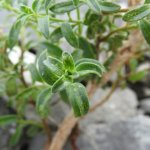
It is a biennial or perennial shrub, with an erect habit, which can reach a height of up to 100 cm. The stem is simple or sometimes branched, with a base generally glabrous or slightly hairy and covered with glandular hairs, giving the plant a slightly sticky appearance.
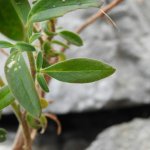
The leaves are relatively large compared to other species of the genus, with a maximum length of around 7 cm and a width that can reach one third or half of the length, thus 2 to 3 times longer than wide. The shape varies from ovate, ovate-lanceolate to lanceolate, with entire margins and herbaceous texture. The leaf arrangement is mixed: the lower leaves are petiolate and opposite, while the upper ones are sessile and alternate, giving the stem a variegated appearance.
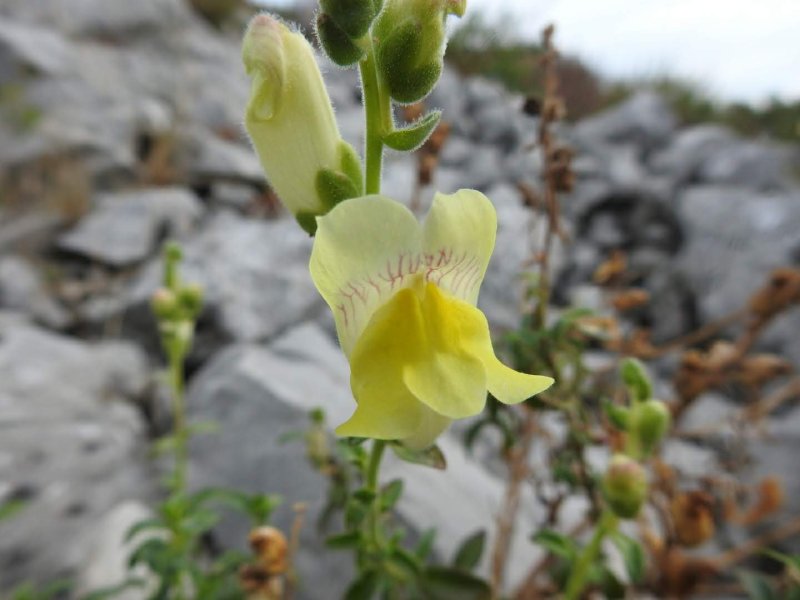
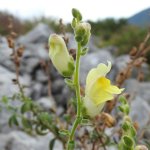
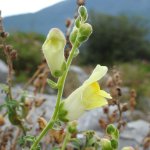
The flowers are grouped in spike-like racemes, erect, placed at the apex of the stem. The corolla is pale yellow, characterized by a bilabiate personate tube, that is with the lower lip having a swelling that partially closes the inside of the flower, and the upper lip with reddish streaks. Each flower is inserted on the stem forming an acute angle through a short pedicel, flanked by an oval-shaped bract. The corolla, larger than in similar species, shows a structure adapted to particular pollination mechanisms.
The fruit is an ovoid, obtuse, woody and slightly hairy capsule. Inside it are reticulated seeds, each with an irregularly denticulate longitudinal ridge, which facilitate dispersal.
The root system is not specifically described in the sources, but a taproot typical of perennial herbaceous plants developing in rocky environments is assumed.
Habitat and distribution
This species is typical of the north-western Mediterranean, with a distribution that includes southern Europe, particularly Italy, where it grows spontaneously. It is a plant adapted to rocky soil conditions, cliffs and walls, preferring sunny exposures and open environments.
It can be found from sea level up to about 600 meters altitude, especially in habitats characterized by calcareous or stony substrates, often in areas with good drainage and low fertility.
Flowering period
Flowering extends from May to September, with possible variations depending on altitude and local climatic conditions. This long period allows the plant to take advantage of the warmer seasons for reproduction and pollination.
Ecology and pollination
The personate shape of the corolla, with the swollen lower lip that closes access to the inside of the flower, is an evolutionary strategy that favors pollination by specific pollinating insects, such as some hymenopterans (bees or bumblebees). These insects, attracted by the pale yellow color and reddish streaks, are able to open the “mouth” of the flower and access the nectar, effectively pollinating the plant.
Seed dispersal occurs through the dehiscence of the woody capsule. The seeds, reticulated and equipped with denticulate ridges, can be transported over short distances mainly by abiotic agents such as wind or water, or possibly by small animals. However, no particularly specialized dispersal strategies are known.
Curiosities and traditional uses
No specific information regarding medicinal, food or folkloric uses of this species has been reported in the analyzed sources. However, the genus Antirrhinum is known in phytotherapy for some species traditionally used as local remedies, but in the specific case of Antirrhinum latifolium no documented uses are reported.
Etymology
The genus name "Antirrhinum" derives from the Greek "anti" = similar and "rhin" = snout, referring to the particular shape of the bilabiate corolla that resembles the snout or mouth of an animal, hence also the Italian common name “bocca di leone” (lion’s mouth). The specific epithet "latifolium" highlights the characteristic of relatively broad leaves compared to other related species.
The common name “yellow snapdragon” effectively describes the shape of the corolla and the distinctive color of the flowers, which differ from other snapdragon species, often with pink or purple flowers.
Sources
- Acta Plantarum - Flora delle regioni italiane (actaplantarum.org)
- Acta Plantarum - Flora delle regioni italiane (scheda di Giuliano Salvai)
Characteristics
Where I found it (8 sightings)
Classification
- Kingdom
- Plantae
- Family
- Plantaginaceae
- Full name
- Antirrhinum latifolium Mill.
- Life form
- Camefite fruticose
Similar species
Search for species with similar characteristicsFurther reading
Noticed an error in the identification? Write to me
Other species of the same family
Plantaginaceae
Explore
Other species of Plantaginaceae