Botanical species
Veronica montana
L.
Wood Speedwell
Description
Morphological description
Wood Speedwell is a perennial plant belonging to the Plantaginaceae family, characterized by a predominantly creeping and rooting habit, with weak stems that normally develop between 5 and 25 cm in length. The rhizome is thin, branched, and superficial, from which apical vegetative shoots with prolonged growth arise that can root in the soil.
The stems are initially creeping and rooting, then assume a more ascending habit, presenting a pubescence made of patent and glandular hairs, especially along the axes of the floral racemes and on the leaf peduncles. The leaves are alternate, with a petiole 7-15 mm long, and a herbaceous blade, broadly oval or suborbicular, often with a slightly cordate base. Leaf dimensions vary between 15-35 mm in width and 15-30 mm in length. The leaf margins are crenate-serrated and the surface is slightly hairy with scattered hairs.
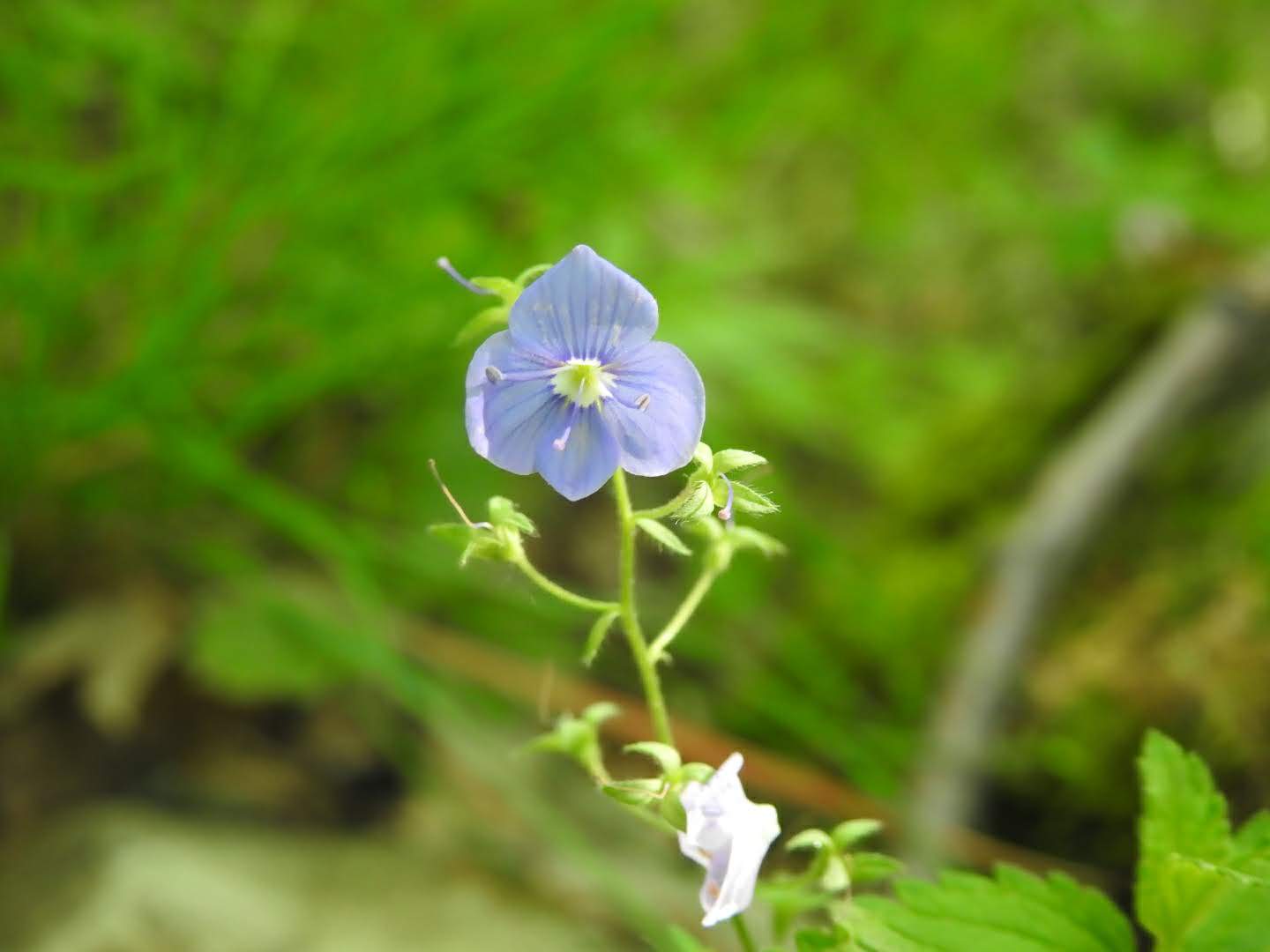
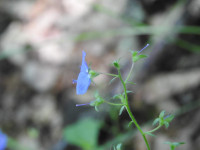
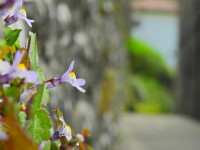
The flowers, gathered in sparse and short racemes composed of 2-7 flowers each, are pedunculate with peduncles 4 to 8 mm long, clearly longer than the bracts. The corolla has a diameter ranging from 6 to 12 mm, with four pale blue-lilac petals, often shaded with white, decorated with darker veins that accentuate the venation. The calyx has four broadly oval lobes. The style measures about 4-5 mm and is shorter than the fruit.
The fruit is a compressed capsule, 6-8 mm wide and 4-6 mm long, slightly oval and flattened in shape, sometimes described as "spectacle-shaped" due to its obtusely notched base and apex. The capsule surpasses the calyx, with a weakly denticulate keel and glandular cilia, while the surface is otherwise glabrous.
Habitat and distribution
Wood Speedwell is a species typical of montane and submontane environments, preferring humid broadleaf forests. It grows mainly in hilly and mountainous areas, from the plain to medium altitudes, where it finds conditions of humidity and partial shade. In Italy it is mainly present in the Apennines, in the Alps (although with some gaps in distribution), in Sicily and Corsica, but it is rather rare and localized.
It prefers fresh and well-drained soils, with generally shaded or semi-shaded exposure typical of humid understories. Its presence is indicative of intact and not too disturbed forest environments, where the humid microclimate favors its development.
Flowering period
The flowering of Wood Speedwell mainly extends between May and June. In some areas it may present slight temporal variations, but generally it occurs in late spring or early summer, a period in which the plant produces its characteristic pale blue-lilac flowers with darker venation.
Ecology and pollination
The species adapts to conditions of partial shade and humidity, typical of montane and submontane forests. Flowering occurs in small and scattered clusters, facilitating pollination by pollinating insects, particularly bees and other medium-small sized pollinators, attracted by the coloration and arrangement of the flowers.
The plant reproduces both sexually, through the seeds contained in the capsules, and vegetatively, thanks to the creeping rhizome that allows local expansion and rooting of new shoots. Seed dispersal probably occurs by mechanisms of falling near the mother plant, without particular adaptations for long-distance dispersal.
Curiosities and traditional uses
No specific information on traditional or medicinal uses of Wood Speedwell is reported in the available sources. However, many species of the genus Veronica have historically been used in herbal medicine for their soothing and anti-inflammatory properties, although for this particular species no certain data are recorded.
Etymology
The generic name Veronica probably derives from the medieval Latin "vera icon" (true image), referring to a Christian legend linked to a woman named Veronica who supposedly wiped the face of Christ during the Passion, leaving a sacred image imprinted. The specific name "montana" indicates the ecological preference of the plant for montane or hilly environments. The common Italian name "Wood Speedwell" directly reflects the scientific denomination without widespread vernacular variations.
Sources
- Prof. S. Pignatti, "Flora d'Italia"
- World Flora Online (WFO)
Characteristics
Where I found it (7 sightings)
Classification
- Kingdom
- Plantae
- Family
- Plantaginaceae
- Full name
- Veronica montana L.
- Life form
- Emicriptofite reptanti
Similar species
Search for species with similar characteristicsFurther reading
Noticed an error in the identification? Write to me
Other species of the same family
Plantaginaceae
Explore
Other species of Plantaginaceae