Botanical species
Plantago coronopus
L.
Buck's-horn Plantain
Description
Morphological description
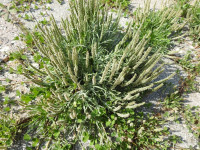
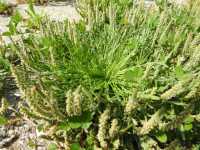
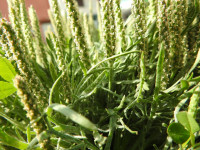
Herbaceous plant annual, biennial or perennial, with a bushy habit and variable height from 5 to 50 cm, with an elongated, whitish and finely branched root. Lacking an evident aerial stem (acaulescent), it has numerous thin floral scapes, ascending or arcuate, emerging from the basal rosette of leaves.
The leaves are arranged in a basal rosette, membranous and often fleshy, with a blade length from 3 to over 10 cm and 2-6 mm wide. The shape of the leaves is very polymorphic: the first leaves are entire and lanceolate, while the more developed ones become deeply pinnatifid or bipinnatipartite, with 3-6 pairs of linear or lanceolate, acute and toothed segments, resembling a crow's foot or Buck's-horn Plantain. The main veins (1-3) are evident and the surface can be glabrous or with appressed hairs.
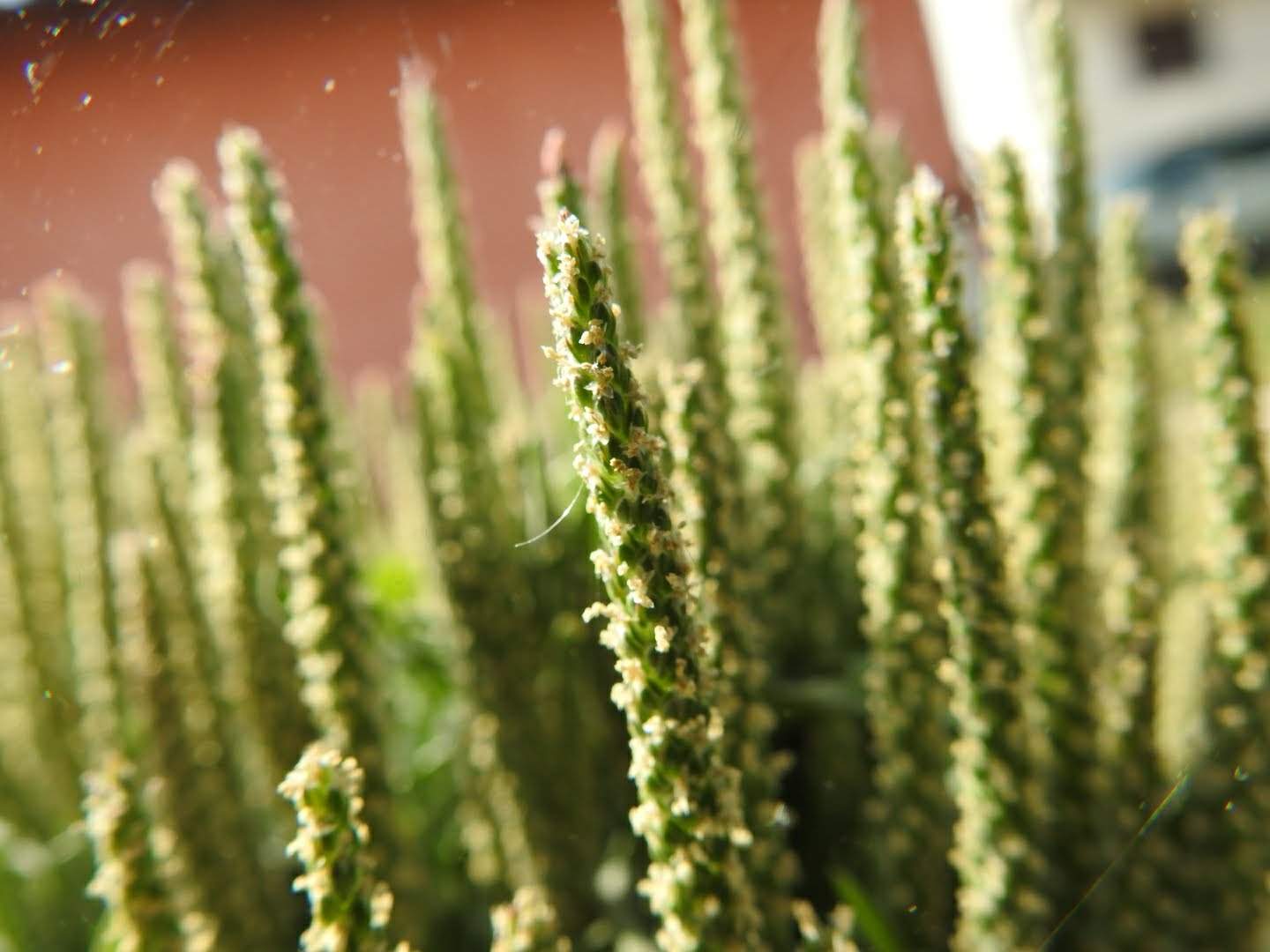
The inflorescence is a cylindrical spadix 2 to 17 cm long, supported by a robust, cylindrical scape, often pubescent with appressed hairs. The spadix is compact and can range from loose to denser, recurved in the pre-anthesis phase. The bracts accompanying the flowers are oval-acuminate, green, with a membranous and scarious margin at the base, about 2-4 mm long, covered with slight pubescence and with a median nerve ending in a mucro.
The flowers are small, regular and actinomorphic, white tending to brownish-white, with a tubular corolla 1.8-3 mm long, lobed into 4 ovate-acuminate petals. The corolla tube is covered with hairs. The anthers are yellowish and about 1-1.3 mm long, supported by brownish, flexible filaments protruding beyond the corolla tube. The sepals are fused at the base, anterior ones obtuse or oval, pubescent and ciliate along the margin, posterior ones with a ciliate membranous wing.
The fruit is a small pyxis containing 4 to 6 ellipsoid seeds, brown, smooth or slightly pubescent, about 0.8-1.6 mm long and 0.5-0.8 mm wide.
Habitat and distribution
This species is typical of Mediterranean and sub-Mediterranean coastal environments, with a range extending from southern and central Europe to western Asia and North Africa. In Italy it grows mainly along the coasts, on sandy soils, cliffs, salt meadows and dry uncultivated lands, up to 800 meters altitude. It prefers well-drained, sandy or arenaceous soils, with sunny exposure and marine or brackish conditions.
It can also be found in inland environments with similar aridity and poor soil characteristics, where it shows morphological variations in leaves and pubescence. The species is polymorphic and can vary in size and shape depending on the habitat.
Flowering period
Flowering generally occurs from March to October, with possible extension to November in some milder areas. The long flowering period allows good reproduction and spread, especially in Mediterranean environments where climatic conditions are favorable for most of the year.
Ecology and pollination
Buck's-horn Plantain reproduces sexually through seeds produced in small capsule fruits. The flowers, although inconspicuous and small in size, are visited by pollinating insects, mainly small hymenopterans and dipterans, which favor cross-pollination. The tubular corolla and the arrangement of the anthers suggest an adaptation to insects capable of penetrating the floral tube.
Seed dispersal occurs mainly by falling near the mother plant, but can be facilitated by water or mechanical transport, especially in coastal or sandy environments where soil movement is frequent.
Curiosities and traditional uses
This plant has a long history of food and medicinal use. It has been cultivated as a salad vegetable, appreciated for its young leaves, rich in vitamins A, C and K. The leaves can be eaten raw in mixed salads or boiled as a side dish, often accompanying grilled meats and sausages.
From a medicinal point of view, dried roots used in infusions have tonic, astringent and cholagogue properties, employed to stimulate digestion and as a mild laxative, especially for children. The leaves contain tannins, mucilages and pectins, substances useful for soothing irritations and promoting gastrointestinal health. In traditional herbalism it is also considered a stomachic herb.
The common name "Buck's-horn Plantain" derives from the shape of the leaves, which resemble the beard or crow's foot (coronopus), while "plantain" indicates the belonging to the genus Plantago.
Etymology
The genus name derives from the Latin "planta", meaning "plant" but also "sole of the foot" or "footprint", referring to the particular shape of the leaves of many species of this genus. The specific epithet "coronopus" derives from the Greek "κορώνη" (korōnē) meaning "crow" and "πούς" (pous) meaning "foot", recalling the shape of the leaves similar to the foot of a crow or an animal with long and slender toes.
The Italian name "barba di cappuccino" is instead linked to the filiform and laciniate shape of the leaves, which resemble the scruffy beard of a Capuchin friar.
Sources
- Prof. S. Pignatti, "Flora d'Italia"
- Acta Plantarum - Flora delle regioni italiane
- Tela Botanica / H. Coste, "Flore descriptive et illustrée de la France"
- World Flora Online (WFO)
Characteristics
Scheda botanica
| Famiglia | Plantaginaceae |
|---|---|
| Fioritura | marzo – ottobre |
| Forma biologica | Scapose |
| Habitat | with white flowers, biennial plant, annual plant |
Domande frequenti
- Quando fiorisce Buck's-horn Plantain?
- Buck's-horn Plantain fiorisce marzo – ottobre.
- Che tipo di pianta è Buck's-horn Plantain?
- Buck's-horn Plantain è una Therophytes (Scapose) secondo la classificazione di Raunkiaer.
- A quale famiglia appartiene Buck's-horn Plantain?
- Buck's-horn Plantain appartiene alla famiglia botanica Plantaginaceae.
Where I found it (6 sightings)
Classification
- Kingdom
- Plantae
- Family
- Plantaginaceae
- Full name
- Plantago coronopus L.
- Life form
- Therophytes scapose
Similar species
Search for species with similar characteristicsFurther reading
Noticed an error in the identification? Write to me
Other species of the same family
Plantaginaceae
Explore
Other species of Plantaginaceae