Botanical species
Linaria vulgaris
Mill.
Butter And Eggs
Description
Morphological description
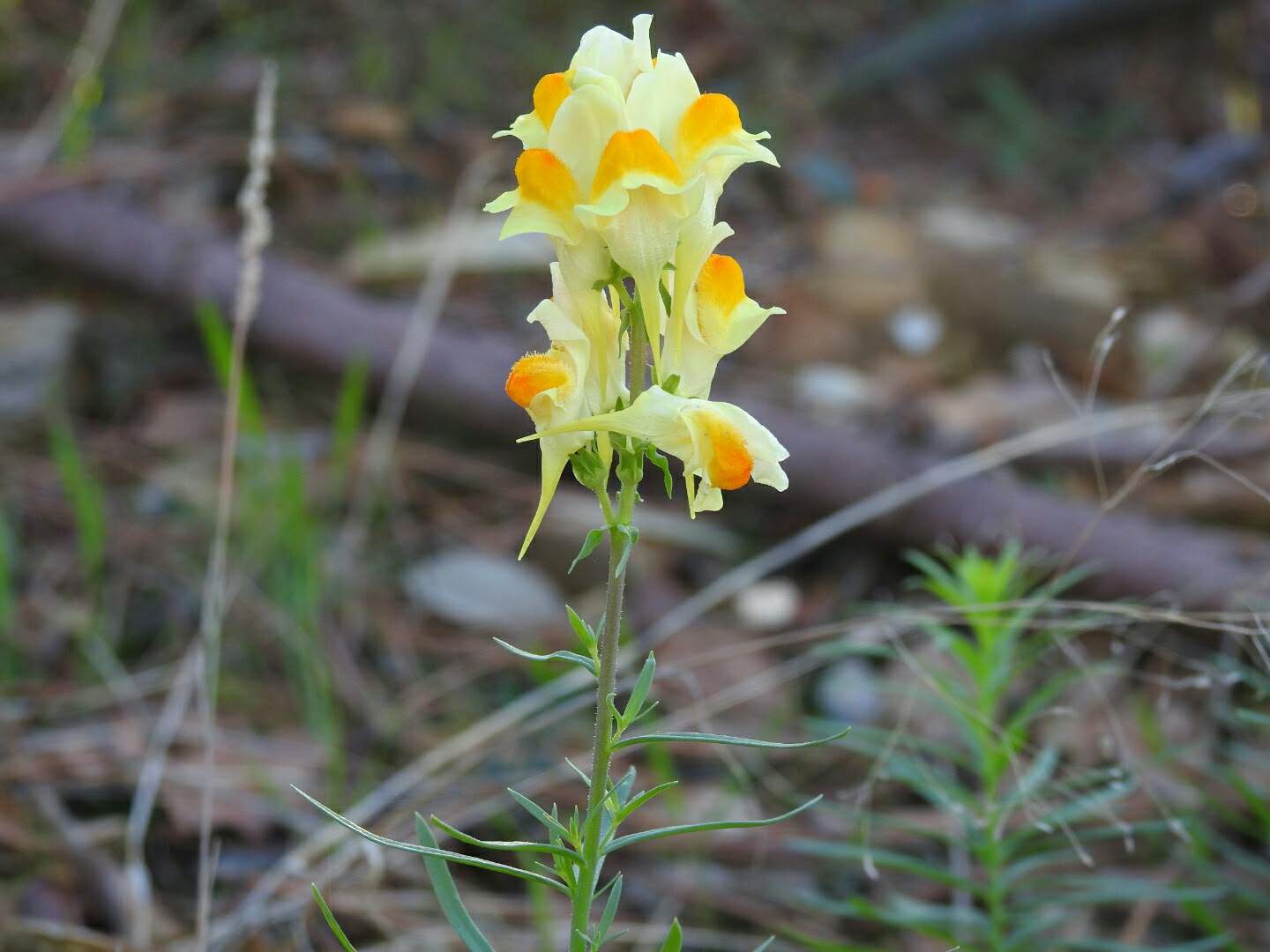
Perennial herbaceous plant that can reach a height between 30 and 90 cm, characterized by an erect habit with robust stems, simple or branched, sometimes ascending, generally glabrous but with the presence of glandular hairs especially in the inflorescences. The stems are branched and sometimes have a hairy surface in the upper part, giving the plant a slightly velvety appearance.
The leaves are alternate, sessile, linear or narrowly lanceolate in shape, with entire margins and acute apex. Leaf size usually varies from 1 to 6 cm in length and from 2 to 10 mm in width; the texture is herbaceous and the surface may appear slightly glaucous. The veins are generally uninerved, sometimes with two or three veins.
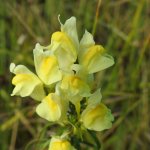
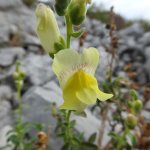
The inflorescences are racemose, dense and formed by numerous flowers arranged in terminal spike-like clusters. The flower peduncles are longer than the calyx, which is glabrous with lanceolate and acute lobes 2-3 mm long. The corolla is bilabiate, bright yellow with the lower lip often orange or with a darker area in the palate; it is 20 to 33 mm long, with a corolla tube about 10 mm wide at the opening. The characteristic spur is conical, slightly curved and about 9-13 mm long, yellow in color. The five petals are arranged zygomorphically, with the upper lip longer than the lower one. The bracts are linear, longer than the pedicel and bent backward.
The fruit is an ovoid capsule, generally 5-10 mm long, which opens releasing disc-shaped seeds, with winged margins and a warty surface at maturity. The root system is rhizomatous, with a main root developed from which secondary roots branch off, favoring the plant’s perennial nature and possible invasive capacity.
Habitat and distribution
Butter And Eggs is widespread throughout Italy, from the plains to the hilly and medium-altitude mountainous areas, and is also present in much of the Mediterranean area and continental Europe, extending to Western Asia. In Italy it is particularly common in central and northern regions, while in the South there is a form with larger and darker-colored flowers, sometimes indicated as a distinct variety or form.
It prefers anthropized or disturbed environments such as roadsides, railways, uncultivated areas, field margins and abandoned lands. It grows on generally well-drained soils, of various types but often calcareous or stony, with sunny or semi-shaded exposure. The species adapts well to poor and dry soil conditions, typical of Mediterranean areas.
Flowering period
Flowering extends from late spring to autumn, generally from June to October, with some geographical variations related to the local climate. In milder regions, such as some areas of the South and the islands, flowering can last until November or even December under particularly favorable conditions.
Ecology and pollination
Butter And Eggs is mainly pollinated by pollinating insects, particularly bees and bumblebees, attracted by the bright color and peculiar shape of the flowers, which facilitate pollination through contact with the reproductive organs during nectar collection present in the spur. The bilabiate corolla with orange palate and presence of hairs serves to guide pollinating insects.
Seed dispersal occurs through the capsule that opens at maturity, releasing seeds equipped with marginal wings that can be easily carried by the wind, favoring colonization of new habitats. The plant also has a rhizomatous root system that allows vegetative propagation and may contribute to its ability to become invasive in disturbed soils.
Curiosities and traditional uses
Butter And Eggs was used in the past in folk medicine for its alleged diuretic and purifying properties, thanks to the presence of active compounds in the leaves and flowers. It was employed to treat urinary disorders and as a mild laxative. However, medicinal use is not widespread today and requires more thorough scientific confirmation.
In some areas, the plant was also known for its ability to rapidly colonize disturbed soils, so much so that it was considered invasive, but at the same time it plays an important role in soil stabilization and erosion prevention.
The common name "linaiola" derives from the similarity of its leaves to those of flax (Linum), being thin and linear, while the scientific name "Linaria" historically refers to plants with characteristics similar to flax.
Etymology
The genus Linaria derives from the Latin linum, meaning "flax", indicating the similarity of the leaves of many species of this genus to those of common flax. The specific epithet vulgaris means "common" or "widespread", highlighting the frequency of the species in its natural range.
The Italian name "linaiola" precisely recalls this leaf similarity with flax and its widespread presence in Mediterranean territories.
Sources
- Prof. S. Pignatti, "Flora d'Italia"
- Tela Botanica / H. Coste, "Flore descriptive et illustrée de la France"
- World Flora Online (WFO)
Characteristics
Scheda botanica
| Famiglia | Plantaginaceae |
|---|---|
| Fioritura | giugno – ottobre |
| Forma biologica | Scapose |
| Habitat | with white flowers, with yellow flowers |
Domande frequenti
- Quando fiorisce Butter And Eggs?
- Butter And Eggs fiorisce giugno – ottobre.
- Che tipo di pianta è Butter And Eggs?
- Butter And Eggs è una Hemicryptophytes (Scapose) secondo la classificazione di Raunkiaer.
- A quale famiglia appartiene Butter And Eggs?
- Butter And Eggs appartiene alla famiglia botanica Plantaginaceae.
Where I found it (7 sightings)
Classification
- Kingdom
- Plantae
- Family
- Plantaginaceae
- Full name
- Linaria vulgaris Mill.
- Life form
- Hemicryptophytes scapose
Similar species
Search for species with similar characteristicsFurther reading
Noticed an error in the identification? Write to me
Other species of the same family
Plantaginaceae
Explore
Other species of Plantaginaceae