Botanical species
Veronica persica
Poir.
Common Field-Speedwell
Description
Morphological description
Annual herbaceous plant, generally with a prostrate or decumbent habit, but with the flowering part erect or scapose, reaching a variable height from 5 to 50-60 cm. The stems, thin and branched especially at the base, are pubescent, with multicellular hairs often denser along two lines. The root system is fasciculate, typical of annual species.
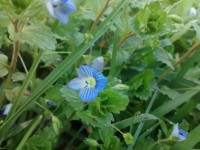
The leaves are simple, ovate or elliptical in shape, sometimes cuneate-lanceolate, with a strongly dentate or crenate margin. They are shortly petiolate and have a herbaceous texture with more or less evident pubescence. The basal leaves are arranged oppositely, while the cauline leaves are alternate. The size varies from 5 to 25 mm in length and 4-15 mm in width, with a base often truncate or slightly cuneate.
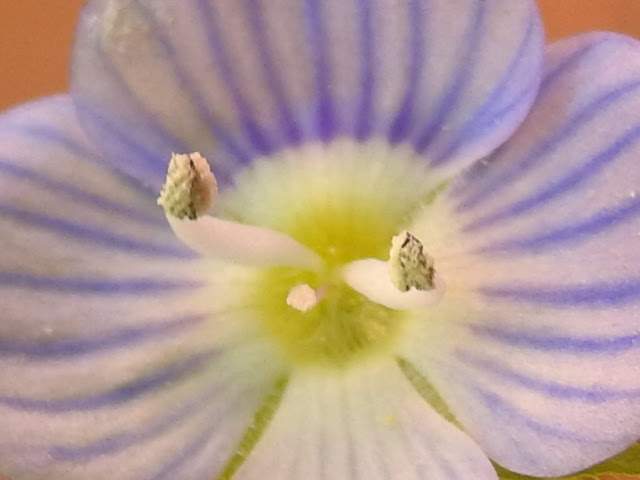
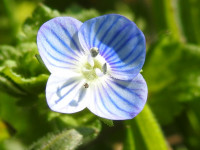
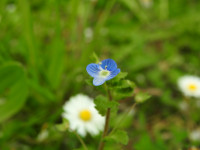
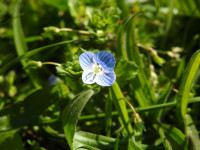
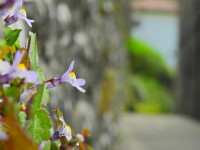
The flowers are solitary and axillary, borne on filiform peduncles, generally longer than the leaves (1-4 cm), which become arcuate or reflexed during the fruiting stage. The corolla, characteristic for its blue to bluish color with blue-violet shades, has a diameter of 8-12 mm and is rotate with ovate or orbicular petals. The calyx is composed of four slightly ciliate lanceolate lobes and is persistent. The corolla has a throat of yellowish color, often with darker veins that may resemble a stylized face.
The fruit is a laterally compressed capsule, obcordate (inverted heart-shaped) or reniform, 4-7 mm wide and 6-9 mm high, with two divergent lobes separated by a deep sinus. The capsule surface is pubescent, especially along the keel, and reticulated. The seeds are elliptical, brown-yellowish in color, with a transversely wrinkled surface and deeply concave on one side, about 1.5-2 mm long.
Habitat and distribution
The species is native to Persia, from which the specific epithet derives, but it has spread as a subcosmopolitan species almost worldwide. In Italy it is very common in all regions, where it grows particularly in anthropized areas. It is frequently found in cultivated fields (especially among cereals), vegetable gardens, pastures, uncultivated lands, roadsides, and gardens.
It prefers nitrophilous soils, well worked or disturbed, with full or partial sun exposure. The species adapts to different soil types, often with clayey or silty substrates, and is found from the plains up to about 1,800 meters in altitude, extending into lower hilly and mountainous environments.
In the Mediterranean basin it is mainly widespread in temperate and sub-Mediterranean areas, where it colonizes open and disturbed habitats.
Flowering period
The flowering of this species is extended and occurs from January to December, with a peak from March to October. In areas with mild or temperate climate the species flowers almost all year round, while in colder zones it may have a more marked winter dormancy period.
Ecology and pollination
The plant exhibits a reproductive strategy typical of scapose therophytes: it flowers with single flowers, solitary in the leaf axils, often on long peduncles that facilitate seed dispersal. The flowers are open and brightly colored, adapted for entomophilous pollination. They are visited by numerous pollinating insects, particularly small hymenopterans and dipterans, attracted by the blue color and the presence of nectar guides.
The corolla closes on cloudy or low-light days, a strategy to protect the reproductive organs. Seed dispersal occurs through the fall of mature capsules, which open releasing small, wrinkled seeds, facilitating dissemination also through accidental transport by animals or human activities.
Curiosities and traditional uses
Veronica persica has long been known as a medicinal plant. Traditionally it has been used for its tonic and expectorant properties. However, medicinal uses should be considered for informational purposes only and do not replace medical advice.
No widespread alimentary or food uses are reported, nor particular legends or folklore connected to the species in Italy, although the common name "veronica" recalls religious figures and symbolic traditions linked to the legend of the Christian Veronica.
Etymology
The genus name "Veronica" has uncertain origins. It probably derives from common European names dating back to the 16th century, with a possible association to the religious figure of Saint Veronica, who according to Christian tradition offered her veil to Jesus during the ascent to Calvary, on which his image was imprinted ("vera icon" = true image). This association is also linked to the flowering period of many species of the genus around Holy Week or to the dark veins of the flowers that may resemble a face.
The specific epithet "persica" indicates the original origin of the plant from Persia (modern Iran).
The Italian common name "veronica comune" derives from the widespread diffusion of the species, very frequent in cultivated areas and anthropized places, making it one of the most easily recognizable speedwells.
Sources
- Prof. P.V. Arrigoni, "Flora analitica della Toscana", "Flora dell'Isola di Sardegna"
- Acta Plantarum - Flora delle regioni italiane (sheet by Marinella Zepigi)
- Tela Botanica / H. Coste, "Flore descriptive et illustrée de la France"
- World Flora Online (WFO)
Characteristics
Scheda botanica
| Famiglia | Plantaginaceae |
|---|---|
| Fioritura | tutto l'anno |
| Forma biologica | Scapose |
| Habitat | with blue flowers, annual plant, with blue-purple flowers |
Domande frequenti
- Quando fiorisce Common Field-Speedwell?
- Common Field-Speedwell fiorisce tutto l'anno.
- Che tipo di pianta è Common Field-Speedwell?
- Common Field-Speedwell è una Therophytes (Scapose) secondo la classificazione di Raunkiaer.
- A quale famiglia appartiene Common Field-Speedwell?
- Common Field-Speedwell appartiene alla famiglia botanica Plantaginaceae.
Where I found it (6 sightings)
Classification
- Kingdom
- Plantae
- Family
- Plantaginaceae
- Full name
- Veronica persica Poir.
- Synonyms
- Pocilla persica (Poir.) Fourr.; Veronica buxbaumii Ten., non F.W.Schmidt, nom. illeg.
- Life form
- Therophytes scapose
Similar species
Search for species with similar characteristicsFurther reading
Noticed an error in the identification? Write to me
Other species of the same family
Plantaginaceae
Explore
Other species of Plantaginaceae