Botanical species
Globularia cordifolia
L.
Heart-leaved Globe-daisy
Description
Morphological description
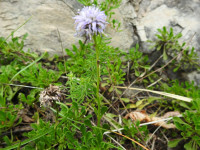
Small perennial plant, 3 to 10 cm tall, with a creeping habit and lignified stem. The stems can extend for several decimeters, are glabrous, angular, often leafless (aphyllous) or with one or two lanceolate leaflets along the axis. In some parts of the stem, tufts of roots form, anchoring the plant to the substrate.
The leaves are arranged in a basal rosette, coriaceous and spatulate in shape; the blade is 4 to 7 mm wide and 10 to 20 mm long, with a toothed margin and generally mucronate, bilobed or with three small teeth apex. The leaf gradually narrows into a petiole 2-4 cm long, which connects it to the stem. In some descriptions, the leaf shape is indicated as obovate, with a rounded margin or with a characteristic inverted heart shape (cordate).
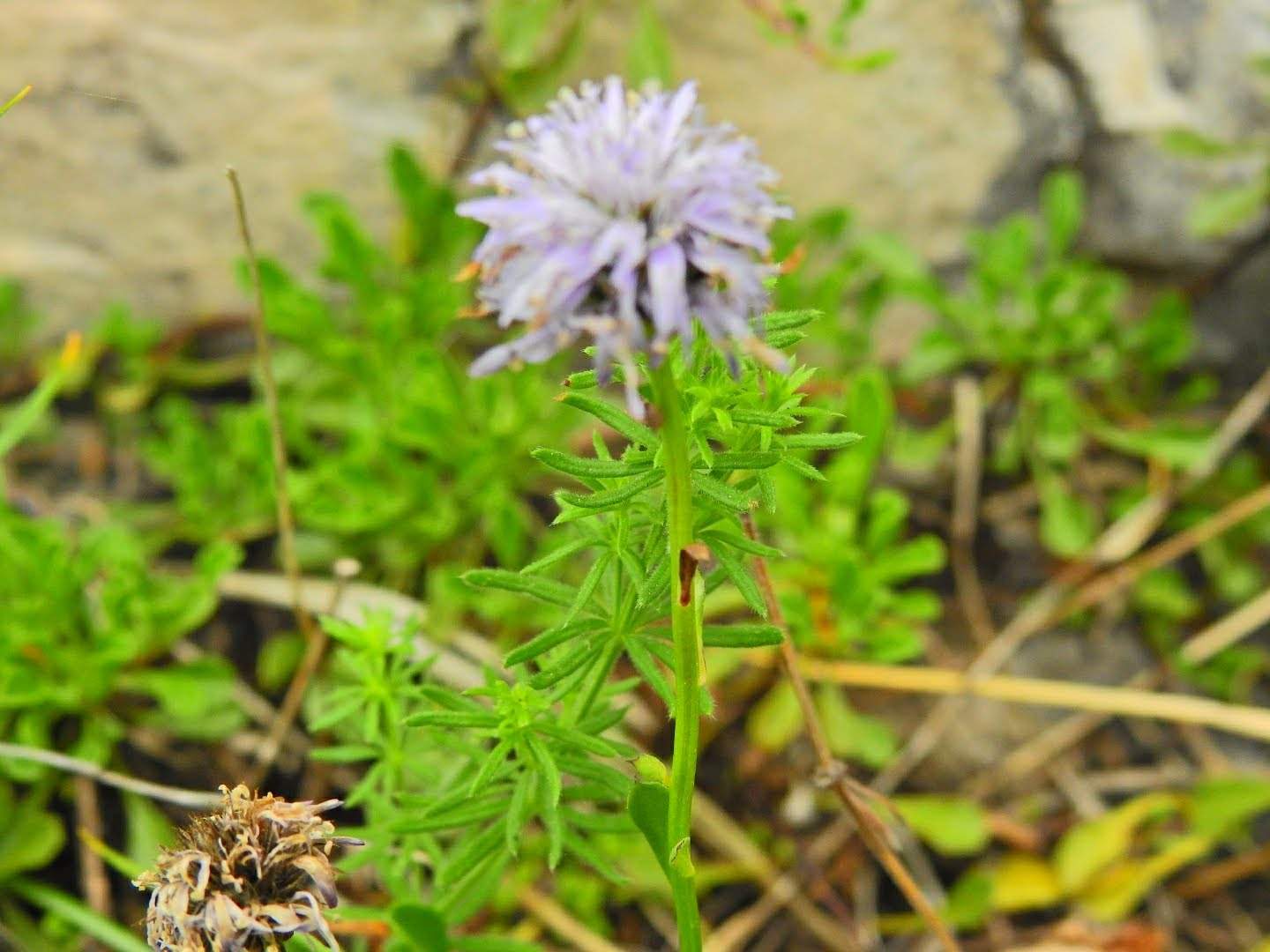
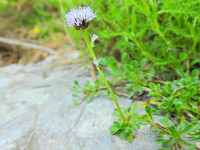
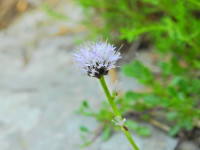
The flowering scapes are erect, up to 10 cm long, leafless or with at most two lanceolate leaflets. At the apex develops the hemispherical capitulum, 1.5-2 cm in diameter, composed of numerous flowers. The bracts surrounding the capitulum are lanceolate, about 3.5-4.5 mm long and 1.2-1.5 mm wide, dark-colored and covered with fine pubescence; in some Apennine populations they have conspicuous white cilia along the margin.
The flowers vary in color from violet to lilac and blue, with a corolla 6-11 mm long, funnel-shaped with two lips; the lower lip is divided into three linear lobes and is longer than the upper one. The calyx has a tube covered with rounded hairs, with teeth that do not exceed the length of the tube itself.
The fruits are monosperm capsules, about 2 mm long, containing a single seed.
Habitat and distribution
This species is typical of mountainous environments, particularly montane and alpine zones. It grows mainly on calcareous substrates, preferring rock crevices and calcareous debris. Its typical altitude ranges from about 1000 to 2500 meters, with documented presence especially in the Alps, from the Julian Alps to the Maritime Alps, and the Prealps.
In Italy it is also present in the northern Apennines, with confirmed populations in the Apuan Alps; the southernmost Apennine populations are sometimes attributed to related species, but those checked in the Forca Canapine and Terminillo mountains fall within this species without taxonomic differences.
The species is calcicolous and prefers sunny exposures typical of rocky slopes and mountain screes.
Flowering period
Flowering occurs between April and June, with possible variation depending on altitude and latitude. In the higher alpine zones, flowering is concentrated between May and June, while in the Prealps and lower areas it can start as early as April.
Ecology and pollination
The flowers, blue-violet in color, are adapted to attract pollinating insects, presumably hymenopterans and other small pollinating insects. The globose capitulum structure aggregates numerous flowers, facilitating visits by insects and thus cross-fertilization.
The plant reproduces by seed produced by the monosperm capsule, which is probably dispersed barochorously (falling near the mother plant) or possibly through transport by animals or runoff waters, although precise data on dispersal are lacking.
Curiosities and traditional uses
No traditional medicinal or food uses are known for this species, nor particular references in local folklore. Its presence is mainly significant in a naturalistic context as a typical species of alpine and prealpine rocky environments.
Etymology
The scientific name of the genus, Globularia, derives from the Latin globulus, meaning “small sphere,” referring to the globose shape of the flower head. The specific epithet cordifolia refers to the “heart-shaped” form (from Latin cordis = heart) of the leaves, which often have rounded or sometimes cordate margins.
The Italian common name “Heart-leaved Globe-daisy” precisely recalls this characteristic of the leaves, highlighting their particular shape and the delicacy of the plant, which appears small and creeping like a silent “widow” of the mountains.
Sources
- Prof. S. Pignatti, "Flora d'Italia"
- World Flora Online (WFO)
Characteristics
Classification
- Kingdom
- Plantae
- Family
- Plantaginaceae
- Full name
- Globularia cordifolia L.
- Life form
- Camefite reptanti
Similar species
Search for species with similar characteristicsNoticed an error in the identification? Write to me
Other species of the same family
Plantaginaceae
Explore
Other species of Plantaginaceae