Botanical species
Trifolium repens
L.
White Clover
Description
Morphological description
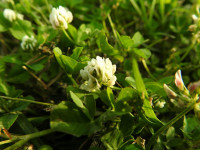
Perennial herbaceous plant, with a creeping and ground-covering habit, generally 10 to 30 cm tall. The stem is horizontal, stoloniferous and rooting at the nodes, allowing rapid expansion on the ground. The rhizomes are highly branched and glabrescent, with erect scapes bearing the flowers at the apex, 5 to 20 cm long.
The leaves are trifoliate, with petioles 4 to 12 cm long (in some cultivated varieties even longer, up to 60 cm). The leaflets are obovate to subovate in shape, 12 to 25 mm wide and up to 35 mm long, with finely toothed or serrated margins. The upper surface of the leaflets is green, often characterized by a light transverse or marbled white spot, making the plant easily recognizable. The stipules are large, membranous, toothed and abruptly ending with a thin point (subulate).
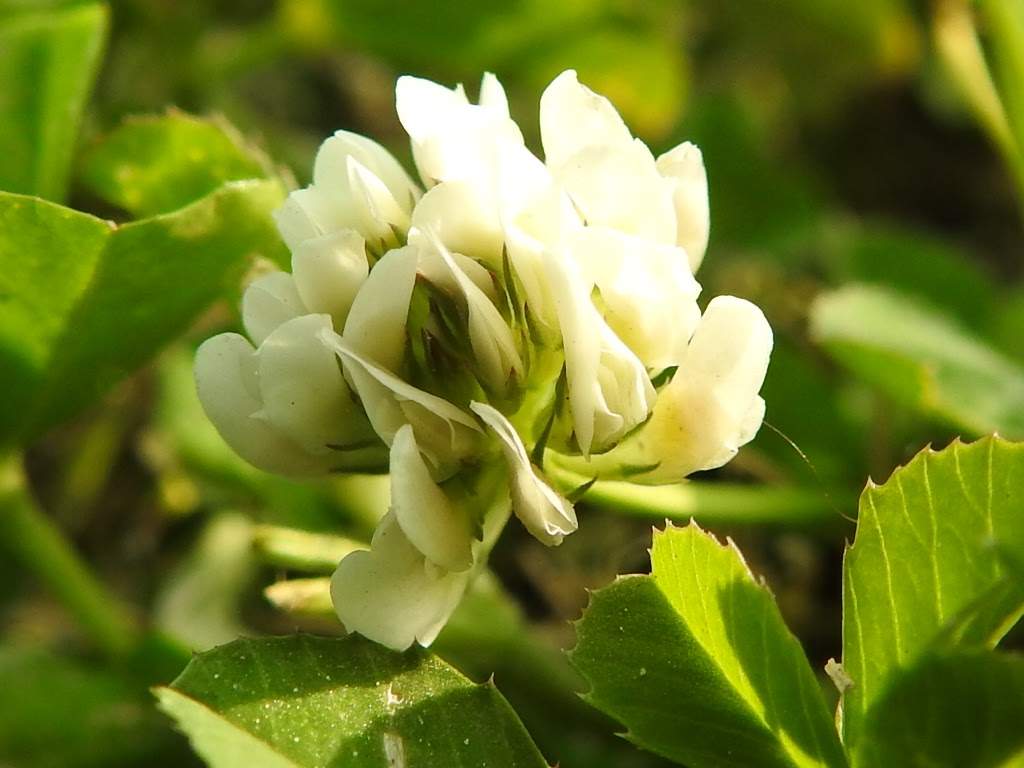
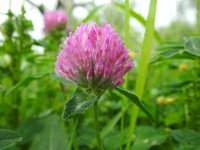
The flowers, grouped in solitary globose heads 15-20 mm in diameter, are white or slightly pinkish, composed of 40-80 papilionaceous flowers. Each flower is 8-11 mm long, with a corolla enclosing 10 stamens, 9 of which are fused together. The calyx is campanulate, glabrous, with unequal teeth, two upper ones longer and pointed, as long as the calyx tube (about 4-5 mm). After flowering, the flowers become pendulous, brownish and reflexed downward.
The fruit is a linear-oblong legume, compressed between the seeds, 4-5 mm long, containing 2-4 seeds of ovoid or reniform shape, about 1 mm. The seeds can vary in color from yellow, orange to red.
The plant adapts to various environments, with forms ranging from the spontaneous mountain ecotype, smaller and adapted to harsher conditions, to cultivated varieties selected for livestock, such as Trifoglio lodigiano, characterized by larger stem, leaves and flowers.
Habitat and distribution
Species widely distributed in Italy and the Mediterranean area, it grows spontaneously in meadows, pastures, forest edges and road margins. It is present from the plains up to subalpine mountain altitudes, with records up to about 2,750 m. It prefers fresh, well-drained but also moist soils, often siliceous or alluvial, with exposure ranging from full sun to partially shaded areas.
In Italy it is common especially in northern and central regions, where intensive forage cultivation is also found in the Lombard marshes and in the plains of the Po Valley. In mountain environments it appears in reduced forms adapted to harsher conditions.
The species has a wide global distribution, being native to Europe but naturalized in many other parts of the world, where it is cultivated as forage.
Flowering period
Flowering extends from April to July in most Italian regions. In some Mediterranean and temperate areas it can last until October or December, especially in crops or under favorable climatic conditions. After flowering the flowers become pendulous and take on brownish colors.
Ecology and pollination
White Clover is an entomogamous plant, mainly pollinated by bees and other pollinating insects attracted by the rich production of nectar and pollen. The flowers, with their papilionaceous corolla, are well adapted for pollination by insects with relatively long tongues, such as Italian bees, which can reach the nectar even in deep corollas.
The plant reproduces both sexually through seeds and vegetatively through rooting stolons. The seeds, contained in the legumes, fall to the ground or are dispersed in a limited way in the surrounding environment. The ability to root at the nodes of creeping stems allows rapid colonization of the soil.
Curiosities and traditional uses
This species is one of the most important forage herbs, used in agriculture for grazing and for the production of high-quality green forage, thanks to its rapid growth and ability to enrich the soil with nitrogen due to symbiosis with nitrogen-fixing bacteria in the roots.
In ethnobotany, it is known for its medicinal properties: it has traditionally been used as an antirheumatic, depurative, tonic and ophthalmic. It is used to relieve digestive disorders, persistent diarrhea, respiratory tract inflammations and rheumatism. For external use it is considered antiseptic.
The flowers are edible and can be used in cooking, for example in omelets or to prepare a beverage called “sangrilla,” obtained by macerating flowers and tender leaves in wine with citrus and sugar. In the past, during famines, dried flower heads were ground to supplement flour.
For beekeeping, White Clover represents an important source of nectar and pollen, contributing to the production of high-quality honey, especially in areas where cultivation is still widespread.
Etymology
The genus name “Trifolium” derives from Latin “tri” (three) and “folium” (leaf), referring to the characteristic trifoliate leaf. The specific epithet “repens” means “creeping,” describing the habit of the stem that develops horizontally rooting at the nodes.
The Italian common name “trifoglio strisciante” emphasizes precisely this characteristic ground-covering growth of the plant.
Sources
- Prof. S. Pignatti, "Flora d'Italia"
- Acta Plantarum - Flora delle regioni italiane (scheda di Marinella Zepigi)
- Tela Botanica / H. Coste, "Flore descriptive et illustrée de la France"
- World Flora Online (WFO)
Characteristics
Scheda botanica
| Famiglia | Fabaceae |
|---|---|
| Fioritura | aprile – luglio |
| Forma biologica | Creeping plants |
| Habitat | with white flowers, creeping plant, Perennial plant |
Domande frequenti
- Quando fiorisce White Clover?
- White Clover fiorisce aprile – luglio.
- Che tipo di pianta è White Clover?
- White Clover è una Hemicryptophytes (Creeping plants) secondo la classificazione di Raunkiaer.
- A quale famiglia appartiene White Clover?
- White Clover appartiene alla famiglia botanica Fabaceae.
Where I found it (2 sightings)
Classification
- Kingdom
- Plantae
- Family
- Fabaceae
- Full name
- Trifolium repens L.
- Synonyms
- Trifolium prostratum Biasol., nom. illeg.; Trifolium repens L. subsp. prostratum Nyman
- Life form
- Hemicryptophytes creeping plants
Similar species
Search for species with similar characteristicsFurther reading
Noticed an error in the identification? Write to me
Other species of the same family
Fabaceae
Explore
Other species of Fabaceae