Botanical species
Lotus corniculatus
L.
Common Bird's-Foot-Trefoil
Description
Morphological description
Perennial herbaceous plant belonging to the Fabaceae family, it has a variable habit, from prostrate to ascending or erect, with lignified stems at the base and thin, striated, often angular herbaceous branches. The height can reach up to 80 cm. The stems are generally sparsely branched, sometimes glabrous or with modest pubescence that tends to increase under arid conditions.
The leaves are imparipinnate, consisting of five segments: the two lower ones, actually stipules, are triangular to subrounded in shape and measure about 4-13 mm; the three apical ones, lanceolate or ovate-lanceolate, 9-15 mm long, have a rounded or slightly mucronate apex and a narrower wedge-shaped base. The leaf surface can be glabrous or slightly hairy, with more evident hairs especially on the margins and veins in drier environments.
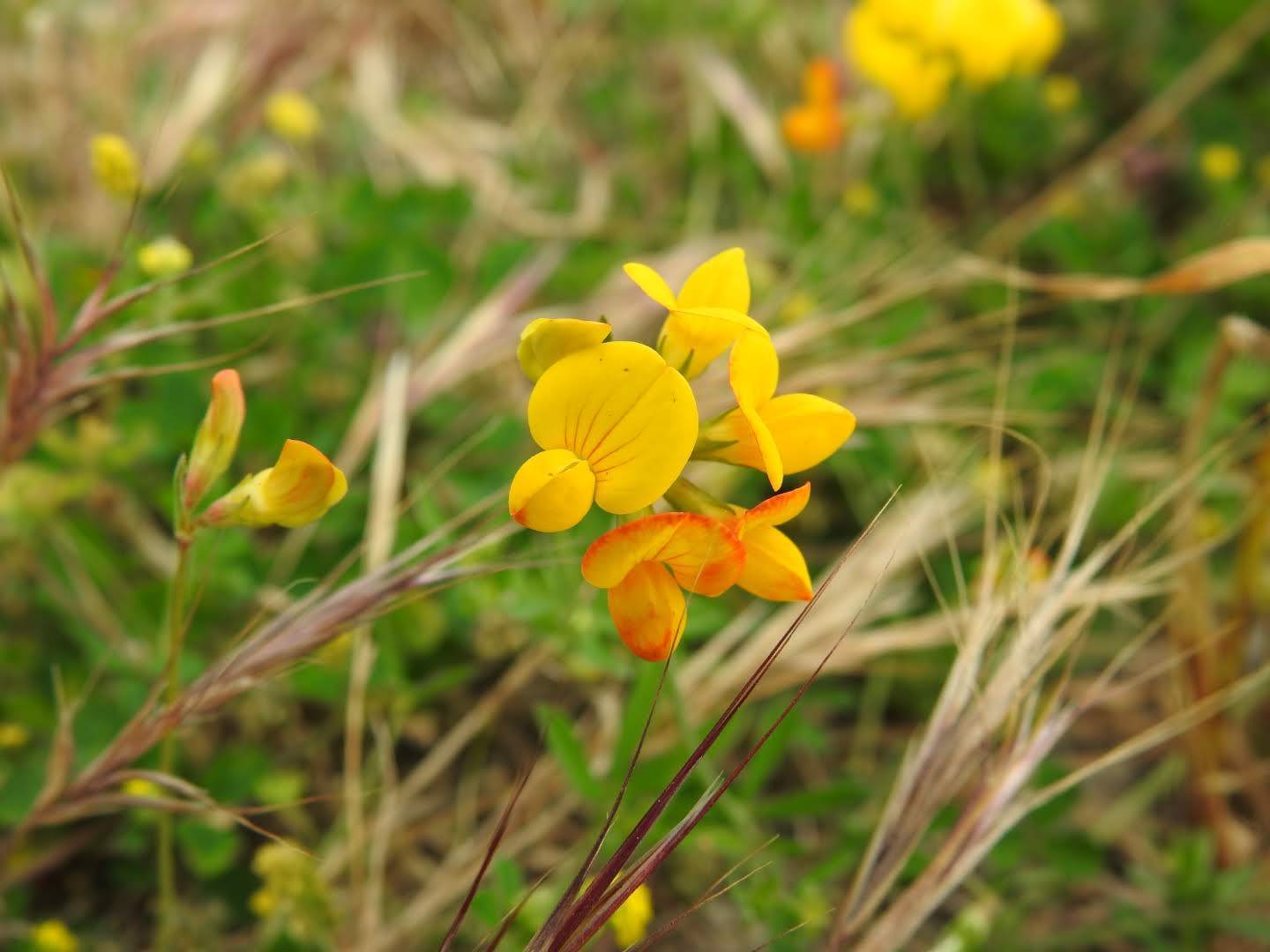
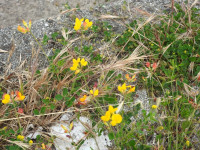
The inflorescence consists of axillary or terminal umbels, with a variable number of flowers, usually from 2 to 8, but sometimes up to 15. The flowers are borne on peduncles 4-8 cm long and pedicels shorter than the calyx. The corolla, typically papilionaceous, is bright yellow or orange, often speckled or veined with red; the standard petal is distinguished by the blade folded upwards forming an angle of about 90°, while the lateral petals are free and the lower ones, united to form the keel, end in a beak pointing upwards. The calyx is 5-7 mm long, with more or less equal teeth, often villous.
The fruit is a cylindrical, narrow and elongated legume (2-3.5 cm long by about 2 mm in diameter), characterized by a “corniculate” shape (with small horns) due to the pointed and thin tip. The legume is dehiscent, opening at maturity to release numerous oval, shiny seeds, with color varying from green to brown with blackish spots.
The root system is taprooted, with a rhizome enriched by tubercles, which contributes to the plant’s ability to survive in variable soil and climate conditions.
Habitat and distribution
Cosmopolitan species, very common throughout the Italian territory and also widespread in the Mediterranean area, the Common Bird's-Foot-Trefoil grows in a wide altitudinal range, from 0 up to about 2700 m a.s.l., adapting to different environments. It prefers anthropized and open habitats such as meadows, dry pastures, grassy wastelands and cultivated fields, especially on well-drained and sunny soils. It is frequent in mountain, hilly and subalpine habitats, showing excellent tolerance to drought, cold and even saline soils. It is often present in fertilized meadows and arable land, where it also acts as a forage plant and soil improver thanks to atmospheric nitrogen fixation.
Flowering period
Flowering extends from spring to early autumn, generally from March to September (3-9), with possible variations depending on altitude and latitude. In more mountainous or cooler areas, flowering may be shorter and concentrated in the summer months.
Ecology and pollination
The Common Bird's-Foot-Trefoil is an entomogamous species, mainly pollinated by pollinating insects such as bees and bumblebees, attracted by the bright yellow-orange color of the flowers and the presence of nectar. The papilionaceous structure of the flowers favors an efficient pollination mechanism, with diadelphous stamens and a beaked keel that facilitates contact with pollinating insects.
Seed dispersal occurs through the dehiscence of the legumes, which open releasing the seeds into the surrounding soil; the pointed shape of the pods (hence the name “corniculatus”) can also facilitate partial mechanical or animal transport.
Curiosities and traditional uses
The Common Bird's-Foot-Trefoil is a medicinal plant with antispasmodic, sedative, astringent, antiseptic and emollient properties. It contains flavonoid and phenolic glycosides, cyanogenic compounds and hydrocyanic acid. Traditionally it has been used in phytotherapy for disorders such as insomnia, dysmenorrhea and bronchitis and is employed as a cardiac tonic.
From an agricultural point of view, it is a forage species of great value, appreciated for its low cultivation requirements and good tolerance to difficult climatic and soil conditions. It does not cause bloating problems in animals and is used both for direct grazing and for hay production. Thanks to its ability to fix nitrogen, it is also used for soil improvement and erosion control.
Historically it has been cultivated since the 18th century also for the extraction of a yellow dye. It is believed that the naturalist Georges-Louis Leclerc, Comte de Buffon, studied the properties of the Common Bird's-Foot-Trefoil following observations on its nervine action, after a mistaken use in place of Melilotus.
It is also considered a decent melliferous plant, useful for honey production.
Etymology
The generic name "Lotus" derives from ancient Greek and indicated various valuable forage plants. The specific epithet "corniculatus" means “with small horns”, referring to the typical pointed shape of the legumes.
The Italian common name "Ginestrino" probably derives from the resemblance of the yellow flowers to those of the broom, although they belong to different genera.
Sources
- Prof. S. Pignatti, "Flora d'Italia"
- Acta Plantarum - Flora delle regioni italiane (scheda di Marinella Zepigi)
- World Flora Online (WFO)
Characteristics
Scheda botanica
| Famiglia | Fabaceae |
|---|---|
| Fioritura | marzo – settembre |
| Forma biologica | Scapose |
| Habitat | with yellow flowers, with red flowers, Perennial plant |
Domande frequenti
- Quando fiorisce Common Bird's-Foot-Trefoil?
- Common Bird's-Foot-Trefoil fiorisce marzo – settembre.
- Che tipo di pianta è Common Bird's-Foot-Trefoil?
- Common Bird's-Foot-Trefoil è una Hemicryptophytes (Scapose) secondo la classificazione di Raunkiaer.
- A quale famiglia appartiene Common Bird's-Foot-Trefoil?
- Common Bird's-Foot-Trefoil appartiene alla famiglia botanica Fabaceae.
Where I found it (8 sightings)
Classification
- Kingdom
- Plantae
- Family
- Fabaceae
- Full name
- Lotus corniculatus L.
- Life form
- Hemicryptophytes scapose
Similar species
Search for species with similar characteristicsFurther reading
Noticed an error in the identification? Write to me
Other species of the same family
Fabaceae
Explore
Other species of Fabaceae