Botanical species
Trigonella alba
(Medik.) Coulot & Rabaute
Trigonella bianca, Meliloto bianco
Description
Morphological description
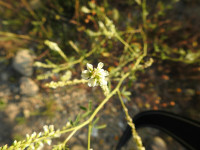
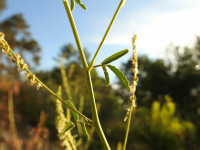
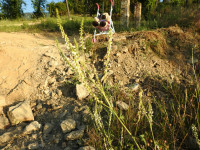
Annual or biennial herbaceous plant belonging to the Fabaceae family, characterized by a scapose habit with erect and highly branched stems, reaching a height between 50 and 120 cm. The stems are glabrous, angular, with a smooth surface and without pubescence, often emitting a characteristic coumarin odor.
The leaves are trifoliate, with lanceolate leaflets of oblong-lanceolate shape, of variable size, equipped with finely serrated or toothed margins, sometimes crenate-toothed. The leaflets are petiolated, and the stipules are thin, similar to fishbones (lesiniform or setaceous). The leaf arrangement is imparipinnate.
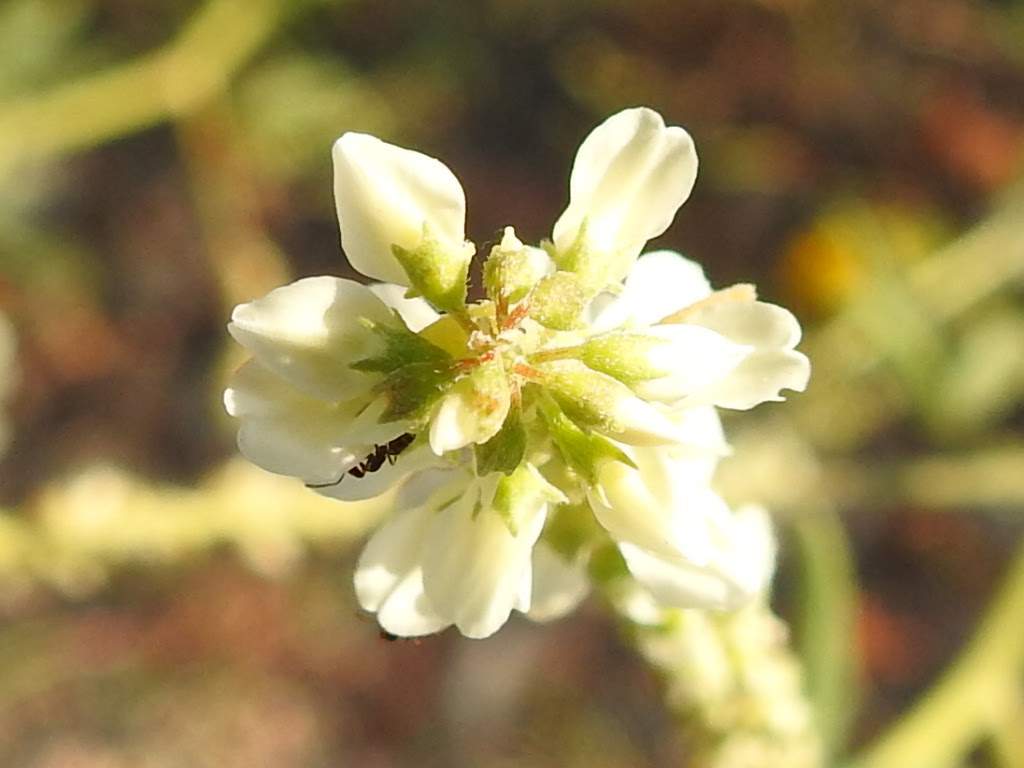
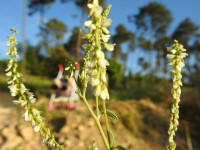
The inflorescence consists of very elongated and dense axillary racemes, bearing numerous small flowers of cream-white color, sometimes with yellow-greenish shades. The flowers are odorless and have a scapose habit, with shortly aristate peduncles and pedicels reaching the length of the calyx. The flower has a standard (vexillum) longer than the wings and the keel, which are equal in length to each other.
The fruits are ovoid legumes, pendulous, glabrous, about 4 mm long and black at maturity. The surface of the legumes shows a reticulate and grooved venation, with an upper edge not keeled and an apex obtuse or slightly pointed with a small mucro. Inside there are one to two ovoid seeds, smooth and slightly concave.
The root system is not described in detail in the sources, but as typical of Fabaceae, it is presumably well developed and capable of fixing atmospheric nitrogen thanks to symbiosis with rhizobial bacteria.
Habitat and distribution
Species with a subcosmopolitan distribution, widespread in Europe, Western and Northern Asia up to China, it grows in Italy and throughout the Mediterranean basin, preferring humid and ruderal environments.
It is commonly found along the banks of watercourses, at the edges of fields, meadows, wastelands and paths, on sandy or clay soils, often in semi-shaded or sunny positions. The species adapts well to fresh and moderately moist soils, not particularly demanding in terms of pH.
The altitude range varies from 0 up to about 1200 m a.s.l., frequently reported in plains and hilly areas. The typical environment is therefore aquatic or semi-aquatic, or otherwise characterized by good water availability.
Flowering period
Flowering extends from July to September (sometimes June-September), with some variability linked to latitude and local climatic conditions. In more temperate climates and Mediterranean areas, the peak flowering period coincides with summer, when temperatures are high and humidity still sufficient.
Ecology and pollination
Trigonella alba is a melliferous plant of interest for pollinating insects. The small white flowers, gathered in dense and elongated racemes, mainly attract bees and other hymenopterans that act as pollinators. The flower structure, with a prominent standard, favors insect visits that facilitate cross-fertilization.
Seed dispersal occurs through the release of mature legumes, which detach and can be transported by water or contact with soil and animals. Being annual or biennial, the plant relies on seed production for population regeneration.
Curiosities and traditional uses
The species is known for its content of coumarinic glucosides, essential oil, starch, nitrogen, resins and saponins, which confer traditional medicinal properties. In herbal medicine it has been used for its resolutive, antiseptic, emollient, sedative and antispasmodic properties.
The infusion of Trigonella alba, with a pleasant taste, has traditionally been used to promote sleep in children and nervous people, administered shortly before bedtime. Historically it has also been used as an eye wash, thanks to its soothing properties.
References to the use of the plant as fodder are not lacking, occasionally cultivated for this purpose. It is also considered a good source of nectar and pollen for bees, thus contributing to honey production.
It should be noted, however, that the medicinal and food use of the plant must be carried out with caution and under expert supervision, as some active principles can be toxic if improperly used.
Etymology
The genus name derives from the Greek τρίγωνος (trígonos), meaning “triangular”, referring to the shape of the leaves composed of three leaflets. The specific epithet “alba” is Latin and refers to the white color of the flowers, which distinguishes this species from related ones, such as Trigonella officinalis, which has yellow flowers.
The Italian common name “trigonella bianca” directly reflects these morphological characteristics, while “melilot white” reflects the old taxonomic classification in the genus Melilotus and the flower color.
Sources
- Acta Plantarum - Flora delle regioni italiane (scheda di Marinella Zepigi)
- Tela Botanica / H. Coste, "Flore descriptive et illustrée de la France"
Characteristics
Scheda botanica
| Famiglia | Fabaceae |
|---|---|
| Fioritura | luglio – settembre |
| Forma biologica | Scapose |
| Habitat | with white flowers, plant with a scapose habit |
Domande frequenti
- Quando fiorisce Trigonella bianca, Meliloto bianco?
- Trigonella bianca, Meliloto bianco fiorisce luglio – settembre.
- Che tipo di pianta è Trigonella bianca, Meliloto bianco?
- Trigonella bianca, Meliloto bianco è una Therophytes (Scapose) secondo la classificazione di Raunkiaer.
- A quale famiglia appartiene Trigonella bianca, Meliloto bianco?
- Trigonella bianca, Meliloto bianco appartiene alla famiglia botanica Fabaceae.
Where I found it (5 sightings)
Classification
- Kingdom
- Plantae
- Family
- Fabaceae
- Full name
- Trigonella alba (Medik.) Coulot & Rabaute
- Synonyms
- Melilotus albus Medik.
- Life form
- Therophytes scapose
Similar species
Search for species with similar characteristicsFurther reading
Noticed an error in the identification? Write to me
Other species of the same family
Fabaceae
Explore
Other species of Fabaceae