Botanical species
Bellis sylvestris
Cirillo
Garden Daisy
Description
Morphological description
Perennial herbaceous plant, Garden Daisy presents an erect habit and a height generally ranging between 10 and 30 centimeters. The stem is simple, leafless (without leaves along the stem), thickened and covered by a light pubescence that gives it a velvety appearance.
The leaves are all gathered in a compact basal rosette. They have an oblanceolate shape, with a blade up to 3 centimeters wide and up to 8 centimeters long, herbaceous in texture and pubescent on the surface. The leaf margin is finely dentate or crenate-dentate, and the blade shows 3 to 5 very evident prominent veins, gradually narrowing into a winged petiole 2-4 centimeters long.
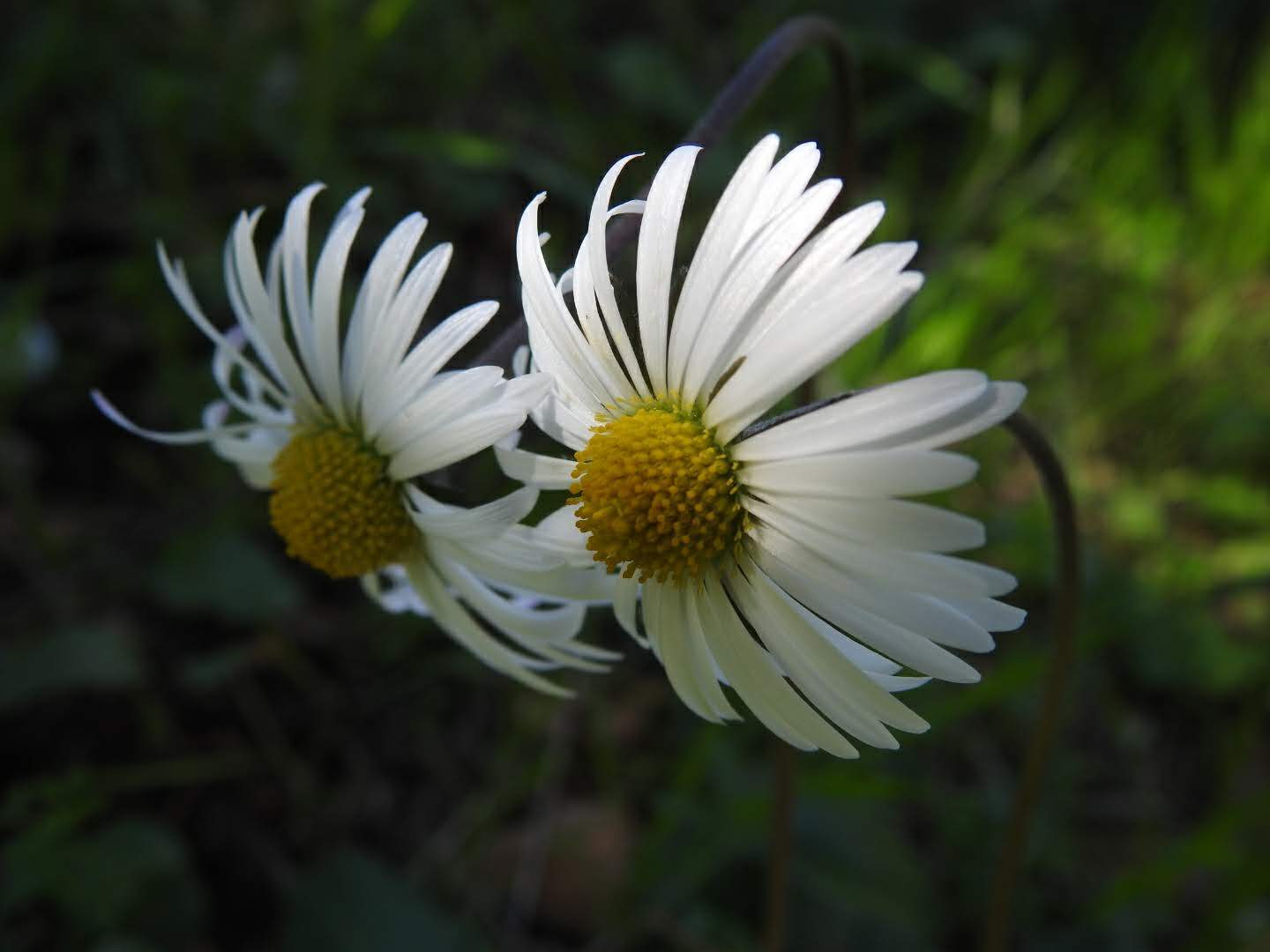
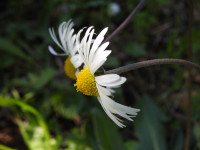
The flowers are gathered in a single capitulum 3-4 centimeters in diameter, supported by acute scales 7-10 millimeters long. The capitulum is composed of two types of flowers: ligulate flowers, 12 to 15 millimeters long, white in color often tending to shade to pink or reddish, and tubular flowers, yellow or slightly reddish. The corolla is actinomorphic and the ligulate flowers are numerous, giving the typical daisy-like appearance.
The fruit is an achene about 2 millimeters long, compressed and covered by fine hairs (hirsute), sometimes equipped with short bristles. The root system, as typical of hemicryptophyte rosulate species, is concentrated at the base, with buds located at ground level that allow perenniality.
Habitat and distribution
Garden Daisy is a typically Mediterranean species, with a range extending along the coasts of the Mediterranean, known as the “Olive area”. In Italy it is present from the plains up to about 1400 meters altitude, where it prefers open or semi-shaded habitats such as sparse woods, uncultivated lands, pastures, olive groves and road margins.
It grows on well-drained soils, often calcareous or loose, with generally sunny or partially shaded exposure. Its presence is more common in regions with temperate-Mediterranean climate, where flowering mainly occurs in autumn, but can also extend into winter or spring depending on local conditions and altitude.
Flowering period
Flowering is concentrated mainly between September and June, with an autumnal and winter peak. In mountainous areas or at higher altitudes, flowering may be delayed until spring and extend until June. This temporal extension makes Garden Daisy an almost “perennial” flowering species in some environmental conditions, similar to the common Bellis perennis.
Ecology and pollination
The flowers of Garden Daisy attract various pollinating insects, including bees and other generalist pollinators, attracted by the white ligulate flowers and the yellow tubular ones, which offer both nectar and pollen. The actinomorphic symmetry and the presence of numerous ligulate flowers facilitate insect visits.
The reproductive strategy involves the formation of achenes provided with hairs which, although not equipped with special appendages for long-distance transport, facilitate local dispersal by wind or adhesion to animals. Hybrids between Bellis sylvestris and other species of the genus, such as Bellis annua, are also known, demonstrating some genetic fluidity and possibilities of crosses in nature.
Curiosities and traditional uses
Garden Daisy, although less common than Bellis perennis, is an edible and medicinal plant. Historically it has been used for its medicinal properties, similar to those of the common daisy. Internal use of the aerial parts (flowers and leaves, excluding roots) is linked to mild laxative properties, but especially to diuretic effects, stimulating sweating and depurative actions.
Externally, astringent and anti-inflammatory applications are exploited in cosmetics to refresh the skin, lighten the epidermis and decongest the face, especially around the eyes. The tender leaves can be added raw to salads, giving a fresh and pleasant flavor.
It is interesting to note that this species is included in the list of medicinal plants of the Cistercian friar Domenico Palombi, highlighting a traditional use rooted in Italian herbal culture.
Etymology
The genus name, probably derived from the popular Latin “bèllus”, means “pretty” or “beautiful”, recalling the delicate and pleasant appearance of the flowers. The specific name “sylvestris” indicates an origin or woodland habitat, “silvestre”, emphasizing the species’ tendency to grow in natural and semi-natural environments, often at the edges of woods or in ruderal areas.
The Italian common name “Garden Daisy” refers both to the appearance similar to the common daisy (Bellis perennis) and to its particular flowering which is concentrated mainly in the autumn months, thus distinguishing it from the more familiar spring daisy.
Sources
- Acta Plantarum - Flora delle regioni italiane (actaplantarum.org)
- Acta Plantarum - Flora delle regioni italiane (scheda di Daniela Longo)
Characteristics
Where I found it (7 sightings)
Classification
- Kingdom
- Plantae
- Family
- Asteraceae
- Full name
- Bellis sylvestris Cirillo
- Synonyms
- Bellis perennis L. subsp. sylvestris (Cirillo) Rouy
- Life form
- Emicriptofite rosulate
Similar species
Search for species with similar characteristicsFurther reading
Noticed an error in the identification? Write to me
Other species of the same family
Asteraceae
Explore
Other species of Asteraceae