Botanical species
Urospermum picroides
(L.) Scop. ex F.W.Schmidt
False Hawkbit
Description
Morphological description
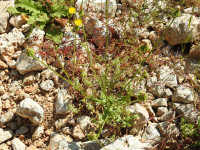
Annual herbaceous plant, the False Hawkbit can reach a height of up to 60-120 cm. It has an erect stem, often branched and corymbose, with a rough and hairy surface due to the presence of long simple and bristly hairs. The stem is hollow inside and may contain a milky latex.
The leaves are arranged in a basal rosette and along the stem; the lower ones are spatulate, obovate-oblong in shape, with a toothed or crenate-toothed margin, glossy green in color, 5 to 15 cm long and up to 5 cm wide, with a widened base and semi-clasping or with a winged petiole. The upper leaves are progressively smaller, alternate, with variable shapes from almost entire to pinnatifid or irregularly divided, often acute and auriculate, always rough and bristly especially along the veins.
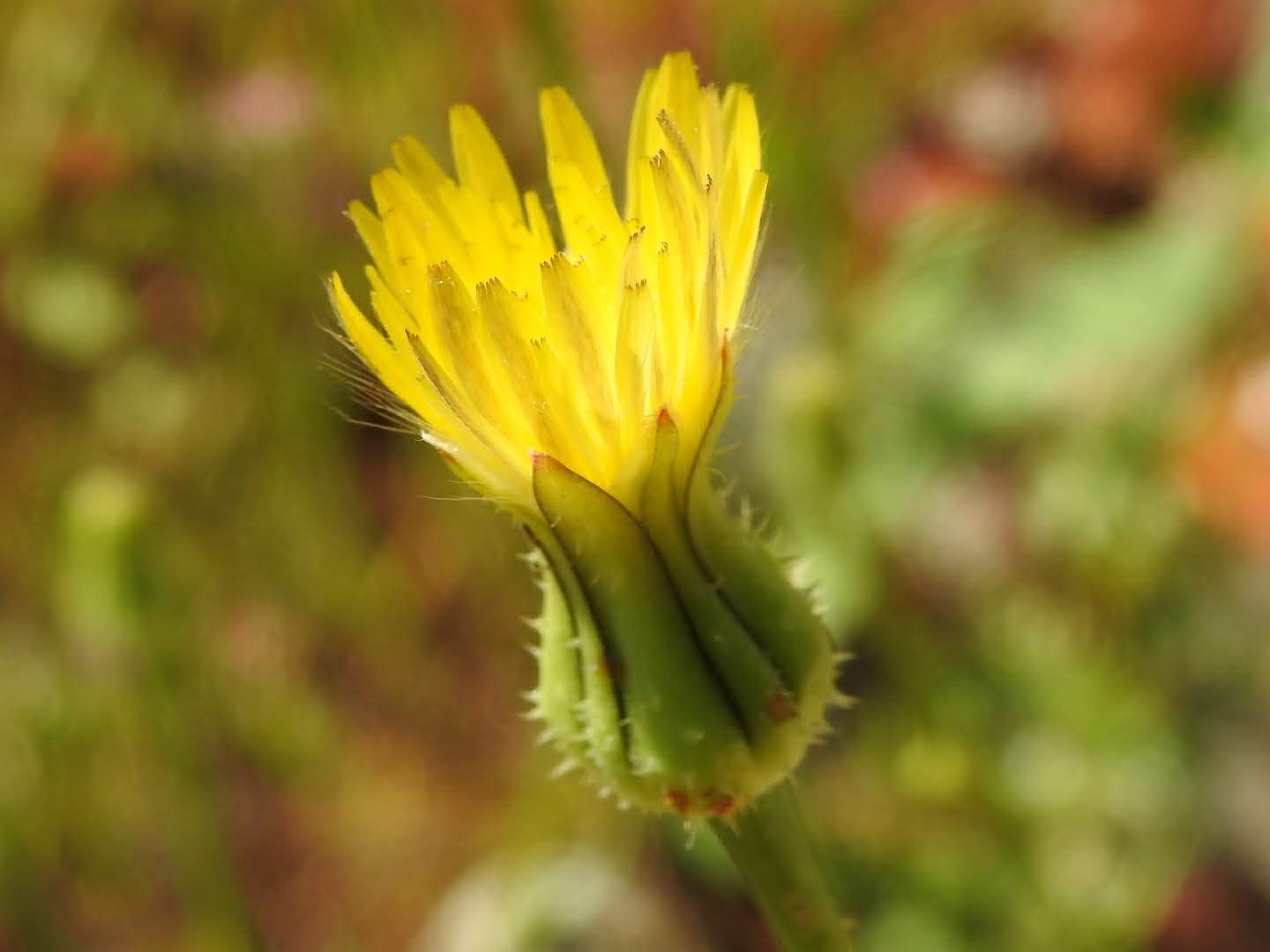
The flower heads are from 2 to 6 or more, arranged in terminal corymbs at the tips of the branches, each ovoid in shape and 15 to 40 mm in diameter. The involucre is formed by lanceolate-linear bracts about 15 mm long, arranged in a single series and covered with bristly hairs. The flowers are all ligulate, light yellow in color, about 20 mm long, with actinomorphic symmetry and scape-like habit. Each flower is hermaphroditic, with five petals fused into a tube at the base and extended into a ligule ending with five small teeth. The stamens are five, with anthers fused into a tube surrounding the bifid style.
The root system is taproot, robust and well developed.
The fruit is an elongated, linear and subterete achene, generally curved, with transverse ribs and an elongated beak swollen at the base. The beak is hollowed and separated from the body of the achene by a diaphragm. The pappus consists of feathery hairs, basally widened, which facilitate wind dispersal.
Habitat and distribution
Native to Mediterranean regions, the False Hawkbit is widespread along much of the Italian and Mediterranean coasts, with a range extending also northwards and eastwards in Europe. In Italy it is common in ruderal environments, road edges, paths, olive groves and vineyards, from the plains up to about 1000 meters altitude.
It prefers well-drained soils, often sandy or poor, and adapts well to sunny exposures typical of coastal and sub-Mediterranean areas. It is frequent in disturbed and uncultivated environments, where it exploits the ability to rapidly colonize open spaces.
Flowering period
Flowering extends from February to July, with peak flowering in spring. In some Mediterranean areas it can continue until late autumn, from October to December, especially in zones with milder climates.
Ecology and pollination
The yellow flowers attract a variety of pollinating insects, particularly bees and other hymenopterans, which promote entomogamous pollination. The ligulate structure and scape-like habit of the flowers facilitate access to nectar and pollen.
Seed dispersal occurs mainly by wind, thanks to the feathery pappus that allows the achenes to be carried even at a distance. The achene equipped with a swollen beak at the base represents an adaptation that favors seed dissemination and survival.
Curiosities and traditional uses
The False Hawkbit is also known as “false prickly lettuce” and is edible. The basal leaves and the tips collected before flowering are used in cooking, preferably cooked and often mixed with other vegetables, to prepare soups, fillings or as a bitter vegetable. Although belonging to the group of “bitter plants,” it is less intense in bitterness compared to the related species Urospermum dalechampii.
No significant medicinal applications are known, but traditionally the plant has been used as a wild food in local Mediterranean diets. Caution and informed use are recommended, as there are no certain scientific indications for therapeutic purposes.
Etymology
The genus name Urospermum derives from the Greek “oúra” (tail, beak) and “spérma” (seed), referring to the long beak characteristic of the achene which resembles a tail. The specific name picroides is composed of “picris” (a genus of similar plants) and the Greek suffix “-eídos” (similar), indicating the resemblance to plants of the genus Picris.
The common name “False Hawkbit” highlights the relatively smaller size of the flower heads compared to larger related species, such as Urospermum dalechampii (“greater hawkbit”).
Sources
- Prof. P.V. Arrigoni, "Flora analitica della Toscana", "Flora dell'Isola di Sardegna"
- Acta Plantarum - Flora delle regioni italiane (scheda di Daniela Longo)
- World Flora Online (WFO)
Characteristics
Scheda botanica
| Famiglia | Asteraceae |
|---|---|
| Fioritura | febbraio – luglio |
| Forma biologica | Scapose |
| Habitat | with yellow flowers, annual plant |
Domande frequenti
- Quando fiorisce False Hawkbit?
- False Hawkbit fiorisce febbraio – luglio.
- Che tipo di pianta è False Hawkbit?
- False Hawkbit è una Therophytes (Scapose) secondo la classificazione di Raunkiaer.
- A quale famiglia appartiene False Hawkbit?
- False Hawkbit appartiene alla famiglia botanica Asteraceae.
Where I found it (5 sightings)
Classification
- Kingdom
- Plantae
- Family
- Asteraceae
- Full name
- Urospermum picroides (L.) Scop. ex F.W.Schmidt
- Synonyms
- Tragopogon picroides
- Life form
- Therophytes scapose
Similar species
Search for species with similar characteristicsFurther reading
Noticed an error in the identification? Write to me
Other species of the same family
Asteraceae
Explore
Other species of Asteraceae