Botanical species
Teucrium chamaedrys
L.
Wall Germander
Description
Morphological description
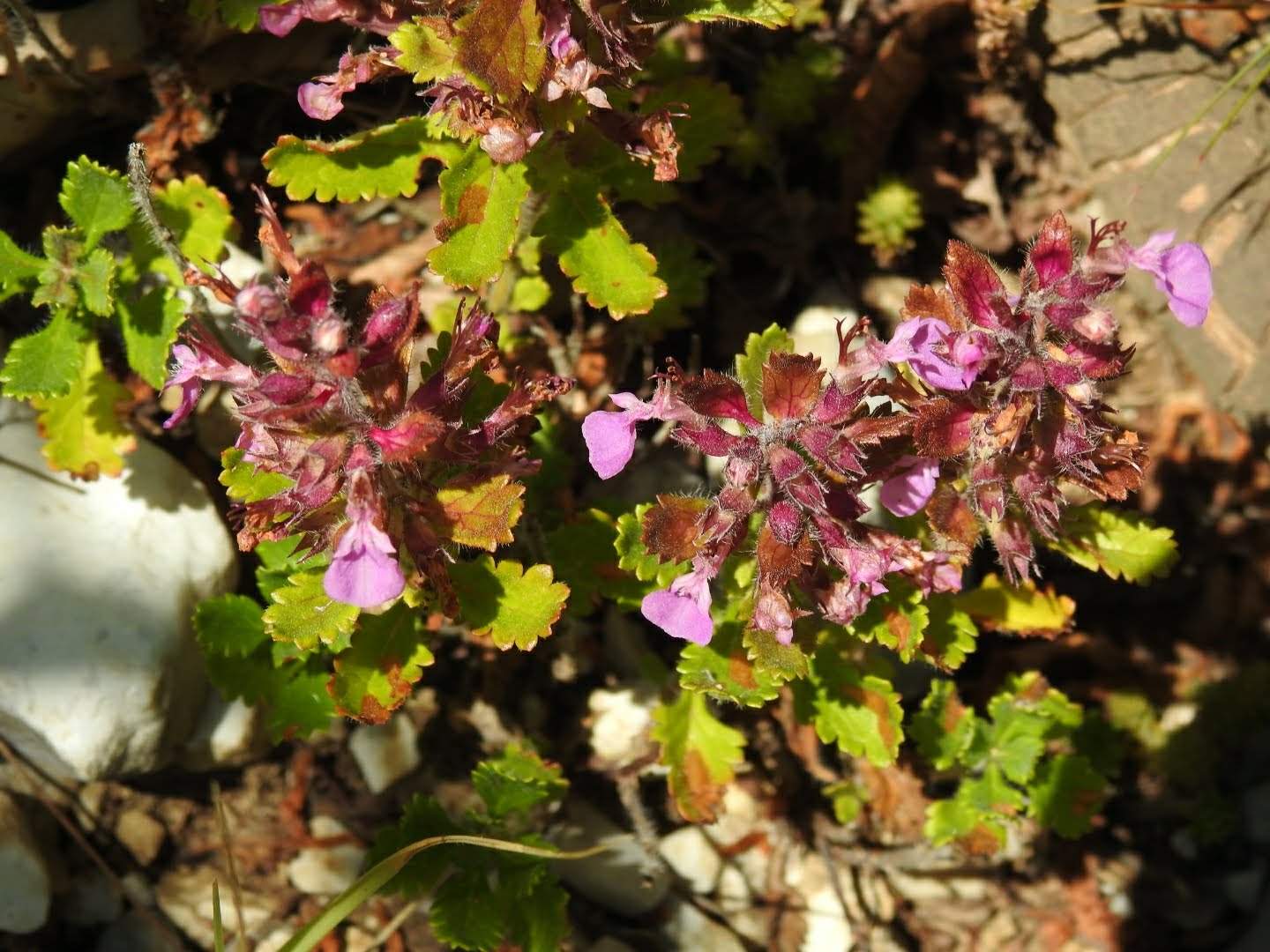
Small perennial suffrutescent plant, generally 10 to 30 cm tall, with an erect-ascending habit. The stem is quadrangular, lignified at the base and herbaceous in the upper part, covered with a dense pubescence of simple hairs, more or less patent or reflexed, giving a bristly and gray-green or brownish appearance. Sometimes glandular hairs are also found, especially in mountain specimens.
The leaves are opposite, sessile or with a short petiole (3-6 mm), ovate, oblanceolate or ovate-spatulate in shape, 7 to 25 mm long and 13-25 mm wide. The blade is coriaceous, dark green in color, with crenate or lobed margins, often mucronate, and may present varying density of pubescence, from almost glabrous to densely tomentose. The number and shape of the marginal teeth vary considerably: from 5-8 acute or rounded teeth per side, sometimes divided into several lobes, up to 7-9 divergent teeth almost at right angles in the typical subspecies of some areas of the Riviera. Leaf shape and indumentum density also vary according to environmental conditions, with more pinnatifid and toothed leaves in dry and sunny stations, and broader and less toothed leaves in humid and shady habitats.
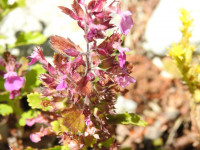
The inflorescence consists of dense verticillasters arranged in the axils of the upper leaves, with groups of 2-6 fragrant flowers. The bracts accompanying the flowers are often smaller than the leaves, variable in shape, sometimes reddish. The calyx is tubular-campanulate, 4-5 mm long, with five lanceolate, almost equal, ciliate and glandular teeth, green or reddish in color. The corolla is one-lipped, 12-15 mm long, pink-purple, fuchsia or pale yellow, without an upper lip and with the lower lip divided into five lobes: four small upper ones and one large obovate lower one, with crenate or undulate and reflexed margin. The stamens are four, didynamous, protruding from the corolla, with bilocular anthers. The ovary is semi-inferior with a bifid stigma.
The fruit is a microbasarium composed of four ovoid mericarps measuring 1-2.5 mm, with a papillose surface and evident veins.
The root system is rhizomatous and branched, typical of suffrutescent plants.
Habitat and distribution
The species is mainly widespread in Mediterranean regions, with a range centered on the Mediterranean coasts but extending northwards and eastwards, including some internal mountainous areas such as Valle Maira and Valle Grana. In Italy it is commonly found from hilly environments up to the montane level, at altitudes ranging from 0 to about 1700 meters.
It prefers xerothermic and sunny habitats, such as dry meadows, rocky slopes, garrigues, rocky steppes and xerophilous pine and oak woods. It grows on calcareous soils, often in well-lit and dry exposures. The plant adapts to poor and well-drained soil conditions.
Flowering period
Flowering generally occurs between April and July, with possible variations related to latitude and altitude. In warmer environments and at lower elevations flowering may start earlier, while in the mountains it tends to concentrate in the central months of spring and early summer.
Ecology and pollination
The flowers, fragrant and brightly colored (pink-purple, fuchsia or pale yellow), are hermaphroditic and attract various pollinating insects, such as bees and other hymenopterans, which play a fundamental role in pollination. The arrangement of the flowers in dense verticillasters facilitates insect access to nectar and pollen.
The plant produces small fruits, consisting of four mericarps, which are probably dispersed through mechanisms of falling and secondary transport by animals or wind, although no particular adaptations for long-distance dispersal are known.
Curiosities and traditional uses
Historically Wall Germander has been used in phytotherapy for its alleged medicinal properties: it was believed to be anti-inflammatory, antirheumatic, carminative, diaphoretic, astringent, digestive, stimulating, laxative, tonic and diuretic. The flowering tops were used in infusions or tinctures for soothing rinses of inflamed mucous membranes or taken to aid digestion and regulate intestinal functions.
In the liquor industry, the plant was appreciated for its flavoring and bittering qualities, used in the preparation of vermouth, aperitifs and digestives.
However, extreme caution must be exercised in the use of Wall Germander, as it contains hepatotoxic neoclerodane diterpenes, responsible for acute and chronic hepatitis. Internal use is therefore dangerous and not recommended. Traditional medicinal uses should be considered historical and informative, without modern scientific validation.
Etymology
The generic name Teucrium derives from Teucer, the legendary king of Troy, to whom the discovery of the medicinal properties of the plant is attributed. The specific name chamaedrys indicates the similarity of the leaves to those of a species of oak (in Latin “chamaedrys” means “ground oak”), from which also derives the Italian common name “querciola” sometimes used for this plant. The name “camedrio” derives precisely from this association with the oak.
Sources
- Prof. S. Pignatti, "Flora d'Italia"
- Acta Plantarum - Flora delle regioni italiane (scheda di Giuliano Salvai)
- World Flora Online (WFO)
Characteristics
Scheda botanica
| Famiglia | Lamiaceae |
|---|---|
| Fioritura | aprile – luglio |
| Forma biologica | Suffruticose |
| Habitat | with fuchsia flowers, fragrant plant, Perennial plant |
Domande frequenti
- Quando fiorisce Wall Germander?
- Wall Germander fiorisce aprile – luglio.
- Che tipo di pianta è Wall Germander?
- Wall Germander è una Chamaephyte (Suffruticose) secondo la classificazione di Raunkiaer.
- A quale famiglia appartiene Wall Germander?
- Wall Germander appartiene alla famiglia botanica Lamiaceae.
Where I found it (8 sightings)
Classification
- Kingdom
- Plantae
- Family
- Lamiaceae
- Full name
- Teucrium chamaedrys L.
- Life form
- Chamaephyte suffruticose
Similar species
Search for species with similar characteristicsFurther reading
Noticed an error in the identification? Write to me
Other species of the same family
Lamiaceae
Explore
Other species of Lamiaceae