Botanical species
Clinopodium grandiflorum
(L.) Kuntze
Greater Calamint
Description
Morphological description
Greater Calamint is a perennial plant belonging to the family Lamiaceae, characterized by a generally creeping habit with a woody stem at the base and erect flowering branches. The main stem is often woody in texture and develops horizontally in contact with the soil, while the branches bearing the flowers rise vertically, giving the plant a scapose appearance.
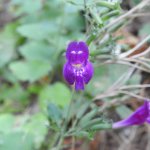
The leaves are arranged oppositely along the branches, have an ovate shape and a hairy surface, with a sharply toothed margin. The leaf blade generally measures between 2-4 cm in width and 3-5 cm in length and is inserted on a petiole about 1 cm long. The hairiness, consisting of curly hairs up to 1 mm long, is clearly visible on both leaves and stems, contributing to give the plant a characteristic texture.
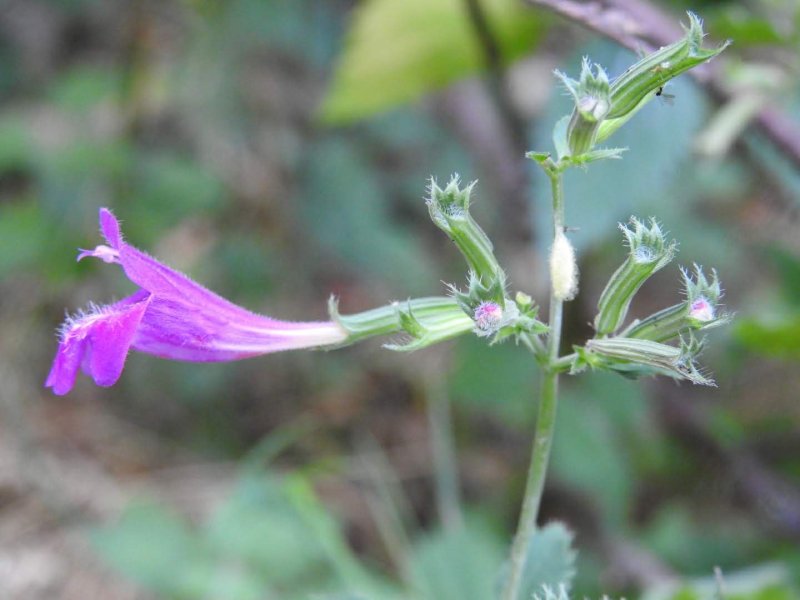
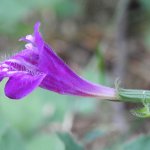
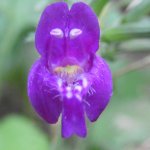
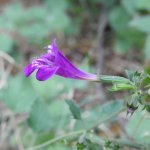
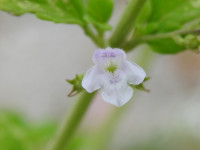
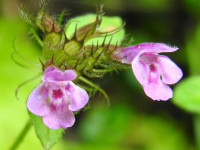
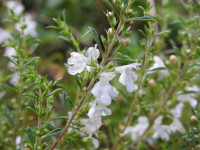
The flowers, large compared to other related species, are lip-shaped (typical of the family Lamiaceae), with a corolla length ranging from 25 to 35 mm. The predominant color is intense violet, which makes them particularly showy. The flowers are arranged oppositely, inserted on leafy spikes that are ± unilateral, supported by peduncles 3-5 mm long. The calyx has a cylindrical tube 7-8 mm long with teeth 4-5 mm long. The flower structure is pentamerous: it has a calyx with five teeth, a bilabiate corolla formed by two and three petals respectively, two pairs of stamens (2+2), and a superior ovary formed by two carpels. The fruit is a drupe that divides into four nutlets.
The root system is not described in detail in the sources, but as typical of Lamiaceae, a fibrous root system suitable for well-drained soils is presumed.
Habitat and distribution
Greater Calamint is mainly widespread in the mountainous and hilly regions of Italy, with significant presence in Tuscany and Sardinia, where it grows spontaneously in environments characterized by sunny or partially shaded exposures. It prefers well-drained soils, often calcareous or mixed, with a good content of organic matter.
The species is typical of Mediterranean mountain habitats, growing mainly between 600 and 1800 meters of altitude. In these areas it is generally found in clearings, forest edges, pastures, and ruderal areas, where the substrate is not too compact and the moisture is moderate.
Its presence extends throughout the Mediterranean area, although most documentation concerns central-northern and insular Italy.
Flowering period
Flowering is concentrated in the summer months, with a peak between June and August. In some mountainous areas or in cooler climatic conditions, flowering may extend until September, while in warmer environments it tends to end by the end of August.
No significant variations in flowering period are reported in relation to geographic distribution, except those linked to altitude and local microclimatology.
Ecology and pollination
The flowers of Greater Calamint, with their violet corolla and large size, are well adapted to entomophilous pollination, particularly by pollinating insects such as bees and bumblebees. The bilabiate structure facilitates access to nectar, while the morphology of the flower favors contact with the reproductive organs, ensuring effective cross-pollination.
Seed dispersal occurs through the drupe which divides into four nutlets, but no specific strategies for long-distance dispersal are known; presumably dissemination occurs by falling near the mother plant or through small animals.
Curiosities and traditional uses
Greater Calamint is a fragrant plant, like many Lamiaceae, and has traditionally been used in popular contexts both for its aromatic and medicinal properties. The intense scent of the leaves and flowers made it suitable for use as a medicinal herb in infusions or decoctions, particularly indicated to relieve digestive and respiratory disorders, thanks to the anti-inflammatory and carminative properties typical of plants of the family.
In culinary use, although less common than other related species such as Mentuccia comune (Clinopodium nepeta), it has been employed as a flavoring in some traditional preparations, especially in areas where it grows spontaneously.
The common name “mentuccia” recalls the similarity to mint, particularly for the scent and appearance of the leaves, while the reference to “large flowers” highlights the more evident size of the flowers compared to other similar species.
Etymology
The scientific name Clinopodium grandiflorum derives from Latin: “clinopodium” indicates a genus of aromatic plants of the family Lamiaceae, while “grandiflorum” means “with large flowers,” referring to the particularly large size of the corolla compared to other species of the same genus.
The Italian common name “mentuccia a fiori grandi” refers to the similarity with mentuccia (Clinopodium nepeta), a widely spread aromatic herb, and to the distinctive characteristic of this species, namely the larger flowers, of intense violet color.
Sources
- Prof. P.V. Arrigoni, Flora analitica della Toscana, Flora dell'Isola di Sardegna (description in the database)
Characteristics
Where I found it (3 sightings)
Classification
- Kingdom
- Plantae
- Family
- Lamiaceae
- Full name
- Clinopodium grandiflorum (L.) Kuntze
- Synonyms
- Calamintha grandiflora (L.) Moench; Satureja grandiflora (L.) Scheele
- Life form
- Terofite scapose
Similar species
Search for species with similar characteristicsFurther reading
Noticed an error in the identification? Write to me
Other species of the same family
Lamiaceae
Explore
Other species of Lamiaceae