Botanical species
Prunella laciniata
(L.) L.
Cut-Leaved Selfheal
Description
Morphological description
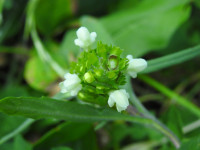
Perennial herbaceous plant of modest size, generally 10 to 25 cm tall, with a scapose habit and ascending stems, simple or slightly branched. The stem is characterized by a densely hirsute surface, covered with erect and soft white hairs that give the plant a villous and wrinkled appearance, especially in the upper part. At the base it has a short and woody root, with stoloniferous development that allows its perenniality.
The leaves are arranged oppositely along the stem, with morphological characteristics varying depending on the position. The basal leaves have a petiole 1.5-2 cm long and present a lanceolate, entire blade of small size (about 1 x 2-3.5 cm). As you move upwards, the leaves become progressively more incised, often pinnatifid or with 1-2 lobes per side, reaching an almost linear and dentate shape in the upper cauline leaves, which often surround the base of the inflorescence. All leaves are slightly hairy, especially on the back and along the veins, and have an entire or dentate margin depending on the specimen.
The inflorescence consists of dense and cylindrical verticillasters, about 2-4 cm long, located at the top of the stem and formed by 3-9 verticillasters with 6 flowers each, arranged in compact spiciform clusters. The bracts accompanying the flowers are reniform, about 2 x 1 cm wide, with mucronate margins and reticulate veins, pale green in color sometimes slightly tinged with reddish.
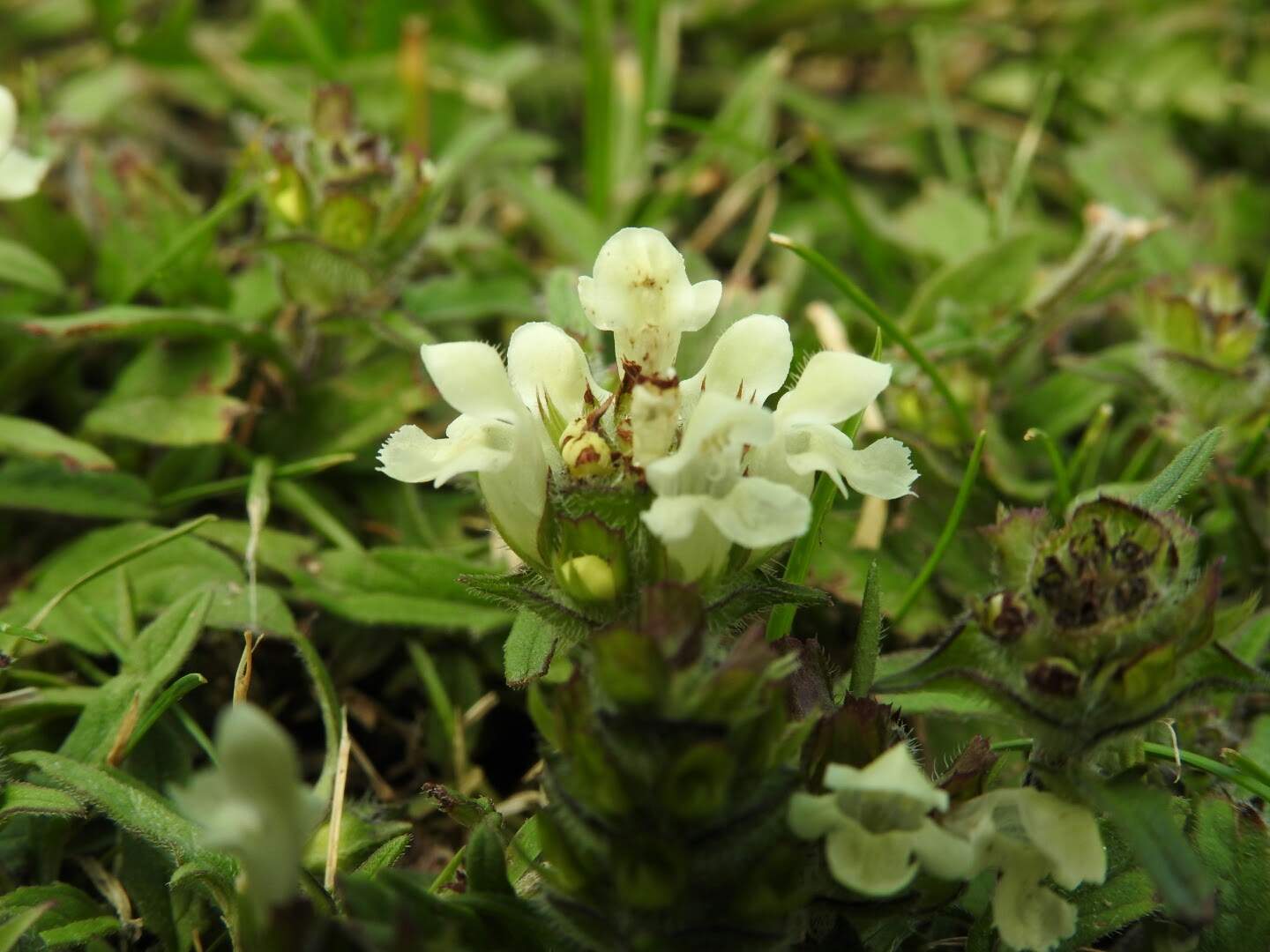
The flowers are hermaphroditic, zygomorphic and tetramerous, with a gamosepalous calyx about 10 mm long, hairy and bilabiate. The upper lip of the calyx has three slightly pronounced teeth, with the median tooth, oval and wider, ending abruptly with a mucro. The lower lip is divided in half into two lanceolate and strongly ciliate lobes. The gamopetalous corolla, 15 to 20 mm long, is white-yellowish or pale yellow, with a tube about 10 mm long. The upper lip of the corolla is helmet-shaped, keeled on the back and slightly larger than the lower lip, which is trilobed with oblong lateral lobes turned downward and a larger, denticulate central lobe. The stamens are four, didynamous, parallel and all fertile, with the two anterior ones curved forward and protruding from the corolla tube. The style is bifid with stigma divided into two acute lobes.
The fruit is a schizocarp called a tetrachene achene, composed of four ovoid-oblong, smooth and trigonous mericarps, light brown in color.
Habitat and distribution
This species is typical of European Mediterranean regions, with a range extending along the Mediterranean coasts and also present in Central Europe and Western Asia. In Italy it is common and widespread in all regions, from the plains up to about 1400 meters altitude.
It prefers habitats of poor, dry and well-exposed meadows, with a particular preference for calcareous soils. It grows in arid and sunny environments, often on poor and well-drained substrates. In the Mediterranean basin it is also found in similar environments characterized by hot and dry climates.
Flowering period
Flowering typically extends from April to August, with peaks in the summer period (June-August). In some more northern areas or at higher altitudes, flowering may be slightly earlier or later, but generally remains in the spring-summer period.
Ecology and pollination
The plant mainly relies on entomogamous pollination, with pollinating insects visiting the flowers for nectar and pollen. The zygomorphic and bilabiate structure of the corolla is suitable for attracting small insects such as bees and hymenopterans, which promote cross-fertilization.
Seed dispersal occurs through schizocarps that separate into four nutlets, facilitating local propagation. The presence of stolons and basal buds also allows vegetative reproduction and the ability to rapidly colonize open spaces.
Curiosities and traditional uses
The species is recognized as medicinal, with properties similar to those of Prunella vulgaris, from which it mainly differs in leaf shape and corolla color. Traditionally it has been used for its presumed antibacterial, antispasmodic, antipyretic, hypotensive, antiseptic, astringent, febrifuge, vermifuge, vulnerary, diuretic, stomachic and tonic virtues.
The common name “Cut-Leaved Selfheal” derives from the characteristic color of the flowers, which differ from the typical violet or blue of other species in the genus. At a popular level, the plant has found use in local traditional medicines, although today it is used with caution and mainly for informational purposes.
Etymology
The genus name Prunella, sometimes also called "Brunella", may derive from the German term “Bräune”, meaning angina, referring to the therapeutic properties attributed to the plant, or from the brown color of the calyces of the species. The specific epithet “laciniata” refers to the deeply incised or laciniate shape of the cauline leaves, a distinguishing feature compared to other Prunella species.
The Italian common name “Cut-Leaved Selfheal” refers to the light, white-yellowish or pale yellow color of the flowers, which visually differentiates it from the more common blue or violet-flowered selfheals.
Sources
- Prof. S. Pignatti, "Flora d'Italia"
- Acta Plantarum - Flora delle regioni italiane (scheda di Giuliano Salvai)
- Tela Botanica / H. Coste, "Flore descriptive et illustrée de la France"
- World Flora Online (WFO)
Characteristics
Scheda botanica
| Famiglia | Lamiaceae |
|---|---|
| Fioritura | aprile – agosto |
| Forma biologica | Scapose |
| Habitat | with white flowers, with yellow flowers, plant with a scapose habit |
Domande frequenti
- Quando fiorisce Cut-Leaved Selfheal?
- Cut-Leaved Selfheal fiorisce aprile – agosto.
- Che tipo di pianta è Cut-Leaved Selfheal?
- Cut-Leaved Selfheal è una Hemicryptophytes (Scapose) secondo la classificazione di Raunkiaer.
- A quale famiglia appartiene Cut-Leaved Selfheal?
- Cut-Leaved Selfheal appartiene alla famiglia botanica Lamiaceae.
Where I found it (5 sightings)
Classification
- Kingdom
- Plantae
- Family
- Lamiaceae
- Full name
- Prunella laciniata (L.) L.
- Life form
- Hemicryptophytes scapose
Similar species
Search for species with similar characteristicsFurther reading
Noticed an error in the identification? Write to me
Other species of the same family
Lamiaceae
Explore
Other species of Lamiaceae