Botanical species
Prunella vulgaris
L.
Heal-all
Description
Morphological description
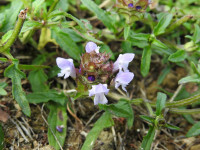
Perennial herbaceous plant, Heal-all presents a creeping or ascending habit, reaching a variable height from 5 up to about 30-45 cm. The stems are generally simple, sparsely branched, often brown or violet in color, and can be glabrous or covered with a slight pubescence, with sparse and patent hairs. The root system is rhizomatous, with horizontal rhizomes that allow the plant to spread on the ground.
The leaves are arranged oppositely along the stem and are herbaceous, lanceolate or ovate in shape, with sizes generally ranging from 1 to 4 cm in length and 2.5 to 9 cm in width. The leaf blade can be entire or irregularly crenulate, with margins sometimes denticulate but weakly veined. The basal leaves, arranged in a rosette, are petiolate, while the upper ones are sessile and often narrower and lanceolate. The two uppermost leaves wrap around the base of the inflorescence.
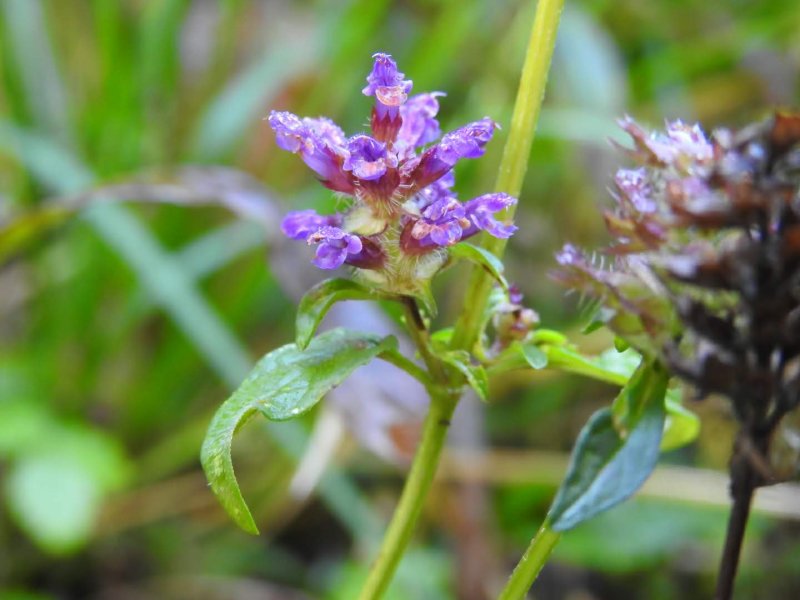
The inflorescence is a compact cylindrical spike, about 2-5 cm long, wrapped at the base by the two upper bracts, which are reniform, kidney-shaped, about 9-12 mm long, with a characteristic thin appendage of 3-5 mm, often pointed. The calyx is campanulate, 6.5-8 mm long, covered with patent hairs, with lanceolate teeth; it is bilabiate, with the upper lip having three slightly pronounced teeth and the lower lip divided into two ciliate lobes.
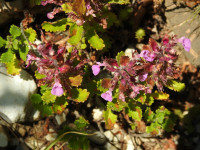
The flowers are bilabiate, with a corolla tube 7-9 mm long, normally violet-blue or intense blue in color, but they can also be pink or, more rarely, white. The upper lip is arched and tall, while the lower lip is shorter and trilobed. The flowers are grouped in compact verticillasters and grow in the axil of the two uppermost leaves. The stamens are four and didynamous, with two longer and two shorter, positioned under the upper lip.
The fruit is a tetrachene composed of four ellipsoid nutlets, approximately 2.2-2.3 x 0.9-1.1 mm in size, light brown in color with well-visible longitudinal veins.
Habitat and distribution
Heal-all is a circumboreal species widely distributed in Europe, Asia, North America, and some regions of Africa and Australia. In Italy, it commonly grows in meadows, pastures, grassy places, and clearings up to 2000 meters altitude, preferring fresh and well-drained soils, often in moist or marginal environments such as forest edges and uncultivated areas.
In the Mediterranean and particularly in Italy, the plant is more frequently found in temperate and mountainous areas, from the plains up to subalpine zones. It prefers sunny or partially shaded exposures and adapts well to soils of different nature as long as they are not excessively dry.
Flowering period
The flowering extends from April to October, with peak flowering between June and September. In some areas, especially cooler or mountainous ones, flowering can last for much of the summer. The plant can also flower at different times depending on local climatic conditions.
Ecology and pollination
Heal-all is a scapose hemicryptophyte species, that is, with buds at ground level and an elongated floral axis often leafless. This strategy allows it to effectively withstand seasonal and climatic variations.
Pollination is entomogamous, mainly favored by pollinating insects such as bees and bumblebees, attracted by the bilabiate flowers of vivid color and the nectar produced. The bilabiate structure of the corolla facilitates specialized pollination, with insects landing on the lower lip to access the nectar, touching the stamens and stigma.
Seed dispersal occurs through the nutlets, which fall to the ground near the mother plant or can be transported by animals or external agents. The rhizomatous capacity also allows vegetative reproduction and colonization of new spaces.
Curiosities and traditional uses
Heal-all, also known as Brunella or Morella, has a long history of use in traditional European and Asian medicine. The name “Brunella” derives from the German “Bräune,” a term indicating angina, a condition for which the plant was commonly used.
It is a medicinal plant rich in bioactive compounds such as rosmarinic acid, oleanolic acid, ursolic acid, flavonoids, tannins, and polysaccharides. These active principles confer antibacterial, antispasmodic, antipyretic, hypotensive, antiseptic, astringent, febrifuge, vermifuge, vulnerary, diuretic, stomachic, constipating, and tonic properties.
Traditionally, Heal-all was used both internally and externally. Internally it was used to treat hemorrhages, heavy menstruation, headaches, high blood pressure, mastitis, and conjunctivitis. Externally, applications included the treatment of small wounds, healing of sores, burns, and bruises. The plant was also used as a mouthwash for inflammations of the mouth and small ulcerations.
Recent scientific studies have shown that extracts from its leaves can prevent and treat herpes simplex infections types 1 and 2. Young leaves are edible and can be consumed raw in salads, while the plant is also valued as melliferous, as its nectar gives a good scent to hay.
In ornamental horticulture, it is cultivated in rock gardens and as a groundcover plant due to its ability to spread and cover the ground.
Etymology
The scientific name “Prunella” is linked to the German denomination “Bräune,” meaning angina, a throat disease for which the plant was traditionally used. The Italian name “Heal-all” derives from the genus and its wide distribution in Italian and Mediterranean regions, where it is one of the most common species of its genus.
Sources
- Prof. S. Pignatti, "Flora d'Italia"
- Acta Plantarum - Flora delle regioni italiane (scheda di Marinella Zepigi)
- Tela Botanica / H. Coste, "Flore descriptive et illustrée de la France"
- World Flora Online (WFO)
Characteristics
Scheda botanica
| Famiglia | Lamiaceae |
|---|---|
| Fioritura | aprile – ottobre |
| Forma biologica | Scapose |
| Habitat | with purple flowers, with pink flowers, Perennial plant |
Domande frequenti
- Quando fiorisce Heal-all?
- Heal-all fiorisce aprile – ottobre.
- Che tipo di pianta è Heal-all?
- Heal-all è una Hemicryptophytes (Scapose) secondo la classificazione di Raunkiaer.
- A quale famiglia appartiene Heal-all?
- Heal-all appartiene alla famiglia botanica Lamiaceae.
Where I found it (5 sightings)
Classification
- Kingdom
- Plantae
- Family
- Lamiaceae
- Full name
- Prunella vulgaris L.
- Life form
- Hemicryptophytes scapose
Similar species
Search for species with similar characteristicsFurther reading
Noticed an error in the identification? Write to me
Other species of the same family
Lamiaceae
Explore
Other species of Lamiaceae