Botanical species
Teucrium scorodonia
L.
Woodland germander
Description
Morphological description
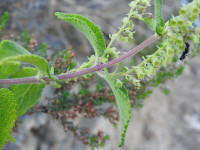
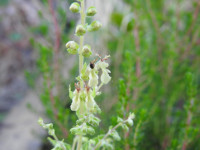
Perennial rhizomatous plant, Woodland germander presents erect, quadrangular and branched stems, ranging from 20 to 70 cm in height. The stem is initially pubescent with hairs that tend to become glabrescent over time, often reddish in color and with a rough surface. The stem section is angular, typical of Lamiaceae.
The leaves are opposite, petiolate with a petiole about 1 cm long, triangular-ovate or ovate-oblong in shape, 3 to 6 cm long and 2.5 to 5.5 cm wide. The leaf blade is thick, rough and dark on the upper side, while the underside, as well as both sides, is pubescent. The margin is irregularly crenate-dentate and the veins form a conspicuous network. The leaf base can be truncate or slightly cordate.
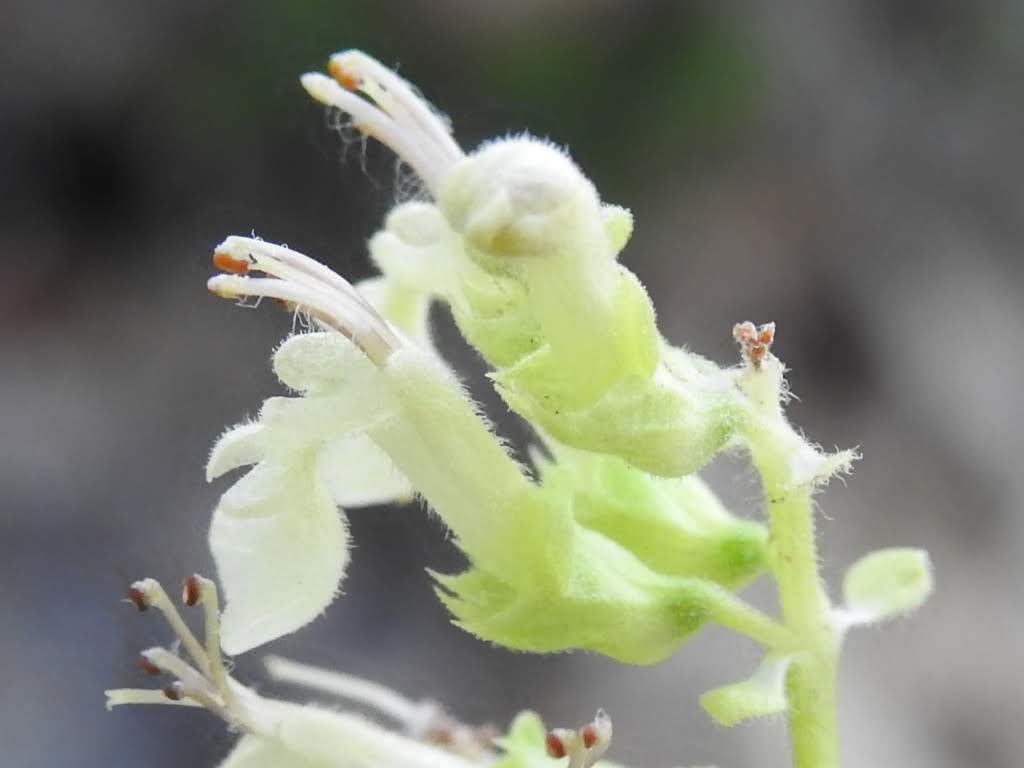
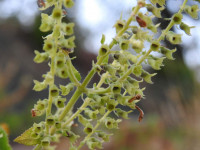
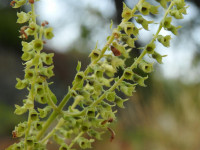
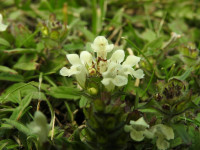
The flowering occurs with flowers arranged in loose and spaced verticillasters, generally composed of 2-4 flowers each, located in terminal and axillary positions, often unilateral and branched at the base. The bracts are oval or lanceolate and progressively narrow towards the base. The calyx is bilabiate, about 4-6 mm long, campanulate with a swelling (gibbosity) at the base, glabrous or with few short glandular hairs, reticulate in the veins at maturity.
The corolla, about 9-10 mm long, is white-cream or pale yellow in color, with shades that may tend to reddish. It is bilabiate but with the upper lip practically absent or reduced to two small lobes joined to the lower lip, which is instead five-parted. The corolla tube is about twice as long as the calyx.
The fruits are smooth, subglobose achenes, brown-blackish in color, 1-1.5 mm long, with spheroidal glands on the surface.
The root system is rhizomatous, allowing the plant to perennialize and regenerate every year.
Habitat and distribution
Woodland germander is a typical species of open forests and broadleaf woods, preferably on acidic and well-drained soils. It commonly grows in wooded environments, along forest edges and thickets, up to the mountain and hill belt.
In Italy it is widely present especially in regions with temperate and subatlantic climates, from the plains up to about 1500 meters altitude. It is well represented in the North and Central Italy areas, and more sporadically in the South and the major islands. In the Mediterranean basin it extends in Western Europe and some areas of Central Europe, with a distribution reaching suboceanic regions.
The plant prefers exposures in bright areas but not fully sunny, frequently found in clearings and forest margins where light is filtered.
Flowering period
Flowering mainly extends during June and July, with slight variations depending on altitude and latitude. At higher altitudes or cooler climates it may start slightly later, but generally the flowering season is concentrated in midsummer.
Ecology and pollination
The flowers of Woodland germander, characterized by a bilabiate corolla with a reduced upper lip, are adapted to pollination by pollinating insects, particularly bees and other pollinators that fit the zygomorphic shape of the flowers. The arrangement of flowers in loose and unilateral verticillasters facilitates access to the nectaries.
The plant reproduces both sexually through seeds (achenes) and vegetatively thanks to the rhizome which allows efficient local spread and persistence in forest habitats. Seed dispersal generally occurs at a short distance from the mother plant, favored by abiotic agents such as natural falling and potentially small animals.
Curiosities and traditional uses
Woodland germander has long been known for its intense and acrid smell, similar to garlic, from which its specific name "scorodonia" derives (from Greek "skòrodon" = garlic). This odoriferous characteristic in the past suggested medicinal and popular uses.
Traditionally it has been used as an aromatic and medicinal herb, with astringent, carminative, diaphoretic, diuretic, sudorific, tonic and vulnerary properties. It was used to treat skin conditions and as a tonic, similarly to gentian root. Moreover, due to its smell and taste, it was used in the past as an anthelmintic.
Also interesting is the use of the infusion of leaves and flowers as a substitute for hops in beer making, exploiting its bitter and aromatic flavor.
It should be emphasized that traditional medicinal and food uses are for informational purposes only and always require caution and specialist consultation.
Etymology
The generic name "Teucrium" derives from Teucer, mythical king of Troy, to whom tradition attributes the discovery of the medicinal properties of some plants of this genus.
The specific name "scorodonia" comes from the Greek "skòrodon", meaning "garlic", referring to the characteristic acrid and pungent odor of the plant.
The Italian common name "Woodland germander" also recalls the garlic-like smell ("scorodonia") and the relationship with other species commonly called "camedri".
Sources
- Prof. S. Pignatti, "Flora d'Italia"
- Acta Plantarum - Flora delle regioni italiane (sheet by Marinella Zepigi)
- World Flora Online (WFO)
Characteristics
Where I found it (12 sightings)
Classification
- Kingdom
- Plantae
- Family
- Lamiaceae
- Full name
- Teucrium scorodonia L.
- Life form
- Emicriptofite scapose
Similar species
Search for species with similar characteristicsNoticed an error in the identification? Write to me
Other species of the same family
Lamiaceae
Explore
Other species of Lamiaceae