Botanical species
Origanum vulgare
L.
Wild Marjoram
Description
Morphological description
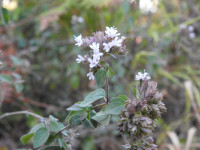
Perennial, bushy plant, with a habit that tends to become semi-shrubby at maturity, characterized by a pleasant and intense aromatic fragrance. The height generally ranges between 20 and 60 cm. The root system consists of a woody, branched, and horizontally creeping rhizome, which allows the plant to expand and survive in natural environments.
The stem is erect in the upper part, while in the basal part it can be prostrate, with a quadrangular section and reddish coloration. It is covered by dense hairiness, which can vary from fine to more evident, giving a tomentose or hirsute surface. Branching is more evident in the upper part of the stem, giving the plant a bushy appearance.
The leaves are opposite, simple, ovate or oval-elongated in shape, with sizes ranging from 1 to 4 cm in length. They have a short petiole and are hairy especially along the main veins; the margins can be entire or slightly toothed, often with hairiness also on the edge. The blade is wider towards the base and rounded, contributing to a compact and characteristic shape.
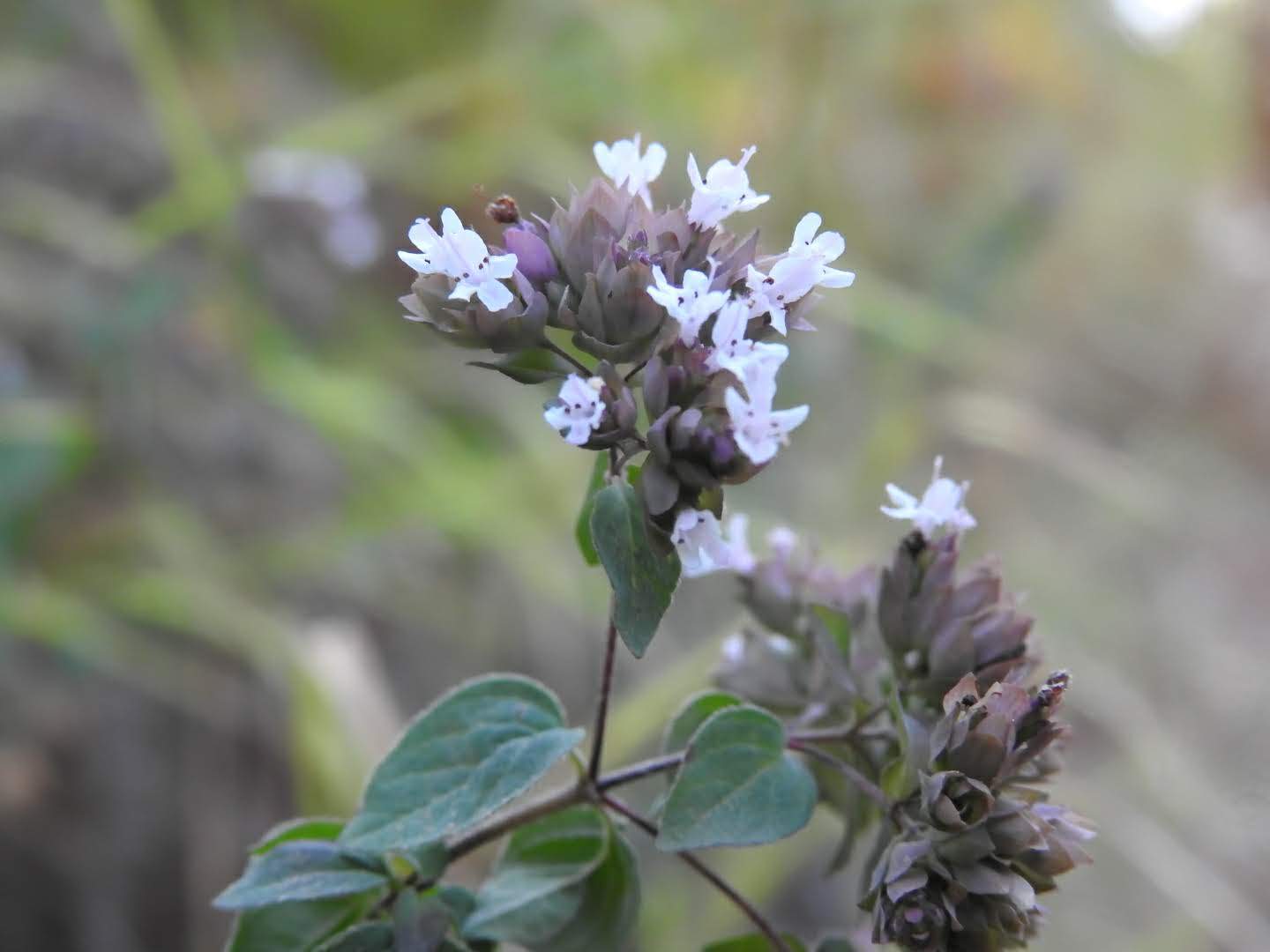
The flowers are gathered in dense capitula, terminal or in the axil of sessile bracts, which resemble leaves and are often shaded with red or purple. The corolla, 4-7 mm long, is pink, rarely white, with an emarginate upper lip and a trilobed and longer lower lip. The calyx, tubular-campanulate and 2-4 mm long, is divided into five teeth about one third of the tube length and can have a glabrous or pubescent surface with glands. The flowers are hermaphroditic, with a pair of stamens slightly protruding.
The fruit is a tetrachene formed by four subspherical mericarps, dark brown or lighter in color, with an acute apex and finely granular surface. These seeds are small, about 0.8-1 mm in length.
Habitat and distribution
Origanum vulgare is a Eurasian species, widespread throughout the Mediterranean basin and in many regions of Europe up to Japan. In Italy it is present in numerous environments, preferring dry and sunny places, sparse woods, rocky places and cliffs, especially on calcareous or gypsum soils. It grows from hill to subalpine altitudes, generally reported between 200 and 1500 meters above sea level.
It prefers sunny exposures and well-drained soils, often poor in organic matter, showing a high adaptability to xerophilous conditions. It is typical of garrigues and clearings, where competition with other species is less intense.
Flowering period
Flowering extends from June to September, with possible geographic variation where southern populations may anticipate or prolong the flowering phase. The pink or rarely white flowers are gathered in terminal inflorescences that attract numerous pollinating insects throughout the summer.
Ecology and pollination
Flowering produces numerous hermaphroditic flowers, favoring both entomophilous pollination and subsequent fertilization. The main pollinating insects are bees, bumblebees, and other hymenopterans, attracted by the intense scent and nectar. The flower structure, with a trilobed lower lip, facilitates insect landing and effective pollination.
Seed dispersal occurs mainly by falling near the mother plant, but can also be favored by small animals or atmospheric agents. The presence of a branched rhizome allows the plant to survive and multiply vegetatively, ensuring good colonization capacity and resistance to environmental stress conditions.
Curiosities and traditional uses
Origanum vulgare is one of the most important and widespread aromatic herbs in Mediterranean cuisine. The flowering tops are harvested and used both fresh and dried to flavor numerous dishes such as pizza, fish, meats, vegetables, cheeses, preserves in oil and vinegar. It is appreciated for its intense and stimulating aroma, which intensifies with drying.
From a medicinal point of view, oregano is known for its antiseptic, disinfectant, antispasmodic, digestive, and sudorific properties. Traditionally it is used to relieve colds, flu, digestive disorders, aerophagia, and painful menstruation. The flowering tops stimulate the secretion of gastric juices and promote digestion, while the extracted essential oil has antibacterial, antifungal, and healing action.
The essential oil, rich in thymol, carvacrol, terpinenes, and other compounds, is also used in cosmetics and for the treatment of inflammations, muscle pains, bronchitis, and even to promote hair growth and combat lice.
In the cultural sphere, the common name "Erba acciuga" or "Acciughero" derives from the traditional use of the plant in the preparation of anchovy paste, highlighting its historical and gastronomic value.
The plant is also melliferous and its flowering tops are used to prepare aromatic pot-pourris and aromatic wines obtained by maceration in wine.
Etymology
The scientific name "Origanum" derives from ancient Greek: "oros" means "mountain" and "ganos" "brightness", referring to the natural growth of the plant on mountains and its graceful and fragrant appearance. The specific name "vulgare" derives from Latin "vulgus", meaning "common" or "widespread", emphasizing the wide distribution of the species.
The Italian common name "origano" is an adaptation of the scientific name, while "Erba acciuga" and "Acciughero" refer to the traditional use of the plant in the preparation of anchovy-based foods.
Sources
- Acta Plantarum - Flora delle regioni italiane (actaplantarum.org)
- Acta Plantarum - Flora delle regioni italiane (scheda di Marinella Zepigi)
- World Flora Online (WFO)
Characteristics
Where I found it (5 sightings)
Classification
- Kingdom
- Plantae
- Family
- Lamiaceae
- Full name
- Origanum vulgare L.
- Life form
- Emicriptofite scapose
Similar species
Search for species with similar characteristicsFurther reading
Noticed an error in the identification? Write to me
Other species of the same family
Lamiaceae
Explore
Other species of Lamiaceae