Botanical species
Salvia verbenaca
L.
Wild Clary
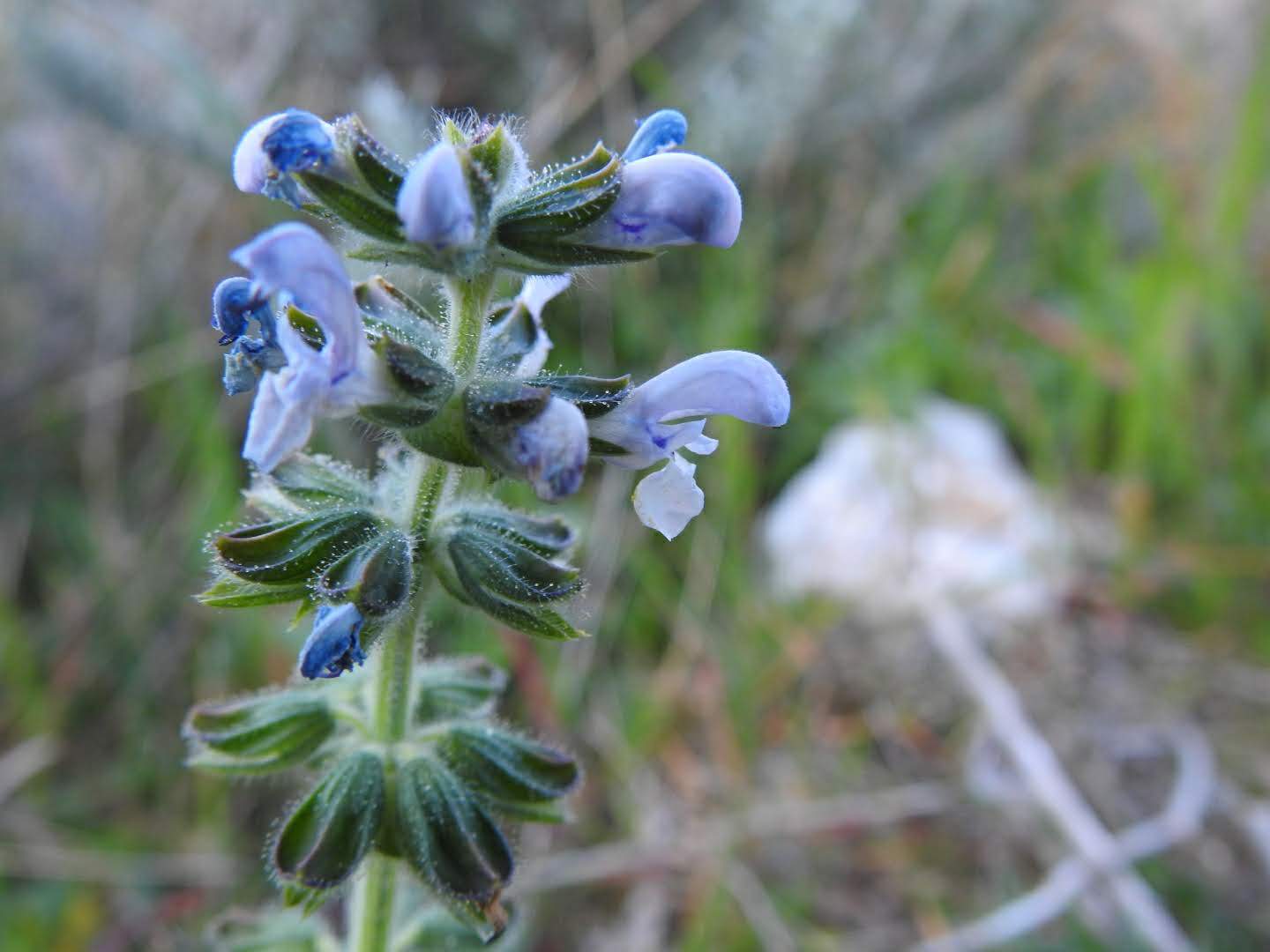
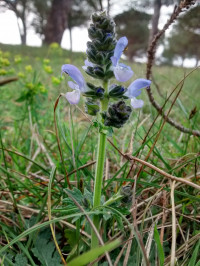
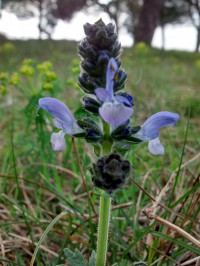
Description
Morphological description
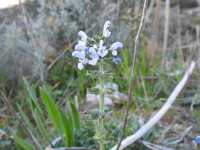
Perennial herbaceous plant belonging to the Lamiaceae family, with a height ranging from 20 to 80 cm. The stem is erect, often simple or branched in the upper part, quadrangular in shape, covered with spreading, glandular, and woolly hairs, giving a rough and often hirsute surface. The plant has a woody taproot system that supports the erect stem.
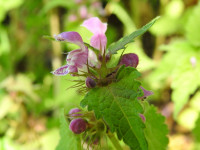
The leaves are mainly arranged in a basal rosette and in opposite cauline positions. The basal leaves are long-petiolate, with a petiole of 2-5 cm, elliptic or ovate-oblong in shape (3-10 cm long by 2-6 cm wide), with a deeply crenulate or pinnatifid margin, usually with 3-4 obtuse lobes per side, which can range from shallow incisions to very pronounced pinnatisect lobes. The cauline leaves are progressively smaller, sessile or with a very short petiole, oval, and with more or less lobed margins. The leaf surface is dull green, rough, and often pubescent with glandular and woolly hairs, giving a rough and hairy appearance.
The inflorescence is scapose and formed by simple or branched whorls, arranged in elongated and lax spikes, with 4-10 flowers per whorl. The bracts are green, cordate at the base and pointed, slightly shorter than the calyx. The calyx is campanulate, bilabiate, 6-10 mm long, covered with whitish woolly hairs, especially in the sinuses between the teeth, which are connivent and short.
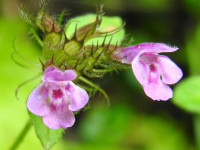
The flowers are bilabiate, with a corolla 6-15 mm long, varying in color from light violet, lilac, pale pink to very rare bluish shades. The upper lip is curved and hairy on the outside, almost straight or slightly falcate, while the lower lip is trilobed with the central lobe directed downwards. Two stamens are present. The corolla may protrude variably from the calyx: in hermaphrodite flowers it is even twice as long as the calyx, while in female or self-pollinating flowers it is shorter and sometimes barely protruding. The presence of different flower types is related to the plant’s reproductive strategy, which includes both cross-pollination and self-pollination.
The fruit is a schizocarp composed of four subglobose nutlets, dark brown in color, about 1.7-2.4 mm long, which separate at maturity.
Habitat and distribution
The plant is widespread in Italian regions and the Mediterranean area, extending also to the European Atlantic coasts. It prefers mountainous and hilly habitats but is also found in plains, up to about 1400 meters altitude. It adapts to a wide range of environments characteristic of Mediterranean territories, such as dry meadows, uncultivated areas, path margins, vineyards, and olive groves. It favors well-drained soils, often calcareous or stony, with sunny or partially shaded exposure.
In southern Europe it is common especially in areas with a Mediterranean climate, preferring dry or semi-arid soils, often disturbed or anthropized. The species is considered thermophilic and also adapts well to grassy places and rocky slopes.
Flowering period
Flowering mainly extends from May to September, with local variations that can anticipate or prolong the period up to April or until December in some milder areas. The flowering period is therefore quite long and coincides with warm and temperate months, favoring the activity of pollinating insects.
Ecology and pollination
The species presents an interesting reproductive strategy, with hermaphrodite and female flowers that can coexist on the same plant. Hermaphrodite flowers, with larger corollas, are predisposed to cross-pollination, while flowers with smaller corollas tend to self-pollinate, especially towards the end of the season.
Pollination is mainly mediated by pollinating insects such as bees and bumblebees, attracted by the violet-lilac color of the flowers and their aromatic scent. The plant is also a good source of nectar and pollen, which is why it is considered melliferous.
Seed dispersal occurs through schizocarps that open at maturity releasing the nutlets; their transport is mainly by falling near the mother plant, with possible secondary movements caused by external agents such as wind or animals.
Curiosities and traditional uses
This species of Salvia has been known since ancient times for its medicinal properties, although less potent than Salvia officinalis. The plant is considered aromatic-medicinal and was traditionally used to treat digestive system disorders (such as bloating, flatulence, slow digestion), respiratory system ailments (asthma, bronchitis, catarrh, sinusitis) thanks to its antiseptic, antibacterial, and antifungal properties.
Moreover, due to the presence of phytoestrogens, it was used as a tonic for menstrual flow, both in cases of hypermenorrhea and dysmenorrhea, and as a depurative and diuretic. The essential oil extracted from the plant is known for its antiperspirant action.
Historically Wild Clary was considered sacred by the Greeks and Romans, who attributed healing and protective virtues against diseases and poisons to it. In the Middle Ages its fame increased, associated with regenerative properties for the mind and body, as well as aphrodisiac qualities, so much so that Cleopatra is said to have used it.
The plant is also mentioned in numerous legends and popular sayings, especially in Veneto and the Salernitan tradition, as a symbol of longevity and health. For example, it was used as a natural toothpaste and mouthwash, a practice documented also in literary texts such as the Decameron.
It should be emphasized that phytotherapeutic and alimentary uses must always be considered with caution and do not replace medical advice.
Etymology
The generic name Salvia derives from the Latin “salus” or “salveo,” meaning “to be well,” “to be healthy,” or “to save,” referring to the therapeutic virtues attributed since ancient times to these plants. The specific epithet verbenaca refers to the resemblance of the leaves to those of Verbena, a plant known and appreciated for its properties.
In Italian it is known as “Wild Clary” or “Salvia falsa verbena,” precisely because of the leaf similarity with verbena, but also to distinguish it from the better-known Salvia officinalis.
Sources
- Prof. S. Pignatti, "Flora d'Italia"
- Acta Plantarum - Flora delle regioni italiane (scheda di Antonino Messina)
- Tela Botanica / H. Coste, "Flore descriptive et illustrée de la France"
- World Flora Online (WFO)
Characteristics
Scheda botanica
| Famiglia | Lamiaceae |
|---|---|
| Fioritura | tutto l'anno |
| Forma biologica | Scapose |
| Habitat | with purple flowers, Perennial plant |
Domande frequenti
- Quando fiorisce Wild Clary?
- Wild Clary fiorisce tutto l'anno.
- Che tipo di pianta è Wild Clary?
- Wild Clary è una Hemicryptophytes (Scapose) secondo la classificazione di Raunkiaer.
- A quale famiglia appartiene Wild Clary?
- Wild Clary appartiene alla famiglia botanica Lamiaceae.
Where I found it (12 sightings)
Classification
- Kingdom
- Plantae
- Family
- Lamiaceae
- Full name
- Salvia verbenaca L.
- Life form
- Hemicryptophytes scapose
Similar species
Search for species with similar characteristicsFurther reading
Noticed an error in the identification? Write to me
Other species of the same family
Lamiaceae
Explore
Other species of Lamiaceae