Botanical species
Teucrium capitatum
L. subsp. capitatum
Felty Germander
Description
Morphological description
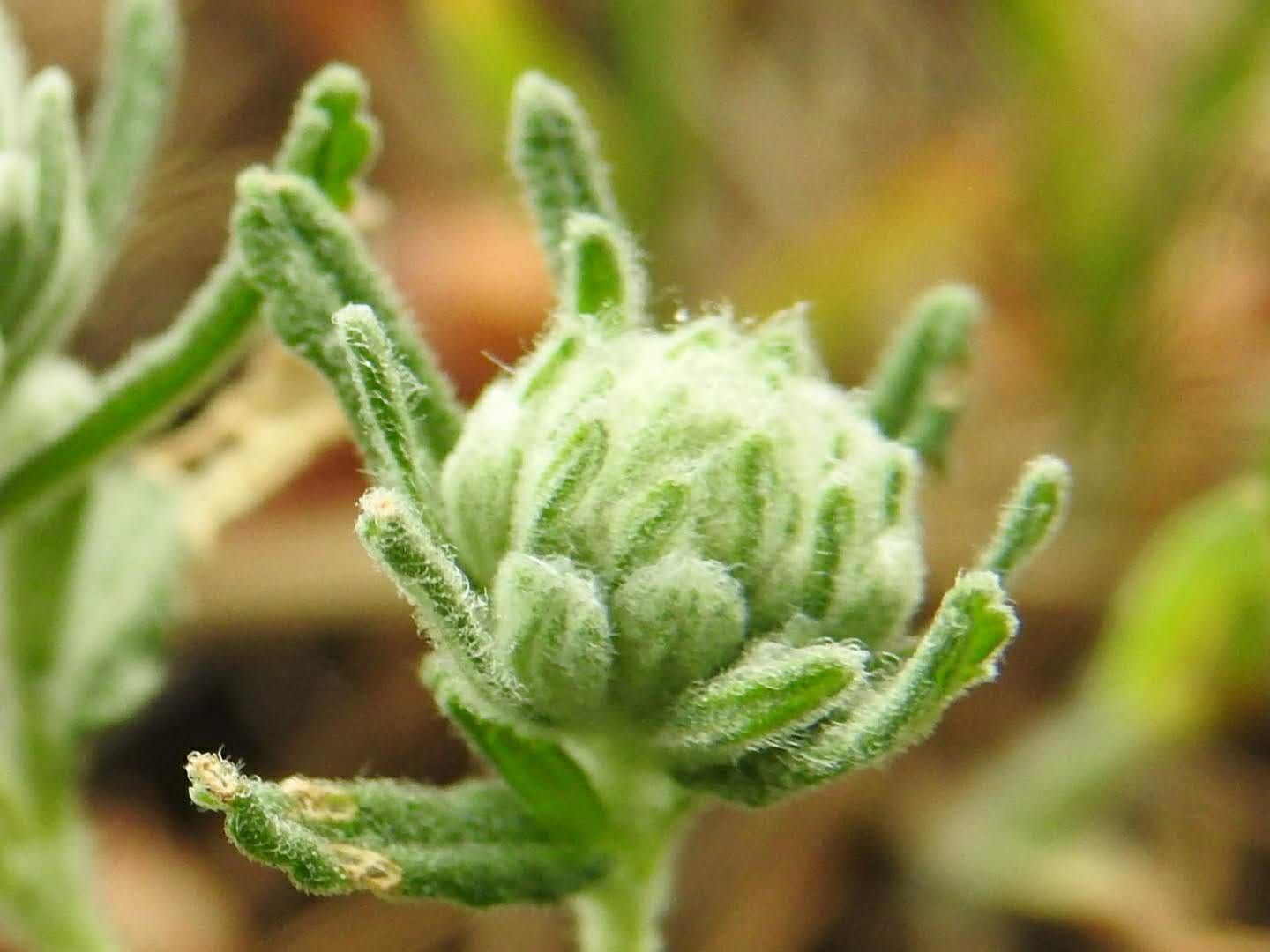
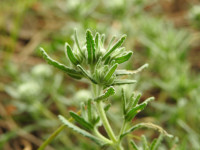
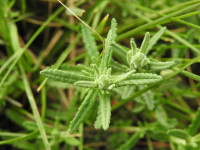
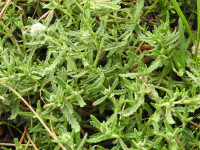
The Felty Germander is a small tufted subshrub with an erect-ascending habit, reaching a height between 20 and 35 cm, with extremes from 10 up to 45 cm. The stem is fragile, sometimes twisted, very leafy and densely pubescent with simple and branched hairs, non-glandular. The plants have woody stems only at the base.
The leaves are opposite, sessile, entire, erect-patent and often fascicled. Their shape is narrowly oblong-linear, with variable dimensions from 5-17 mm in length and 1.5-4 mm in width. They are characterized by a gray-tomentose surface on both sides, with crenate-wavy margins in the upper half, often revolute or flat.
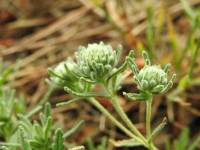
The inflorescence is branched and consists of dense terminal and axillary glomerules, flattened on top, with a diameter less than 1 cm. These glomerules are borne on short peduncles of 5-14 mm and gather numerous hermaphrodite, zygomorphic flowers. The bracteoles are sessile, lanceolate and shorter than the flowers.
The calyx is campanulate, densely tomentose, 2.3-3.5 mm long, with five short, triangular and concave teeth, all obtuse at the apex. The corolla, 3.5-4.5 mm long, is bilabiate with the upper lip absent and the lower lip 5-lobed, with a yellow throat. The color varies from creamy white to pink, with the lateral lobes small and reflexed, while the proximal ones are glabrous or ciliate. The stamens are four, didynamous, with filaments that twist spirally after anthesis; the anthers are brown-reddish.
The fruit is a schizocarp composed of four ovoid, reticulated mericarps of light chestnut color.
Habitat and distribution
This species is typical of Mediterranean regions, with a distribution limited to coasts and areas characterized by the "Olive area". In Italy, it is present only with the nominal subspecies. It grows in dry and sunny environments such as garrigues, rocky places, stabilized dunes and mountainous areas up to 1800 meters in altitude. It prefers well-drained soils, often calcareous or stony.
It is a heliophilous and xerophilous species, meaning it prefers very sunny exposures and conditions of low water availability.
Flowering period
Flowering extends from March to August, with possible variations related to altitude and latitude. In warmer climates and coastal areas, flowers may appear as early as March, while in the mountains flowering lasts until late summer.
Ecology and pollination
Pollination occurs mainly through insects (entomogamous), which are attracted by the zygomorphic flowers and the light colors of the lower lip of the corolla. Details on possible seed dispersal are not specifically documented, but as with many Lamiaceae, dissemination probably occurs by falling and secondary transport by external agents such as animals or wind.
Curiosities and traditional uses
The Felty Germander has a long history of medicinal use, although today its use is discouraged due to its hepatotoxicity. Traditionally it was used to treat disorders such as stomach ache, cold and fever. However, the toxicity of its active principle requires caution and limits its modern use.
No known food uses or particular folkloric references are associated with this species.
Etymology
The generic name Teucrium derives from the Greek "τεύκριον" (teúkrion), already cited by Dioscorides, probably in honor of Teucer, a legendary Trojan king who, according to Pliny the Elder, was the first to use this plant for medicinal purposes. The specific epithet capitatum derives from the Latin "capitatus", meaning "with head", referring to the arrangement of the inflorescences gathered in dense heads or glomerules.
The Italian common name “Camedrio a testa grossa” precisely recalls the characteristic compact and globose shape of the inflorescences.
Sources
- Acta Plantarum - Flora delle regioni italiane (scheda di Anja Michelucci)
Characteristics
Scheda botanica
| Famiglia | Lamiaceae |
|---|---|
| Fioritura | marzo – agosto |
| Forma biologica | Suffruticose |
| Habitat | with white flowers |
Domande frequenti
- Quando fiorisce Felty Germander?
- Felty Germander fiorisce marzo – agosto.
- Che tipo di pianta è Felty Germander?
- Felty Germander è una Chamaephyte (Suffruticose) secondo la classificazione di Raunkiaer.
- A quale famiglia appartiene Felty Germander?
- Felty Germander appartiene alla famiglia botanica Lamiaceae.
Where I found it (5 sightings)
Classification
- Kingdom
- Plantae
- Family
- Lamiaceae
- Full name
- Teucrium capitatum L. subsp. capitatum
- Synonyms
- Teucrium polium L. subsp. capitatum (L.) Arcang.
- Life form
- Chamaephyte suffruticose
Similar species
Search for species with similar characteristicsFurther reading
Noticed an error in the identification? Write to me
Other species of the same family
Lamiaceae
Explore
Other species of Lamiaceae