Botanical species
Mentha suaveolens
Ehrh.
Apple Mint
Description
Morphological description
Perennial herbaceous plant, round-leaved mint is characterized by an erect or ascending habit, sometimes stoloniferous, which can reach a height of up to 90 cm. The stem is quadrangular, branched, and has a variably hairy surface, with simple and branched hairs, giving it a velvety texture. The base of the stem tends to become woody with age.
The leaves are generally sessile, arranged oppositely along the stem, ovate, oblong, or subround in shape, with dimensions approximately between 2-4 cm in width and 3-4.5 cm in length. The upper surface is intense gray-green, rough, and covered with appressed hairs, while the lower side is tomentose, with a dense cottony hairiness composed of simple and branched white hairs. The leaf margin is dentate or crenate-dentate, while the apex is rounded. The blade shows prominent veins and a herbaceous texture.
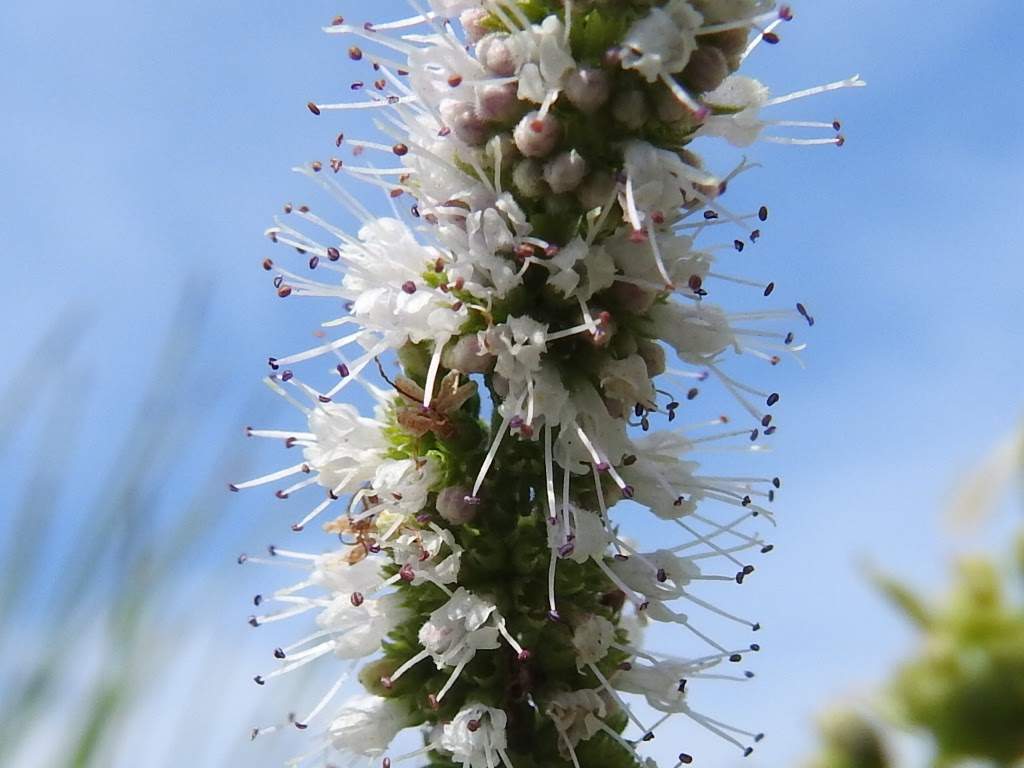
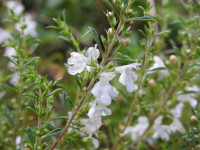
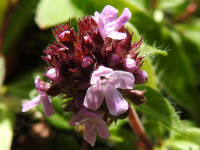
The flowers, hermaphroditic and fragrant, are gathered in terminal spike inflorescences (contiguous verticillasters) ranging from 3 to 9 cm long and fusiform in shape, with an acute apex. The inflorescences are very dense and formed by verticillasters of small flowers borne on very short peduncles (about 1 mm), with lanceolate bracteoles 3-5 mm long, ciliate and persistent. The calyx, 1-2 mm long, is gamosepalous, conical and tomentose, gray in color with triangular-lanceolate teeth. The corolla, 3-4 mm long, can be whitish or pale pink, with four subequal lobes and exserted stamens. The stigma is bifid.
The fruit is a microbasal schizocarp formed by four monospermous achenes, typical of Lamiaceae, although rarely observed in detail. The roots are rhizomatous and the plant tends to spread also through stolons.
The species is evergreen and has a characteristic odor, described as acrid and intense, due to the presence of aromatic essential oils.
Habitat and distribution
Round-leaved mint is a eurymediterranean species with a distribution mainly affecting the coasts and Mediterranean regions of Italy, extending also northwards and into some areas of Central and Eastern Europe. In Italy it is quite widespread especially in southern regions and along the coasts, but it is also found in inland areas up to 600 m altitude, with reports reaching up to 1500 m in southern zones.
It prefers humid habitats such as uncultivated lands, wet meadows, paths, ditches, and riverbanks. It favors fresh and well-drained soils, with exposure ranging from partially shaded to sunny. It is often present in anthropized environments and can behave as a weed due to its easy rhizomatous and stoloniferous growth.
The species adapts well to different soil types but shows preference for those rich in organic matter and with good water content.
Flowering period
Round-leaved mint blooms between May and October, with flowering duration and intensity varying depending on the region and local climatic conditions. In warmer and more humid Mediterranean areas, flowering tends to be more prolonged, while in cooler and mountainous areas it may be more concentrated in the summer months.
Ecology and pollination
The species has a reproductive strategy based on the production of hermaphroditic flowers, which facilitate self-pollination but are mainly pollinated by pollinating insects. Among the main pollinators are bees, bumblebees, and butterflies, attracted by the aromatic scent and nectar produced by the flowers. The arrangement of flowers in dense terminal spikes facilitates the attraction and visitation by insects.
Seed dispersal occurs through the small achenes produced, although the species also spreads effectively vegetatively thanks to stolons and rhizomes. This allows it to rapidly colonize new environments, often becoming a weed in cultivated soils or gardens.
Curiosities and traditional uses
Round-leaved mint has been known since antiquity for its aromatic and medicinal properties. Its English name “apple mint” alludes to the sweet scent, although in reality its odor is more acrid and intense compared to other mints.
Traditionally it has been used as a medicinal plant for its antiseptic, digestive, carminative, analgesic, and antifermentative properties. The menthol contained in the essential oils makes it useful for treating oral inflammations, promoting digestion, and soothing cough. In folk medicine it has also been employed to prevent cataracts, promote sleep, relieve renal and biliary colics, combat halitosis, and even stimulate sexual desire.
In popular culture it was believed that its scent kept rodents away, so in the past it was scattered in granaries precisely for this purpose. Even today, aside from medicinal use, the plant is used in cooking to flavor liqueurs, sweets, and some cosmetic preparations.
However, it is important to remember that medicinal and food uses must always be carefully evaluated and under specialist supervision.
Etymology
The genus name derives from the nymph Minthê of Greek mythology, loved by Hades and transformed into a plant by Proserpina out of jealousy. The specific name “suaveolens” means “with a sweet scent,” a somewhat ironic appellation since the species’ odor is actually quite acrid and intense.
The Italian common name “menta a foglie rotonde” refers to the characteristic shape of the leaves, rounder compared to other Mentha species, which often have more lanceolate or elongated leaves.
Sources
- Prof. S. Pignatti, Flora d'Italia
- Acta Plantarum - Flora delle regioni italiane (scheda di Giuliano Salvai)
- Tela Botanica / H. Coste, Flore descriptive et illustrée de la France
- World Flora Online (WFO)
Characteristics
Where I found it (4 sightings)
Classification
- Kingdom
- Plantae
- Family
- Lamiaceae
- Full name
- Mentha suaveolens Ehrh.
- Life form
- Emicriptofite scapose
Similar species
Search for species with similar characteristicsFurther reading
Noticed an error in the identification? Write to me
Other species of the same family
Lamiaceae
Explore
Other species of Lamiaceae