Botanical species
Ajuga reptans
L.
Bugle
Description
Morphological description
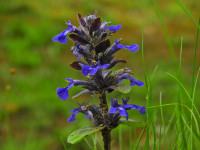
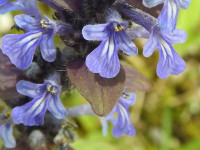
Perennial herbaceous plant, characterized by a tufted habit with erect flowering stems reaching a height between 10 and 30 cm. The base of the plant produces long creeping stolons, 10 to 30 cm long, which root at the nodes and allow the species to spread forming dense and continuous mats with a typical metallic green color, often with violet or coppery hues. The stems are quadrangular, with an angular cross-section and often alternately pubescent on two opposite faces at the top, sometimes with purple or violet coloration.
The basal leaves are arranged in a rosette, spatulate or obovate in shape, with entire or weakly crenate margins, about 8-12 cm long and 2-4 cm wide, supported by a petiole as long as the leaf blade. They have a herbaceous texture, glossy, often with violet coloration at the base. The cauline leaves are smaller, subsessile, arranged oppositely and decussate (crossed at 90° along the stem), and reduce to leaf-like bracts accompanying the inflorescence, of blue-violet color.
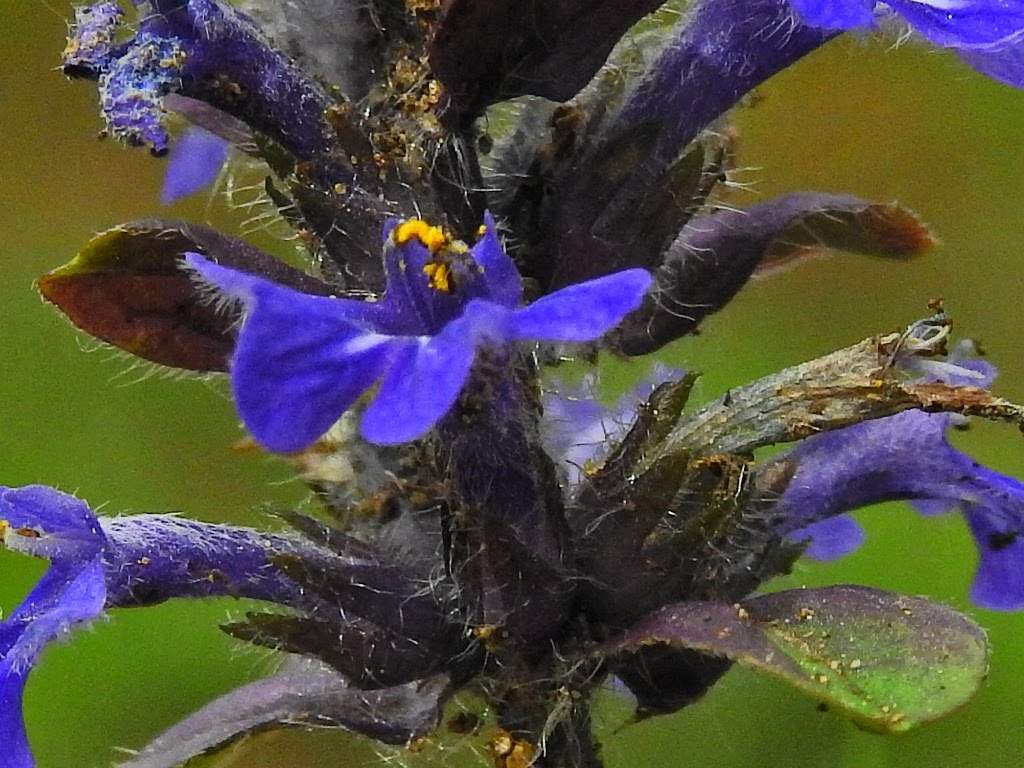
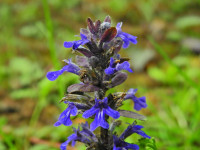
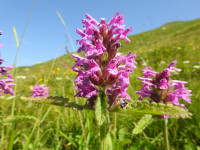
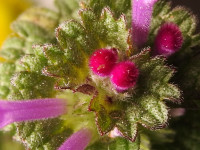
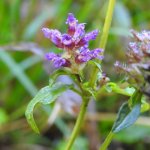
The inflorescence consists of verticillasters of 6-8 flowers each, located in the axils of the upper leaves; the bracts are smaller than the flowers and not colored. The calyx, 4-6 mm long, has teeth as long as the tube, and is often hairy. The corolla is bilabiate, blue-violet striped with white and dark blue, sometimes it may appear pink or whitish. The corolla tube, about 9-10 mm long, is pubescent internally; the upper lip is very reduced or absent, while the lower lip is trilobed with the central lobe larger and often divided into two parts. The stamens protrude from the corolla tube. The ovary is superior and four-locular.
The fruit is a tetrachene (drupe composed of four achenes), with a rough and reticulated surface, about 2.5 mm long.
The root system is fasciculate, connected to the stolons which allow the plant to rapidly colonize the surrounding soil.
Habitat and distribution
Typical species of Europe and the Caucasus, it is widely distributed in Italy and Mediterranean regions, where it grows mainly in cool and shady environments such as broadleaf forests, clearings, meadows, and grassy slopes. It prefers well-drained but moist soils, with exposure ranging from partial shade to full sun, showing good adaptability even in intense light conditions.
In Italy it is found up to 1500 meters altitude, especially in hilly and mountainous areas. It grows on grassy slopes, forest edges, and clearings, often forming extensive grassy mats thanks to its ability to propagate through stolons.
Flowering period
Flowering mainly occurs between May and June, with possible local variations depending on altitude and climate. In some areas the period may extend until July.
Ecology and pollination
The species reproduces both sexually through seeds and asexually through leafy stolons that root at the nodes, ensuring rapid expansion on the ground. The flowers, characterized by bilabiate corollas and vivid colors, are particularly attractive to pollinating insects such as bees, bumblebees, and butterflies, which favor pollination.
The protrusion of the stamens facilitates contact with pollinators. Seed dispersal occurs through the tetrachenes, which at maturity detach from the plant and are mainly transported by insects or external agents, contributing to the colonization of new environments.
Curiosities and traditional uses
This plant has historically been used in phytotherapy for its astringent, vulnerary, and anti-inflammatory properties. Traditionally it was used to alleviate inflammations of the oral cavity, reduce hemorrhoidal disorders, stop bleeding, and mitigate intestinal inflammations and diarrhea.
In cosmetics, it is appreciated for the treatment of delicate skin prone to couperose, thanks to its soothing properties.
As an edible plant, young shoots can be consumed raw in salads, enriching the flavor and providing nutritional benefits. However, it is important to remember that medicinal and food uses must be practiced with caution and under proper guidance.
Etymology
The generic name derives from the Latin “Ajuga”, composed of the privative prefix “a-” and “jugum” (yoke), probably referring to the absence of the upper lip in the corolla, which appears as “without yoke”.
The specific epithet “reptans” indicates the creeping habit of the stolons.
The Italian common name “Bugle” refers to the prostrate and spreading character of the plant, which extends horizontally on the ground.
Sources
- Prof. S. Pignatti, "Flora d'Italia"
- Acta Plantarum - Flora delle regioni italiane (scheda di Giuliano Salvai)
- World Flora Online (WFO)
Characteristics
Scheda botanica
| Famiglia | Lamiaceae |
|---|---|
| Fioritura | gennaio – aprile |
| Forma biologica | Creeping plants |
| Habitat | edible plant, creeping plant, with purple flowers |
| Uso alimentare | Commestibile |
| Uso officinale | Pianta officinale |
Domande frequenti
- Quando fiorisce Bugle?
- Bugle fiorisce gennaio – aprile.
- È commestibile Bugle?
- Bugle è considerata commestibile. Verifica sempre le parti eduli e la preparazione corretta prima del consumo.
- Che tipo di pianta è Bugle?
- Bugle è una Hemicryptophytes (Creeping plants) secondo la classificazione di Raunkiaer.
- A quale famiglia appartiene Bugle?
- Bugle appartiene alla famiglia botanica Lamiaceae.
Where I found it (10 sightings)
Classification
- Kingdom
- Plantae
- Family
- Lamiaceae
- Full name
- Ajuga reptans L.
- Life form
- Hemicryptophytes creeping plants
Similar species
Search for species with similar characteristicsFurther reading
Noticed an error in the identification? Write to me
Other species of the same family
Lamiaceae
Explore
Other species of Lamiaceae