Botanical species
Sternbergia lutea
(L.) Ker Gawl. ex Spreng.
Winter Daffodil
Description
Morphological description
Perennial bulbous plant belonging to the family Amaryllidaceae, characterized by a pear-shaped bulb, with a diameter between 1 and 4 cm, covered by membranous scales of dark brown color. The bulb is the perennial organ from which the plant annually develops flowers and leaves.
The leaves are 4 to 6 per specimen, rigid, linear and fleshy, with a leathery texture. They have a grooved upper surface and a rounded apex; the margins bear papillae that are wider than tall. The color is matte dark green and their position is erect or slightly curved outward. During flowering, the leaves appear and reach vegetative maturity at the end of the flowering period, exceeding in height the floral stem.
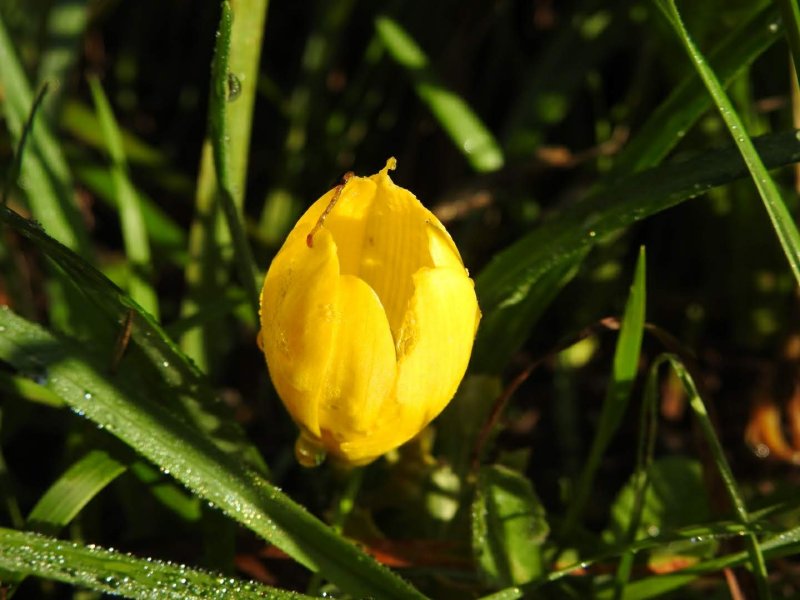
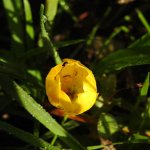
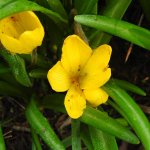
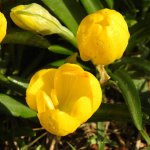
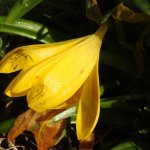
The flowers are solitary, bright and shining yellow, almost always enclosed by a membranous lanceolate spathe about 4 cm long and 1 cm wide, with a green edge. The perigonium consists of six oblong-elliptic tepals, fused at the base into a short tube of 6-8 mm; the lobes measure about 4 cm in length, with the three inner ones narrower and longer, all obtuse at the apex, between 1 and 2.3 cm wide. The flower has six unequal stamens, longer than half the length of the lobes, with well-visible orange anthers. The ovary is inferior and tricarpellary, with ovules arranged in two rows; the style is filiform and the stigma, small, is trilobed.
The fruit is a fleshy obovoid capsule, containing small, subglobose seeds protected by a black shell.
The plant reaches a variable height, with the floral stem generally shorter than the mature leaves.
Habitat and distribution
The species is widespread throughout much of the Italian territory and in various areas of the Mediterranean basin, with a range extending also to mountainous areas. In Italy it is present from the plains up to about 1200 meters of altitude.
It prefers habitats such as meadows, uncultivated fields, and edges of broadleaf woods. The soil is generally well-drained, with usually sunny or partially shaded exposure, typical of Mediterranean montane and submontane environments.
In the Mediterranean context, it can also be found in semi-desert and subdesert environments extending from the basin to Central Asia, consistent with the Mediterranean-Turanian chorological type.
Flowering period
Flowering occurs mainly between September and November. The period may undergo slight variations depending on altitude and local climatic conditions, but generally the plant flowers in autumn, when its showy yellow corollas emerge in meadows and woodland edges.
Ecology and pollination
The flower, with its bright yellow coloration and open structure, is adapted to pollination by pollinating insects, which are attracted by the color and nectar. The inferior ovary and the presence of well-developed stamens favor fertilization.
Seed dispersal occurs through dehiscence of the fleshy capsule, with small and protected seeds that can be transported by biotic or abiotic agents, although specific data on the mode of dispersal are not detailed in the sources.
Curiosities and traditional uses
The plant is notoriously toxic and should not be confused with cultivated saffron (Crocus sativus), either by habit or color. Ingestion of parts of this species can cause symptoms similar to colchicine poisoning, including severe digestive disorders such as enteritis, nephritis, vomiting, diarrhea, and internal hemorrhages that can lead to death. Inhalation of seed dust causes strong sneezing.
From a biological point of view, the species has been used in laboratory experiments for chromosome doubling, obtaining flowers with more complex characteristics.
In ornamental use, the bulbous plant is well suited to beautify flowerbeds and rock gardens, thanks to its autumn flowering and vivid color.
Etymology
The genus name, Sternbergia, is a tribute to G.M. Sternberg, a Bohemian botanist who lived between 1761 and 1838, recognized for discovering and studying these plants. The specific epithet "lutea" derives from Latin and refers to the yellow color of the flower.
The Italian common name "zafferanastro giallo" recalls the chromatic similarity with true saffron, while clearly distinguishing itself by species and botanical characteristics.
Sources
- Acta Plantarum - Flora delle regioni italiane (actaplantarum.org)
- Acta Plantarum - Flora delle regioni italiane (scheda di Antonino Messina)
Characteristics
Where I found it (6 sightings)
Classification
- Kingdom
- Plantae
- Family
- Amaryllidaceae
- Full name
- Sternbergia lutea (L.) Ker Gawl. ex Spreng.
- Synonyms
- Amaryllis lutea L.; Oporanthus luteus (L.) Herb.
- Life form
- Geofite bulbose
Similar species
Search for species with similar characteristicsFurther reading
Noticed an error in the identification? Write to me
Other species of the same family
Amaryllidaceae
Explore
Other species of Amaryllidaceae