Botanical species
Allium ursinum
L.
Ramsons
Description
Morphological description
A perennial herbaceous plant generally 20 to 40 cm tall, Ramsons is characterized by a slender oblong bulb, wrapped in whitish membranous tunics. The stem, or scape, is semicylindrical with two protruding angles, supporting the terminal inflorescence.
The leaves, usually two per plant, are basal, bright green and evergreen; they have an ovate-lanceolate shape, with dimensions ranging from 10 to 20 cm in length and 3 to 6 cm in width. They have a long winged petiole, which can reach up to 15 cm. These leaves emit an intense garlic-like odor, characteristic and easily recognizable when rubbed.
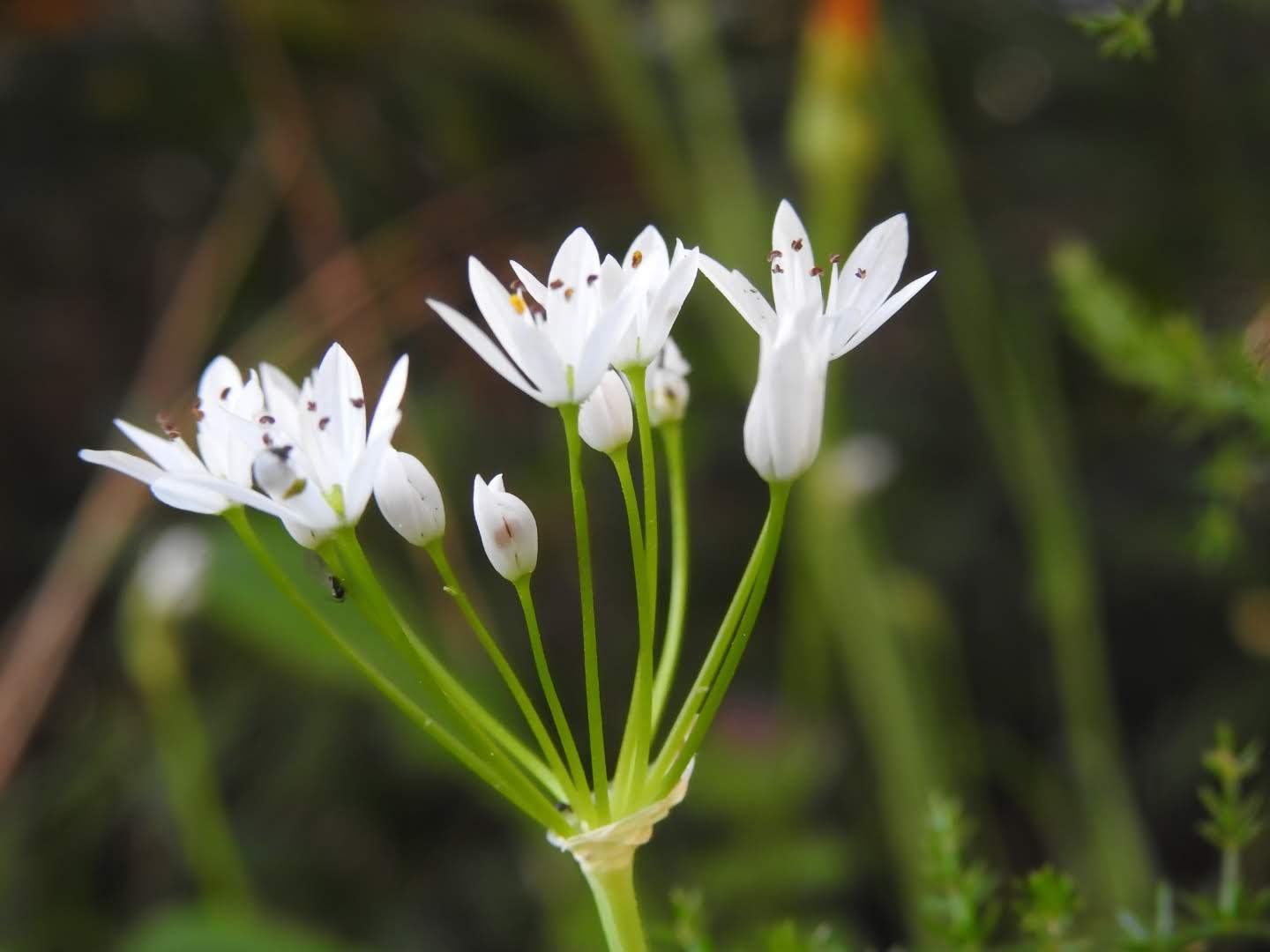
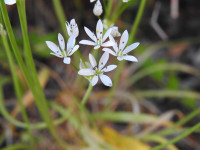
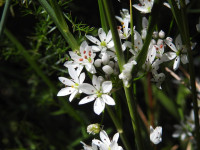
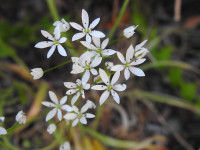
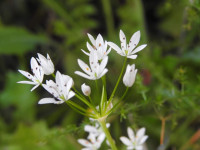
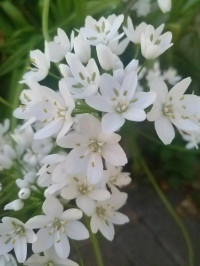
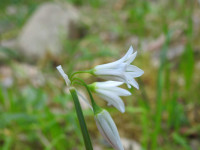
The inflorescence is an umbel composed of 6 to 20 white flowers, gathered in a subspherical shape 3-6 cm in diameter. Before flowering, the flowers are protected by two papery bracts, entire or divided into 2-3 lobes, which do not exceed the size of the umbel and fall off once the flowers open. The flowers have six white lanceolate tepals, about 1 cm long, which exceed the stamens. Each flower is supported by a peduncle up to 2 cm long.
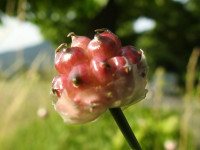
The fruit is a trilocular capsule that opens longitudinally, releasing up to six seeds. The root system consists of the bulb, which acts as a perennial and storage organ.
Habitat and distribution
Ramsons grows mainly in humid and shady woodland environments, preferring broadleaf forests rich in humus and fertile soils. It often develops in numerous colonies in wet areas, such as small valleys and clearings, from the lowlands up to the submontane belt, with an altitude ranging from 0 to about 1500 meters.
In Italy it is present throughout almost the entire territory, with greater diffusion in the northern and central regions, extending to Abruzzo in the subsp. ursinum, while the subsp. ucrainicum is reported in the central-southern regions. It is rarely found in higher alpine zones. In the Mediterranean area, the species is also widespread in other countries with similar climatic and environmental conditions, always in humid and cool forests.
Flowering period
Flowering occurs in spring, generally between April and June. In some areas, especially cooler or mountainous ones, flowering can start in April and continue until June, while in warmer areas it may be anticipated.
Ecology and pollination
Ramsons reproduces sexually through seeds produced by the capsules, but also spreads vegetatively through the bulb, thus forming large colonies. The white, fragrant flowers rich in nectar attract various pollinating insects, particularly bees and other hymenopterans, which facilitate pollination.
The reproductive strategy is therefore entomogamous, with seed dispersal mainly by gravity-dispersal (dispersal by falling). The absence of bulbils in the inflorescence distinguishes the species from other similar Allium.
Curiosities and traditional uses
Ramsons has been known since ancient times for its medicinal and nutritional properties. The fresh leaves, with a delicate but aromatic flavor, are used in cooking in spring to flavor salads, butter, soups, potatoes, chicory, eggs, and broths. It is important to add them at the last moment to preserve their characteristic aroma and flavor. The bulb can replace common garlic in many preparations.
Among traditional preparations, in Slovenia an oil is produced from Ramsons leaves, used as a condiment for boiled potatoes, toasted bread, pasta, and fish dishes such as mackerel or cod. This preparation resembles Genoese pesto and is made from finely chopped leaves, almonds, salt, pepper, and extra virgin olive oil.
From a medicinal point of view, Ramsons shares many properties with common garlic, being anthelmintic, diuretic, gastric stimulant, antiseptic, choleretic, and blood purifier. Fresh leaves can be used externally in poultices to soothe abscesses and boils thanks to their rubefacient properties.
An important aspect is to avoid confusion with toxic plants such as lily of the valley (Convallaria majalis), especially before flowering. The characteristic and intense garlic odor is a valid distinguishing criterion.
Etymology
The genus name Allium derives from classical Latin, although the exact etymology is uncertain. Several hypotheses suggest an origin from an Indo-European root indicating a bitter herb, or from linguistic borrowings from Greek or ancient Italic languages. An interesting theory connects the term to the word indicating the "wings" or cloves of the bulb.
The specific name ursinum means "of bears," probably referring to the woodland environments where the plant grows or to a popular belief that bears, just out of winter hibernation, feed on this plant to purify themselves.
The common Italian name "Ramsons" precisely recalls this association with the bear and the garlic-like aromatic characteristic.
Sources
- Acta Plantarum - Flora delle regioni italiane (scheda di Mirna Medri)
- World Flora Online (WFO)
Characteristics
Where I found it (6 sightings)
Classification
- Kingdom
- Plantae
- Family
- Amaryllidaceae
- Full name
- Allium ursinum L.
- Synonyms
- Allium ursinum L. subsp. ucrainicum Oksner & Kleopow; Nectaroscordum ursinum (L.) Galasso & Banfi
- Life form
- Geofite bulbose
Similar species
Search for species with similar characteristicsFurther reading
Noticed an error in the identification? Write to me
Other species of the same family
Amaryllidaceae
Explore
Other species of Amaryllidaceae