Botanical species
Narcissus tazetta
L.
Bunch-flowered Daffodil
Description
Morphological description
Perennial bulbous herbaceous plant, generally 20 to 70 cm tall, with an ovoid bulb of variable size about 3-6 cm long and 3-5 cm wide, covered by tunics of light or dark brown color. The roots are fasciculate and filiform, originating from the bulb.
The flowering scape is leafless, striated and generally compressed with two edges, more rarely cylindrical, reaching lengths from 20 to 35 cm. The basal leaves are 3-6 in number, herbaceous in texture, linear-lanceolate in shape, 8 to 20 mm wide, flat or slightly canaliculate, often glaucescent, with an acute apex; they are erect in the juvenile phase, then become more patent during flowering, but never exceeding the flowering scape in height.
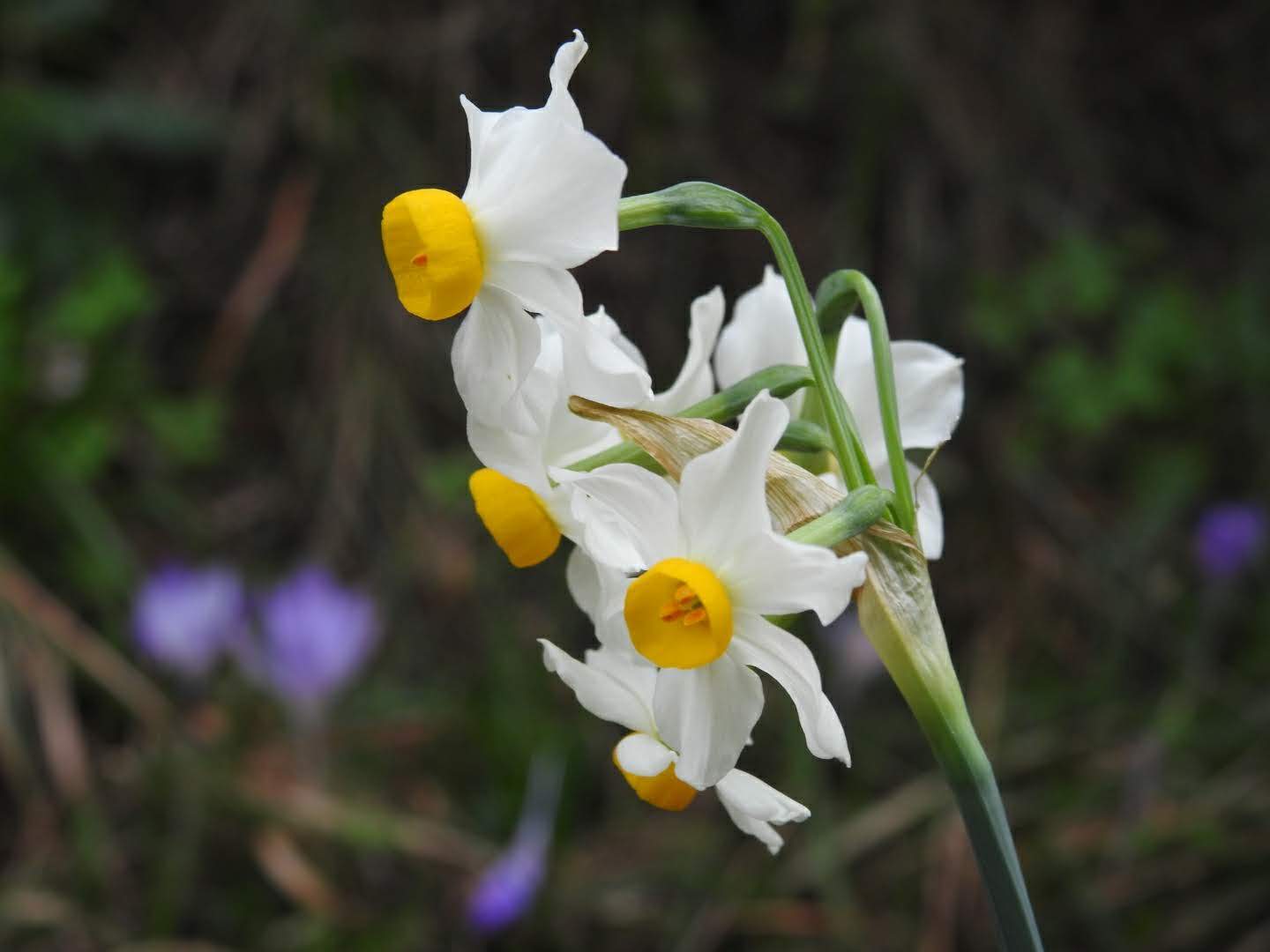
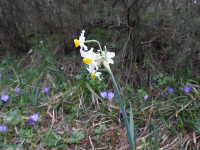
The flowers are grouped in umbel inflorescences (5-15 flowers) with peduncles of variable length up to about 8 cm; they are pendulous, patent or slightly inclined, and are very fragrant. The spathe is membranous, whitish or brownish, about 4-6 cm, with a lateral opening.
The perigonium is formed by six tepals arranged in two whorls, milky white or whitish in color, ovate or ovate-lanceolate in shape, 10-15 mm long and 5-10 mm wide, with an acute apex. The perigonium tube is 15-20 mm long, narrow and slightly widened towards the base.
At the throat of the perigonium is the corona (paracorolla) of bright yellow color, cup- or bowl-shaped, with a height diameter of 3-6 mm and width of 5-10 mm, with an entire or crenulated margin. In some cultivated or subspontaneous specimens the corona can be white.
The stamens are six, inserted inside the perigonium tube, with three shorter included and three longer protruding at the mouth of the corona; the anthers are oblong, borne on short or intermediate filaments. The ovary is inferior.
The fruit is an obovoid, loculicidal capsule containing black seeds.
Polymorphic species presenting several subspecies in the Italian territory, including subsp. italicus and subsp. aureus; the nominal subsp. tends to have a more modest habit in xerophilous environments, with height less than 20-21 cm and fewer leaves.
Habitat and distribution
It is a typical species of Mediterranean regions, widespread along coasts and inland areas up to 1200 m altitude. In Italy it is mainly found in coastal regions and in woodland or woodland edge environments, in humid meadows and clearings, but also in areas with calcareous soils and outcropping rocks with sparse herbaceous cover and xerophilous conditions.
Typical plant associations include species such as Ruscus aculeatus, Asparagus acutifolius, Rubus ulmifolius, Helleborus viridis subsp. bocconei, Viola alba subsp. dehnhardtii, Rosa agrestis, Cyclamen hederifolium, Anemone hortensis subsp. hortensis, and Rubia peregrina.
The species prefers sunny or semi-shaded exposures, with generally well-drained and moderately moist soils, but is also adaptable to drier conditions, where it tends to reduce its development.
Flowering period
Flowering mainly occurs between February and April, with possible variations depending on local climatic and altitudinal conditions. In milder Mediterranean climates, flowers can appear as early as late winter.
Ecology and pollination
The flowers are strongly fragrant and attract numerous pollinating insects; the scent and shape of the flowers are adapted to entomophilous pollination, particularly by bees and other pollinating insects active in the early seasons of the year.
The arrangement of flowers in pendulous umbels favors visibility and access for pollinating insects. The presence of both included and protruding stamens facilitates pollen transfer.
The seeds, contained in loculicidal capsules, are black and mainly dispersed by falling to the ground; no particular long-distance dispersal strategies are known.
Curiosities and traditional uses
The Italian narcissus is a toxic plant, due to the presence of alkaloids such as narcisine, which make ingestion dangerous for both humans and animals: cases of poisoning have been reported even in grazing cattle.
Historically it has been used in folk medicine as an analgesic, emetic, antispasmodic, anticonvulsant, and febrifuge; the bulb reduced to a pulp was applied externally for the treatment of boils and abscesses.
From a cultural point of view, the narcissus is among the most celebrated flowers in Greek and Latin mythology, linked to the myth of Narcissus, a young man who fell in love with his own reflection in the water and who, according to legend, transformed into the flower that bears his name. The term "narcissus" is also associated with the narcotic power and the intense fragrance of the plant.
Etymology
The genus name "Narcissus" derives from the Greek "nàrke" meaning "stupor" or "intoxicating," probably referring to the narcotic effect of the plant or its intense fragrance. According to Pliny, the name refers to the narcotic effect of its essences.
The specific epithet "tazetta" indicates the shape of the corona, similar to a small cup (in Italian "tazza"), which characterizes the flower.
The common Italian name "narciso italiano" emphasizes its typical distribution and presence in the Italian Mediterranean regions.
Sources
- Acta Plantarum - Flora delle regioni italiane (actaplantarum.org)
- Acta Plantarum - Flora delle regioni italiane (scheda di Antonino Messina)
- Tela Botanica / H. Coste, "Flore descriptive et illustrée de la France"
- World Flora Online (WFO)
Characteristics
Where I found it (21 sightings)
Classification
- Kingdom
- Plantae
- Family
- Amaryllidaceae
- Full name
- Narcissus tazetta L.
- Life form
- Geofite bulbose
Similar species
Search for species with similar characteristicsFurther reading
Noticed an error in the identification? Write to me
Other species of the same family
Amaryllidaceae

Explore
Other species of Amaryllidaceae