Botanical species
Pancratium maritimum
L.
Sea Daffodil
Description
Morphological description
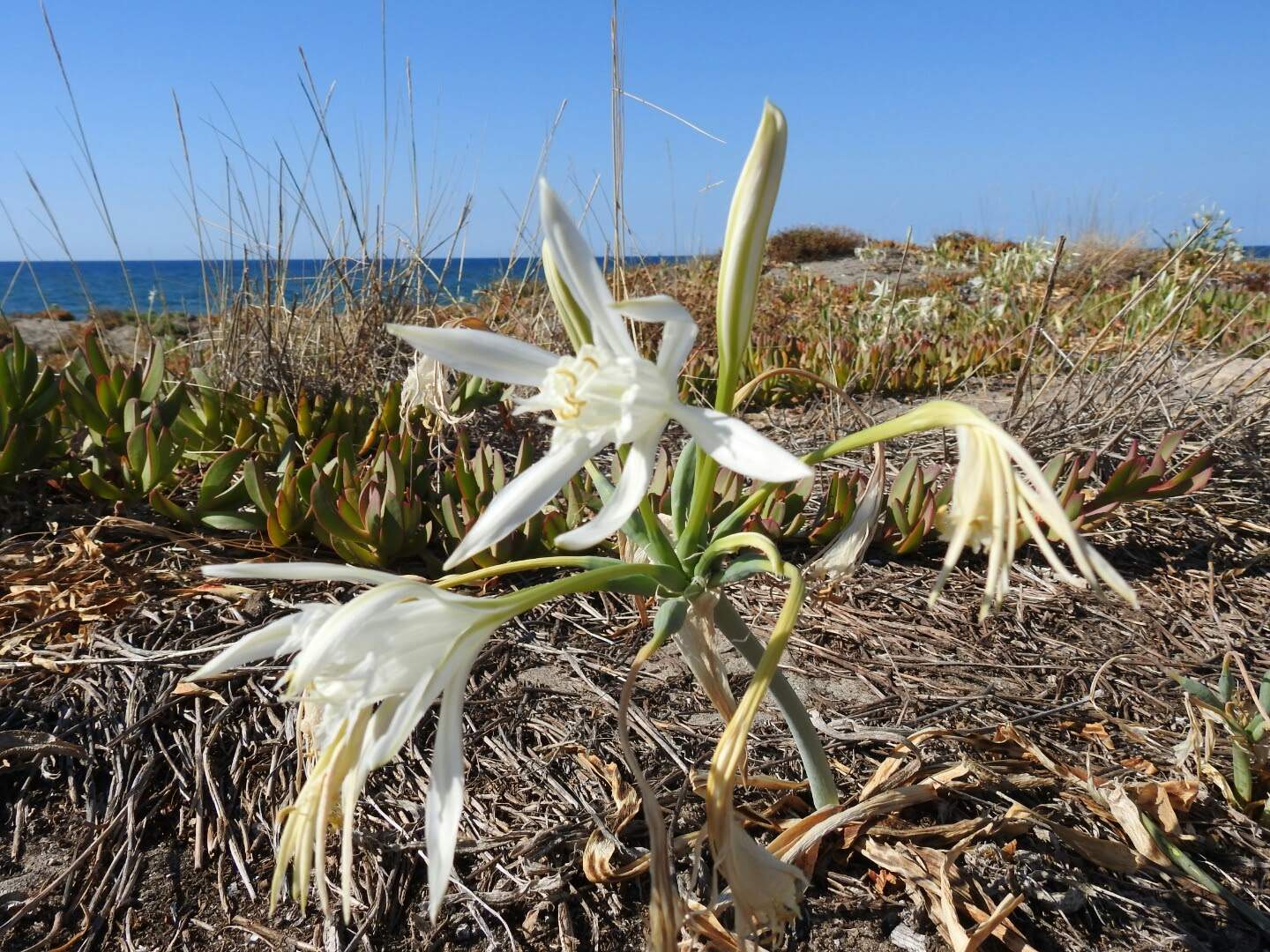
Perennial herbaceous plant 30 to 60 cm tall, the Sea Daffodil is distinguished by its rather large ovoid bulb (5-6 cm), covered by dark membranous tunics. From this underground tuberous organ, leaves and flowers develop every year. The stem is a leafless, compressed scape, supporting at the apex an umbel inflorescence with 3-15 flowers.
The leaves, generally 5-6 per plant, are all basal, glaucous green in color, up to 50-60 cm long and 1-1.5 cm wide. They have a linear blade, often twisted into a spiral, and may wither during flowering. The stem is robust but leafless.
The flowers are large, white, actinomorphic and hermaphroditic, very fragrant, with a funnel-shaped perigonium featuring a long and narrow tube, about 5-8 cm, greenish in color, gradually widening in the upper part. The perigonium is composed of six lanceolate tepals, mucronate at the apex and with a median green external stripe. The paracorolla is wide, campanulate, with 6 bifurcated lobes forming 12 sharp triangular teeth, arranged in pairs between the stamens. The stamens are six, with filaments fused to the paracorolla, bearing linear yellow dorsifixed anthers. The style is filiform and extends beyond the ovary, ending with a capitate stigma.
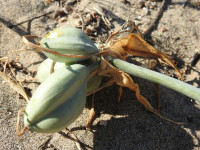
The fruit is a trilocular obovoid capsule, which opens by locules to release numerous compressed seeds, protected by a spongy, black, and angular pericarp. This characteristic allows the seeds to float and facilitates dispersal by marine currents.
Habitat and distribution
The Sea Daffodil is a typical species of Mediterranean coasts, present along sandy shores and dunes throughout the basin, including the major and minor Italian islands (except for the northernmost coasts of Friuli Venezia Giulia). It preferably grows on beaches, dunes, and sandy shores, with direct maritime exposure, in environments characterized by dry and brackish sandy soils. Its presence is limited to coastal areas, generally not exceeding sea level.
This habitat, extremely exposed and harsh, is characterized by high salinity and strong sunlight, to which the plant is well adapted thanks to its morphological and physiological features. The species is considered steno-Mediterranean, i.e., with a distribution strictly limited to Mediterranean climate and environments.
In Italy it is rather rare and threatened, mainly due to anthropic pressure on the coasts for tourism and bathing purposes, which reduce its natural habitat.
Flowering period
Flowering mainly occurs between July and September, with possible slight local variations related to microclimate and exposure. During this period, the very fragrant white flowers open on the umbel inflorescence, attracting pollinating insects.
Ecology and pollination
The Sea Daffodil is pollinated by insects (entomogamous pollination), attracted by the intense fragrance and the shape of the flowers. The flower structure, with the long tubular corolla and the toothed paracorolla, facilitates access for pollinating insects, which carry pollen from flower to flower.
Seed dispersal occurs mainly through barochory, but thanks to the spongy and floating pericarp, dispersal by marine currents (hydrochory) is also very efficient, allowing colonization of new sandy coastal areas.
Curiosities and traditional uses
The genus name Pancratium derives from the Greek “pan” (all) and “kratys” (powerful, strong), probably referring to the plant’s ability to survive in extreme environmental conditions such as dry and saline sandy dunes, or to its supposed medicinal virtues. The specific epithet “maritimum” clearly indicates the marine habitat in which it grows.
The seeds with spongy pericarp are an evolutionary adaptation that allows dispersal via the sea, facilitating the spread of the species along Mediterranean coasts. This mechanism is particularly interesting from an ecological point of view.
No significant current food or medicinal uses are reported; however, historically, some sources attributed therapeutic properties to the genus, presumably linked to related plants of the Amaryllidaceae family. The plant is nonetheless appreciated for its ornamental value and beauty, as well as for the intense fragrance of its flowers.
Etymology
The scientific name Pancratium maritimum derives from Greek and Latin terms: “Pancratium” combines “pan” (all) and “kratos” (powerful), alluding to the resistance of plants of this genus to harsh environmental conditions. The epithet “maritimum” means “maritime,” referring to the coastal habitat.
The Italian common name “Sea Daffodil” recalls the resemblance of the white and fragrant flowers to lilies, as well as the typically coastal habitat in which the species grows.
Sources
- Acta Plantarum - Flora delle regioni italiane (scheda di Anja Michelucci)
- Tela Botanica / H. Coste, "Flore descriptive et illustrée de la France"
Characteristics
Scheda botanica
| Famiglia | Amaryllidaceae |
|---|---|
| Fioritura | luglio – settembre |
| Forma biologica | Bulbous |
| Habitat | with white flowers, fragrant plant, with fragrant flowers |
Domande frequenti
- Quando fiorisce Sea Daffodil?
- Sea Daffodil fiorisce luglio – settembre.
- Che tipo di pianta è Sea Daffodil?
- Sea Daffodil è una Geophytes (Bulbous) secondo la classificazione di Raunkiaer.
- A quale famiglia appartiene Sea Daffodil?
- Sea Daffodil appartiene alla famiglia botanica Amaryllidaceae.
Where I found it (14 sightings)
Classification
- Kingdom
- Plantae
- Family
- Amaryllidaceae
- Full name
- Pancratium maritimum L.
- Synonyms
- Pancratium angustifolium Lojac.; Pancratium linosae Soldano & F.Conti
- Life form
- Geophytes bulbous
Similar species
Search for species with similar characteristicsFurther reading
Noticed an error in the identification? Write to me
Other species of the same family
Amaryllidaceae
Explore
Other species of Amaryllidaceae