Botanical species
Allium sphaerocephalon
L.
Round-Headed Leek
Description
Morphological description
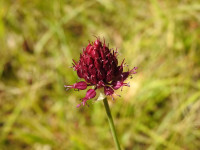
Perennial herbaceous plant, the Round-Headed Leek has an erect habit and a height ranging from 30 to 80 cm, occasionally reaching up to 120 cm. The root system is bulbous: the bulb is ovoid in shape and is usually surrounded by small bulbils, all enclosed in a pale yellow tunic. The floral scape is simple, cylindrical, solid, and unbranched.
The leaves, from 2 to 6 per individual, are sessile and clasping, meaning they embrace the scape at their base, and are gathered in the lower half of the stem. Their shape is linear, with a more or less cylindrical section or deeply grooved on the upper surface; they are hollow only at the base and end with a sharp point.
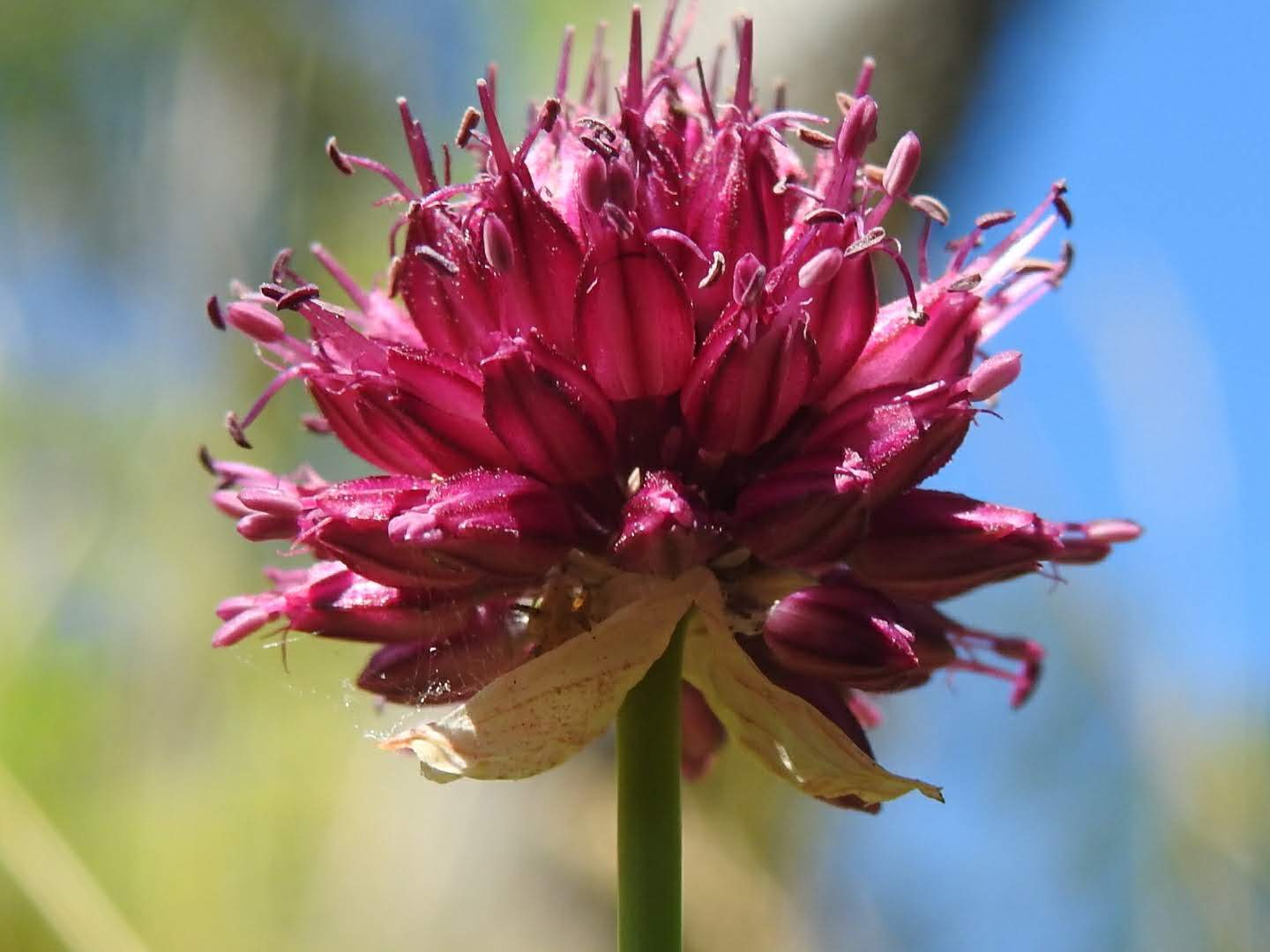
The inflorescence consists of a single umbel, spherical or subspherical-oblong in shape, densely covered with numerous flowers. The flowers are supported by peduncles of variable length (8-12 mm), with the outer ones slightly longer than the perianth and often thickened below the flower. At the base of the umbel there is a broad spathe, formed by 2-4 short, oval, and pointed valves.
The flowers are hermaphroditic, with a bell-shaped perianth formed by obtuse tepals 3.5-5.5 mm long, pink or purple of varying intensity, rarely white. There are six erect stamens, often protruding beyond the tepals; the three inner stamens have filaments equipped with two long and pointed staminal stipules. The ovary is superior, green in color, with a long brown style protruding about 2 mm beyond the tepals.
The fruit is a small capsule containing triangular-shaped seeds.
Habitat and distribution
In Italy, the Round-Headed Leek is present in all regions and is particularly common in the Peninsula and the major islands, while it appears rarer in Northern Italy. Its range also extends to the Mediterranean basin and some areas of North Africa, belonging to the paleotemperate and Euroasiatic species, with a particular affinity for Mediterranean environments.
It prefers habitats characterized by rocky slopes, dry soils, uncultivated lands, and vineyards, growing from the plains up to about 1,900 meters in altitude. It develops in xerothermophilous environments, i.e., sunny and warm-dry climates, typical of hilly and mountainous areas up to the subalpine limit.
Flowering period
Flowering mainly occurs between June and August, with slight variations depending on latitude and altitude. In more southern territories and at lower elevations, flowering may start earlier, while in cooler areas and at higher altitudes it may extend towards the end of summer.
Ecology and pollination
The spherical and dense umbel inflorescence, with pink-purple flowers, attracts various pollinating insects, particularly bees and other pollinators that favor fertilization. The presence of protruding stamens facilitates contact with insects during flower visits.
Seed dispersal occurs through the dropping of mature capsules onto the ground; the triangular shape of the seeds suggests primarily barochorous dispersal (by falling), without particular adaptations for long-distance dissemination by wind or animals.
Curiosities and traditional uses
The Round-Headed Leek belongs to a genus known since antiquity for its nutritional and medicinal properties. The species is edible and medicinal, with a long traditional use in phytotherapy. In particular, some health benefits are recognized related to the reduction of blood pressure, control of hypercholesterolemia, and prevention of atherosclerotic plaque formation, conditions typical of aging.
Recent studies have also highlighted potential antithrombotic and antineoplastic activities, making this plant a subject of interest for drug production. Nevertheless, the species is easily found in the wild, and its properties are also exploited in the food sector, albeit with caution.
The common name “Round-Headed Leek” probably reflects the pungent odor typical of plants in the genus Allium, similar to that of cultivated garlic, and perhaps an ancient association with snakes, animals with which the plant shares dry and sunny habitats.
Etymology
The genus name Allium derives from classical Latin, although the etymological origin is debated: some hypotheses link it to an Indo-European root meaning “bitter herb” or to linguistic borrowings from Greek or ancient Italic languages. One interpretation suggests a connection with the word “ala” (referring to bulbs divided into cloves).
The specific name sphaerocephalon means “spherical head,” a clear reference to the globose shape of the inflorescence characterizing this species.
The Italian common name “Aglio delle bisce” recalls both the belonging to the genus Allium (which includes various garlic species) and a traditional association with snakes, probably due to the preferred habitat of both.
Sources
- Acta Plantarum - Flora delle regioni italiane (actaplantarum.org)
- Acta Plantarum - Flora delle regioni italiane (scheda di Giuliano Salvai)
- World Flora Online (WFO)
Characteristics
Scheda botanica
| Famiglia | Amaryllidaceae |
|---|---|
| Fioritura | maggio – agosto |
| Forma biologica | Bulbous |
| Habitat | edible plant, with pink flowers, with purple flowers |
| Uso alimentare | Commestibile |
| Uso officinale | Pianta officinale |
Domande frequenti
- Quando fiorisce Round-Headed Leek?
- Round-Headed Leek fiorisce maggio – agosto.
- È commestibile Round-Headed Leek?
- Round-Headed Leek è considerata commestibile. Verifica sempre le parti eduli e la preparazione corretta prima del consumo.
- Che tipo di pianta è Round-Headed Leek?
- Round-Headed Leek è una Geophytes (Bulbous) secondo la classificazione di Raunkiaer.
- A quale famiglia appartiene Round-Headed Leek?
- Round-Headed Leek appartiene alla famiglia botanica Amaryllidaceae.
Where I found it (13 sightings)
Classification
- Kingdom
- Plantae
- Family
- Amaryllidaceae
- Full name
- Allium sphaerocephalon L.
- Life form
- Geophytes bulbous
Similar species
Search for species with similar characteristicsFurther reading
Noticed an error in the identification? Write to me
Other species of the same family
Amaryllidaceae
Explore
Other species of Amaryllidaceae