Botanical species
Allium ampeloprasum
L.
Wild Leek
Description
Morphological description
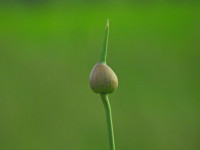
Perennial herbaceous plant belonging to the family Amaryllidaceae, it has an erect habit and can reach variable heights, generally between 40 and 70 cm, but occasionally up to 180 cm. The root system is bulbous: the bulb is ovoid, covered by membranous tunics of white or yellowish color, often accompanied by pointed lateral bulbils.
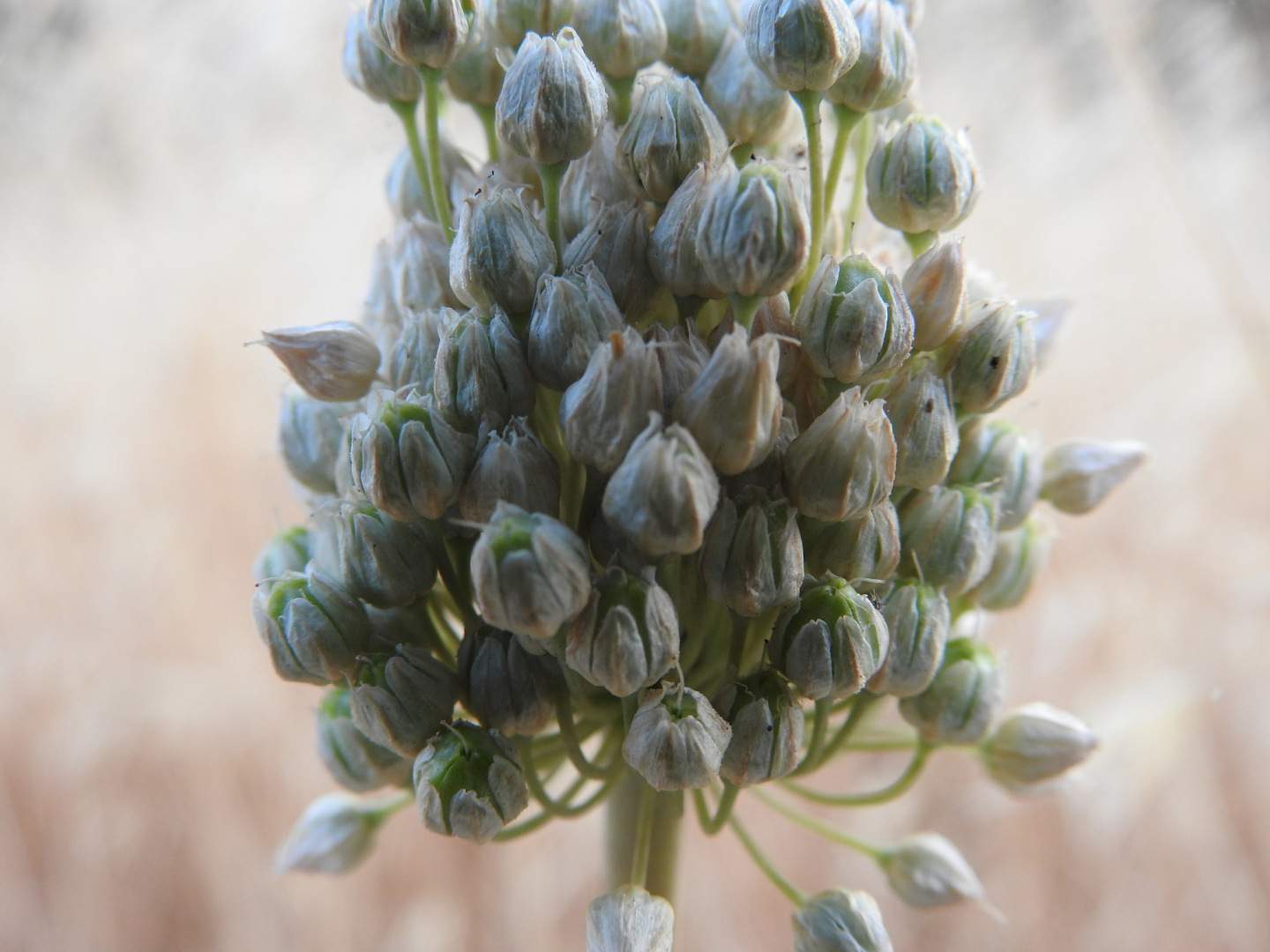
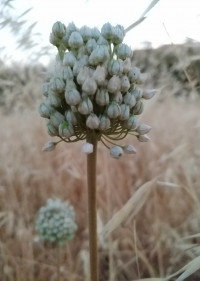
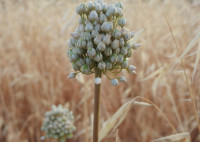
The scape, cylindrical and robust, is unbranched and can be green or take on pinkish hues; it bears at the top a globose inflorescence enclosed, before flowering, by a membranous and papery spathe that falls once the flowers open. The leaves are linear, 5 to 25 cm wide, slender and keeled with finely denticulate margins and rough to the touch. Their color varies from gray-green and they present a strong characteristic garlic odor. These leaves clasp the lower part of the scape and can be from 4 to 10, often withering during flowering.
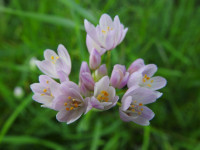
The inflorescence is a large spherical umbel, very dense, composed of a large number of small flowers (up to 500 per inflorescence). The flowers are hermaphroditic, actinomorphic, with a perianth formed by 6 lanceolate tepals, acute or obtuse, of variable color from white to pink-lilac, often with a median stripe of purple or greenish color. The anthers are yellow, and the inner stamens have wide and flat filaments ending in two filiform appendages that surpass the anther. The style protrudes beyond the other organs. The fruit is a loculicidal capsule containing triangular seeds.
Habitat and distribution
The species is widespread throughout the Mediterranean area, with a range extending from the Mediterranean coasts inland, up to north and east, in areas characterized by the presence of the vine, from which the specific name also derives. In Italy it grows mainly in environments such as cultivated fields, vineyards, semi-shaded places, woods, hedges, roadside margins especially near coastal areas and in olive-growing areas. In France it is found in dry places such as hedges and embankments, also on some islands like the island of Yeu and Corsica. The plant prefers well-drained soils, with sunny or partially shaded exposure, and can be found from the plains up to medium altitudes, in typically Mediterranean habitats.
Flowering period
Flowering is concentrated in the months of April-June in Italy, shifting slightly towards June-July in the more southern areas or in the French Mediterranean areas. The spathe that protects the inflorescence falls at the time of flower opening, which thus form a dense umbel of small flowers colored from white to pink-lilac.
Ecology and pollination
The species is generally pollinated by pollinating insects attracted by the dense umbel of flowers and their color and odor. The presence of numerous hermaphroditic flowers favors good sexual reproduction; the flowers are structured to facilitate entomophilous pollination. Seed dispersal occurs through the loculicidal capsule which, at maturity, opens releasing the triangular seeds, which can fall to the ground to germinate. No bulbils are present in the inflorescence, although the plant produces lateral bulbils at the base.
Curiosities and traditional uses
Also known as wild leek, this plant is the wild form of the common cultivated leek. It is edible and has always been used in cooking especially in winter, when its leaves are more tender; it can be used for soups, omelets, savory pies or eaten raw in mixed salads.
From a medicinal point of view, it has been appreciated for its numerous properties: anti-cholesterolemic, anti-asthmatic, antispasmodic, antiseptic, diuretic, expectorant and tonic. It contains fatty acids (stearic, linoleic, palmitic), sugars, mucilages, pectins, proteins, mineral salts such as iron and vitamins C, B1 and E. Traditionally it has been used to promote digestion, regulate the intestine, lower blood pressure, dissolve kidney stones, prevent cramps and colds, help expel intestinal worms and reduce cholesterol.
A popular legend reports that Emperor Nero consumed leeks before his singing performances to clear his voice.
Etymology
The genus name "Allium" derives from classical Latin, but its origin is uncertain and much debated. Among the most accredited hypotheses are Indo-European roots referring to bitter herbs, borrowings from Greek or southern Italic languages, or a reference to the bulbous structure divided into segments ("ali"). The specific name "ampeloprasum" literally means "vineyard leek," indicating its preferential habitat in vine-growing areas. In Italian it is known as "aglio porraccio" for its resemblance and relationship with the common leek.
Sources
- Acta Plantarum - Flora delle regioni italiane (scheda di Giuliano Salvai)
- Tela Botanica / H. Coste, "Flore descriptive et illustrée de la France"
- World Flora Online (WFO)
Characteristics
Where I found it (8 sightings)
Classification
- Kingdom
- Plantae
- Family
- Amaryllidaceae
- Full name
- Allium ampeloprasum L.
- Synonyms
- Allium porrum auct. p.p., non L.; Allium porrum L. var. ampeloprasum (L.) Mirb.; Porrum ampeloprasum (L.) Mill.
- Life form
- Geofite bulbose
Similar species
Search for species with similar characteristicsFurther reading
Noticed an error in the identification? Write to me
Other species of the same family
Amaryllidaceae
Explore
Other species of Amaryllidaceae