Botanical species
Sonchus asper
(L.) Hill
Prickly Sow-thistle
Description
Morphological description
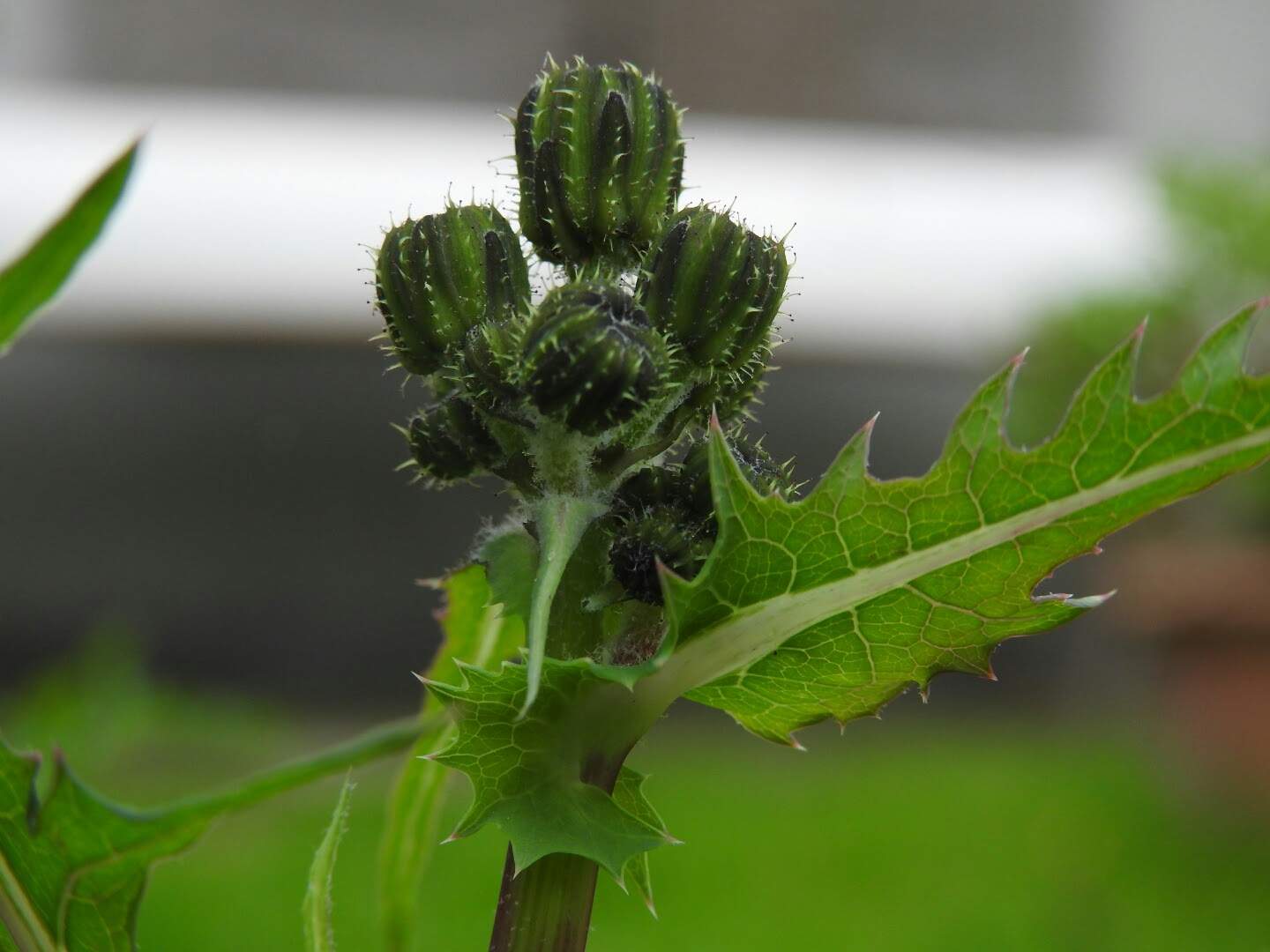
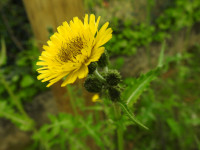
Annual or biennial herbaceous plant, with an erect habit that can reach a variable height between 30 and 100 cm, sometimes up to 150 cm. The stem is robust, hollow, sparsely branched, generally cylindrical in section with longitudinal striations, often reddish or with violet hues in the basal part, and can be glabrous or densely covered with glandular hairs. The root system is taprooted, well developed, sometimes branched, and allows the plant good anchorage and survival ability even in disturbed environments.
The leaves appear in a basal rosette initially tender and not rigid, then become rigid, leathery, glabrous and shiny green on the upper surface. The basal leaves can be entire or pinnatifid, while the cauline leaves are smaller, sparse, sessile and clasping, with broad ear-shaped lobes that wrap around the stem. The leaf margins are toothed, equipped with numerous small spines that give the leaf a spiny and rough texture.
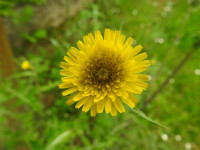
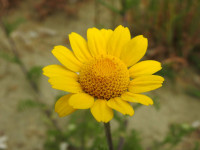
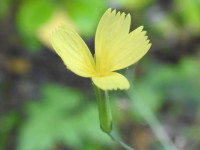
The inflorescence is formed by capitula 2-4 cm in diameter, gathered in umbel-like or corymbiform clusters, with a pyriform involucre 10-15 mm long made up of lanceolate bracts arranged in several overlapping series, with ciliate margins and sometimes with glandular hairs. The flowers are all ligulate, bright yellow in color, sometimes with reddish hues externally, hermaphroditic and fully fertile. The corolla measures about 4-6 mm in length, with five obtuse lobes and a hairy tube at the apex. The symmetry is actinomorphic, with numerous ligulate petals arranged radially.
The fruit is an obovate-elliptical achene, about 2.5-3.5 mm long, brown-reddish, flattened, with three well-marked longitudinal ribs and a smooth or slightly wrinkled surface. The margin is equipped with a thin ciliate and recurved wing. The pappus is formed by numerous white, thin and silky hairs, sometimes accompanied by some sturdier bristles, which facilitate wind dispersal.
The latex, white in color, is present in all green parts of the plant and is harmless to the touch.
Habitat and distribution
Cosmopolitan species, Prickly Sow-thistle is present in almost all Italian regions, including the major islands, and extends throughout the Mediterranean basin up to sub-mountain areas at altitudes that can reach 1500 meters. It grows preferably in soils disturbed by human activity, such as uncultivated fields, vegetable gardens, gardens, roadside edges and urban areas, showing a remarkable ability to adapt even to soils rich in nutrients, particularly nitrogen.
It prefers sunny exposures and well-drained soils but also tolerates conditions of low fertility and mechanical disturbance. Its presence as a weed is well known due to its rapid growth and the ability to maintain seed fertility even for long periods (up to 10 years in dormancy).
Flowering period
Flowering extends from May to December, with a peak that can vary depending on latitude and altitude. In Mediterranean regions flowering begins earlier, around May-June, while in cooler and mountainous areas it can last until October-November. The long flowering window contributes to its effectiveness as a weed and to its widespread distribution throughout the territory.
Ecology and pollination
Prickly Sow-thistle produces hermaphroditic and fertile flowers, mainly pollinated by bees and other pollinating insects attracted by the bright yellow color of the flowers and the presence of nectar. The plant establishes itself as a melliferous resource in various anthropized habitats.
Seed dispersal occurs mainly through the wind, thanks to the silky pappus that facilitates long-distance transport. Furthermore, the ability to keep seeds viable in dormancy for long periods ensures the persistence of the species even in disturbed environments or subjected to agricultural practices.
Curiosities and traditional uses
Prickly Sow-thistle is an edible plant highly appreciated in Italian and Mediterranean wild food traditions. The young and tender leaves, preferably harvested in spring, are consumed raw in salads or boiled and seasoned with oil and lemon. They can also be sautéed with garlic or shallots, used as a side dish for meats, or employed as an ingredient in omelets, fillings and soups.
From a nutritional point of view, this species is rich in minerals (iron, calcium, phosphorus), vitamins and fibers, and has depurative, diuretic and refreshing actions. The white latex, although present, is harmless and was once believed to have galactagogue properties, i.e., capable of increasing milk production in both humans and animals.
Historically, the roots of this and other chicories were roasted and ground to obtain a coffee substitute, a practice now almost abandoned.
Etymology
The genus name Sonchus derives from the Greek “sónkhos”, which in turn comes from “sómfos”, a term meaning “empty, soft, spongy”, probably referring to the hollow consistency of the plant's stem. The specific epithet asper is Latin and means “rough, harsh”, clearly referring to the spiny and rough surface of the leaves.
The Italian name “grespino spinoso” precisely recalls this spiny and rough characteristic of the leaves, which is a distinctive trait of the species compared to other softer chicories.
Sources
- Prof. S. Pignatti, "Flora d'Italia"
- Acta Plantarum - Flora delle regioni italiane (scheda di Mirna Medri)
- Tela Botanica / H. Coste, "Flore descriptive et illustrée de la France"
- World Flora Online (WFO)
Characteristics
Scheda botanica
| Famiglia | Asteraceae |
|---|---|
| Fioritura | tutto l'anno |
| Forma biologica | Scapose |
| Habitat | with yellow flowers, annual plant |
Domande frequenti
- Quando fiorisce Prickly Sow-thistle?
- Prickly Sow-thistle fiorisce tutto l'anno.
- Che tipo di pianta è Prickly Sow-thistle?
- Prickly Sow-thistle è una Therophytes (Scapose) secondo la classificazione di Raunkiaer.
- A quale famiglia appartiene Prickly Sow-thistle?
- Prickly Sow-thistle appartiene alla famiglia botanica Asteraceae.
Where I found it (5 sightings)
Classification
- Kingdom
- Plantae
- Family
- Asteraceae
- Full name
- Sonchus asper (L.) Hill
- Life form
- Therophytes scapose
Similar species
Search for species with similar characteristicsFurther reading
Noticed an error in the identification? Write to me
Other species of the same family
Asteraceae

Explore
Other species of Asteraceae