Botanical species
Centaurea nervosa
Willd.
Singleflower Knapweed
Description
Morphological description
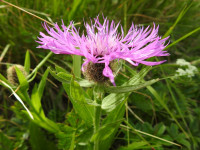
Perennial herbaceous plant of small size, generally 10 to 40 cm tall, with an erect habit and a striated stem, robust and often unbranched, ending with a single flower head. The stem is characterized by a striated surface and a slight pubescence of stiff and spreading hairs of white-gray color.
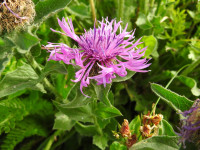
The leaves are alternately arranged along the stem and have a lanceolate to oblanceolate blade, herbaceous in texture and pubescent surface. The basal leaves are attenuated into a short petiole of 2-3 cm, with an oblanceolate-ovate blade varying in size from 4-5 cm wide to 9-11 cm long, acute at the apex and with an entire or slightly dentate margin, equipped with arcuate veins with a base ranging from truncate to semi-clasping. The upper leaves are sessile, with a broad base, semi-clasping and elliptical in shape, always with shallow dentations and a well-marked central vein.
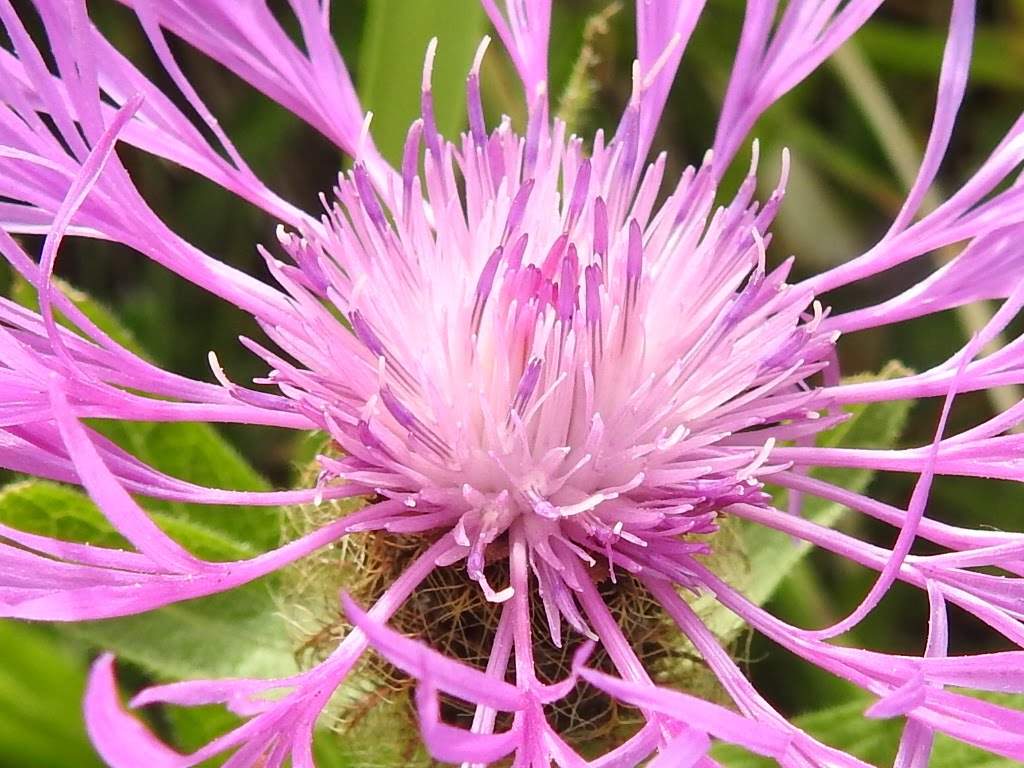
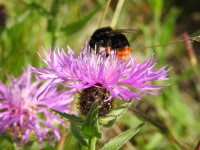
The inflorescence is a single flower head, subglobose in shape, 4-5 cm in diameter, with compact involucres 1.5-2.5 cm long and completely covered by pinnate bract appendages 0.5 to 2 cm long. These appendages have a central awn with numerous lateral fringes (15-30 per side), feathery in appearance, light rusty in color and curved-reflexed on themselves, giving the involucre a feathery and decorative aspect.
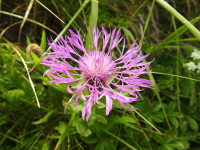
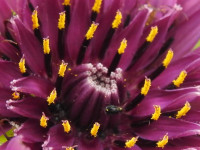
The flowers, all hermaphroditic and actinomorphic, are intense violet in color, with central tubular flowers and peripheral ray flowers divided into linear lobes. There are many tubular petals, without calyx (K 0/5), and five stamens. The achene, about 4 mm long, is brown-grayish in color and bears a white pappus 1.5 to 3 mm long, which aids seed dispersal.
The root system, typical of montane perennial species, is robust and well anchored, allowing the plant to survive the harsh conditions of alpine environments.
Habitat and distribution
The species is typical of montane and subalpine zones of the Alpine area and the northern Apennines, with a distribution extending throughout the Alpine sector and partly in the southeastern Mediterranean area, particularly the Balkans, while it is absent from the Pyrenees. In Italy it is common in the Alps, where it grows in subalpine and alpine belts, generally between 1500 and 2500 meters of altitude.
It prefers sunny pastures, rich meadows and thickets, especially on siliceous soils, such as lava and tuff, but does not disdain substrates with the presence of fine calcareous and dolomitic material, often brought by aeolian phenomena or landslides. The soils on which it develops are generally fertile, neutral to subacid, well supplied with mineral bases. Exposure is usually well lit, in open and sunny environments.
Flowering period
Flowering occurs mainly in July and August, with possible extension until September in higher areas or with particular microclimates. Flowering is a characteristic signal of the mountain summer season and coincides with the period of greatest activity of pollinating insects.
Ecology and pollination
The species is hermaphroditic and its pollination is predominantly entomogamous, i.e., mediated by pollinating insects, which are attracted by the bright color and shape of the flower head. Self-pollination phenomena are also frequent, but the main strategy is the promotion of cross-fertilization to maintain genetic variability.
Seed dispersal occurs through epizoochory, that is, the seeds, equipped with a feathery pappus, attach to the fur of animals that traverse the pastures, thus favoring the colonization of new areas.
Curiosities and traditional uses
The genus name Centaurea is linked to Greek mythology, where the centaur Chiron, known for his wisdom and medical knowledge, supposedly used this plant for its healing properties. Although there are no specific direct references to ethnobotanical or medicinal uses of Centaurea nervosa in traditional Italian contexts, the genus Centaurea is historically known for uses in phytotherapy, especially as an anti-inflammatory and for wound healing.
The Italian common name "Singleflower Knapweed" recalls the similarity of its flowers to those of the common cornflower, but with characteristics typical of the mountain environment and more intense colors.
Etymology
The scientific name derives from the Latin centaureum, a term recalling the centaurs of Greek mythology, particularly Chiron, the wise and medical centaur who, according to tradition, discovered the therapeutic properties of some species of the genus. The specific epithet nervosa refers to the veins or nerves well visible on the leaves of the plant.
The common name "Singleflower Knapweed" highlights the resemblance to the flowers of the cornflower (Centaurea cyanus) and its typical mountain habitat, emphasizing its belonging to the alpine environment.
Sources
- Prof. S. Pignatti, "Flora d'Italia"
- Acta Plantarum - Flora delle regioni italiane (scheda di Mirna Medri)
- Tela Botanica / H. Coste, "Flore descriptive et illustrée de la France"
- World Flora Online (WFO)
Characteristics
Scheda botanica
| Famiglia | Asteraceae |
|---|---|
| Fioritura | luglio – agosto |
| Forma biologica | Scapose |
| Habitat | with purple flowers, Perennial plant, with blue-purple flowers |
Domande frequenti
- Quando fiorisce Singleflower Knapweed?
- Singleflower Knapweed fiorisce luglio – agosto.
- Che tipo di pianta è Singleflower Knapweed?
- Singleflower Knapweed è una Hemicryptophytes (Scapose) secondo la classificazione di Raunkiaer.
- A quale famiglia appartiene Singleflower Knapweed?
- Singleflower Knapweed appartiene alla famiglia botanica Asteraceae.
Where I found it (5 sightings)
Classification
- Kingdom
- Plantae
- Family
- Asteraceae
- Full name
- Centaurea nervosa Willd.
- Synonyms
- Centaurea plumosa A.Kern., nom. illeg.; Centaurea uniflora Turra subsp. nervosa (Willd.) Bonnier & Layens
- Life form
- Hemicryptophytes scapose
Similar species
Search for species with similar characteristicsFurther reading
Noticed an error in the identification? Write to me
Other species of the same family
Asteraceae
Explore
Other species of Asteraceae