Botanical species
Satureja montana
L.
Winter Savory
Description
Morphological description
Perennial suffrutescent plant, Winter Savory has a bushy habit and generally reaches a height between 15 and 40 cm, with exceptional cases up to 50 cm. The stems are woody at the base and more herbaceous and branched in the upper part; they have a subtetragonal shape, are erect or ascending, rigid and distinctly pubescent with short retrorse hairs. The plant tends to form compact bushes thanks to branching from the base.
The leaves are opposite, subsessile, leathery and bright green in color. Their shape varies from linear to ovate-lanceolate, with an acute apex often folded downward. They are characterized by ciliate margins (small hairs along the edge) and a shiny and glabrous surface on both sides, with the central vein well visible on the underside. On the margins, especially at the base, they have bristles and scattered glands that give the typical aroma. The lower leaves measure about 2-3 mm wide by 10-25 mm long. At the axil of the upper leaves, a cluster of 2-8 smaller leaflets often forms or, more rarely, a short secondary branch.
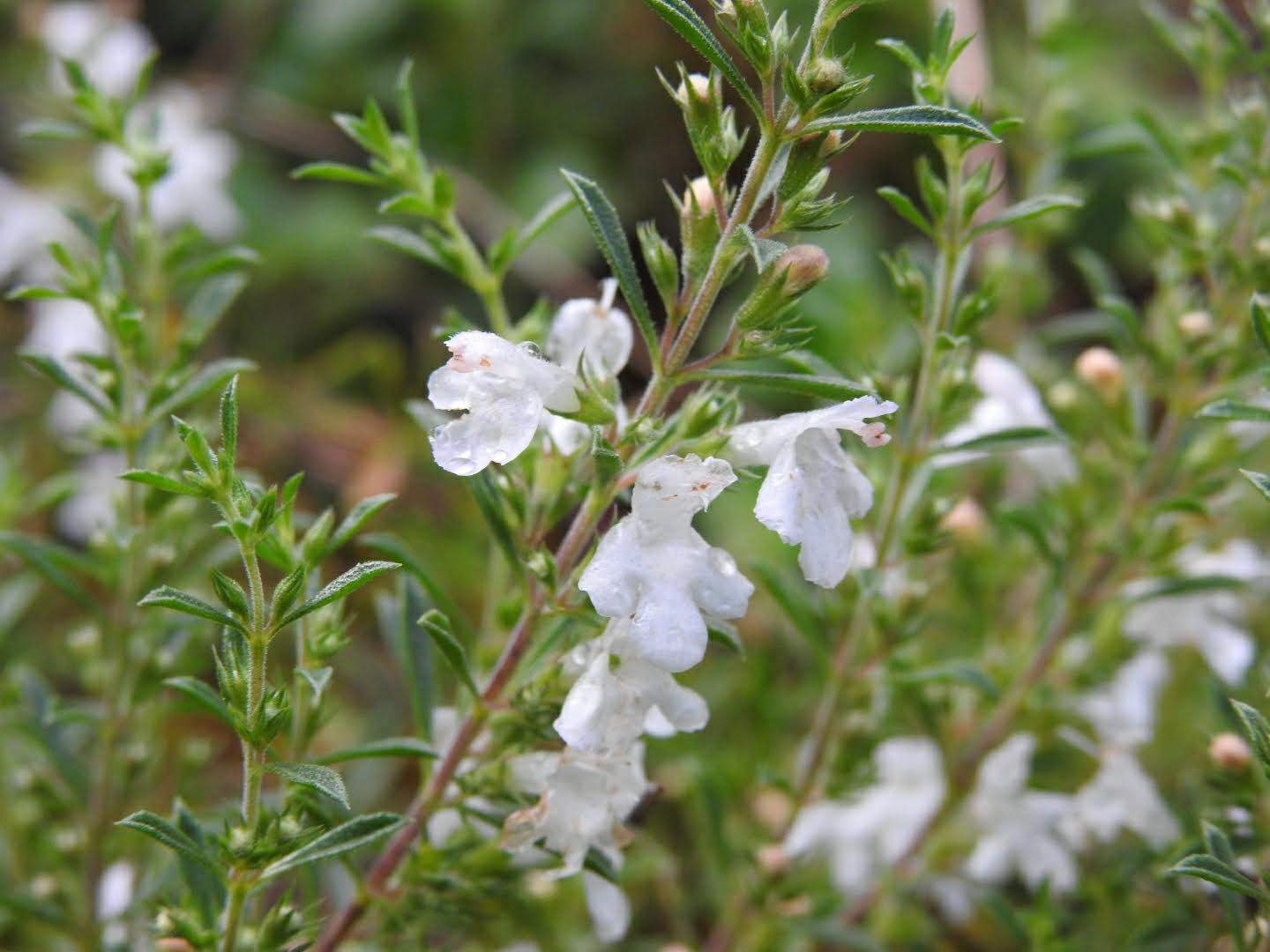
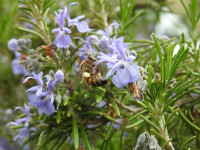
The flowers are hermaphrodite, small in size, arranged in verticillasters (whorled inflorescences) composed of 2-3 flowers (rarely more), located at the axil of the upper leaves. The peduncles are about 3-4 mm long. The calyx is tubular with 10 nerves and ends with 5 pointed triangular teeth of similar size, slightly glandular-pubescent inside the throat. The corolla, 6-10 mm long, has a tube that protrudes from the calyx and divides into two lips: the upper single lip, erect and dark red in color, 4-5 mm long; the lower lip trilobed, perpendicular to the tube, with the central lobe wider and oblong compared to the two lateral ones. The corolla color varies from white or pinkish-white to more violet or pale pink tones, often with violet dots or spots. There are four stamens and a bifid style.
The fruit is a microbasal schizocarp formed by four oval achenes, dotted with small granules and housed inside the persistent calyx. The roots are not detailed in the sources but, as typical of Mediterranean suffrutescent plants, a well-developed root system adapted to dry and rocky soils is presumed.
Habitat and distribution
Winter Savory is a thermophilic and calcicolous species, typical of Mediterranean environments. It grows in Italy and the western Mediterranean regions, spreading from the Mediterranean basin to the Caucasus and Algeria. In Italy it is found on calcareous, rocky, dry and well-exposed soils, typically at the edges of mountain roads and on rocky slopes. It prefers sunny and well-drained exposures.
The growth altitude ranges from hill levels up to about 1300 meters, adapting well to poor and dry soil conditions. It is frequent in mountainous and submontane environments, often in association with other aromatic plants and species typical of Mediterranean maquis and rocky garigues.
Flowering period
Flowering extends from July to September, with peaks in the summer months. No significant geographic variations in the flowering period are reported, which remains constant in the different regions of its Mediterranean range.
Ecology and pollination
The flowers of Winter Savory are hermaphrodite and fragrant, attractive to pollinating insects, particularly bees and other pollinators that facilitate cross-fertilization. The arrangement in verticillasters facilitates access to visitors, while the presence of aromatic essential oils helps attract pollinators.
Seed dispersal occurs through the achenes contained in the schizocarp, which remain protected inside the persistent calyx. The seeds are small and dotted, probably dispersed by natural fall or by small animals and abiotic agents such as wind and water, although there are no specific data on dispersal methods.
Curiosities and traditional uses
Winter Savory is an aromatic-edible plant with a long history of herbal, food and cosmetic use. The ancient Romans called it “satureia”, a name linked to mythology and the belief in its aphrodisiac properties, so much so that moderation in its consumption was recommended to avoid excesses of sexual desire, a phenomenon known as satirism.
From a medicinal point of view, the flowering tops of the plant are used in infusion to treat gastrointestinal disorders such as diarrhea, digestive difficulties, and to fluidify mucus in colds and bronchitis. It has antiseptic, antispasmodic, carminative, tonic, stimulating, expectorant, stomachic, antidiarrheal and digestive properties thanks to its active principles, which include tannins, labiatic acid, vitamin A, calcium, potassium, and an essential oil rich in borneol, camphor, carvacrol, cymene, estragole, terpinene and thymol.
In cosmetics, Winter Savory infusion is used in toning and deodorant baths, and as a remedy to reduce ankle swelling through footbaths. Furthermore, applied to the hair, it strengthens the hair bulb and repels lice.
In cooking Winter Savory is appreciated for its intense aroma similar to thyme, rosemary, marjoram and oregano. It pairs well with grilled meats, cereals, legumes, sausages and sauces. It is also used in liqueur making and perfumery for its characteristic scent.
Etymology
The scientific name of the genus, Satureja, derives from the Latin “satureia”, an ancient term already mentioned by Pliny the Elder but of uncertain origin. Numerous theories have been proposed to explain the name, but none have found definitive confirmation. The specific name “montana” refers to the typical habitat of the species, which grows in rocky and dry mountainous or submontane environments.
The Italian common name “santoreggia montana” directly reflects the scientific name, emphasizing its growth environment.
Sources
- Prof. P.V. Arrigoni, "Flora analitica della Toscana", "Flora dell'Isola di Sardegna"
- Acta Plantarum - Flora delle regioni italiane (scheda di Giuliano Salvai)
- Tela Botanica / H. Coste, "Flore descriptive et illustrée de la France"
- World Flora Online (WFO)
Characteristics
Scheda botanica
| Famiglia | Lamiaceae |
|---|---|
| Fioritura | luglio – settembre |
| Forma biologica | Suffruticose |
| Habitat | with white flowers, edible plant, fragrant plant |
| Uso alimentare | Commestibile |
Domande frequenti
- Quando fiorisce Winter Savory?
- Winter Savory fiorisce luglio – settembre.
- È commestibile Winter Savory?
- Winter Savory è considerata commestibile. Verifica sempre le parti eduli e la preparazione corretta prima del consumo.
- Che tipo di pianta è Winter Savory?
- Winter Savory è una Chamaephyte (Suffruticose) secondo la classificazione di Raunkiaer.
- A quale famiglia appartiene Winter Savory?
- Winter Savory appartiene alla famiglia botanica Lamiaceae.
Where I found it (3 sightings)
Classification
- Kingdom
- Plantae
- Family
- Lamiaceae
- Full name
- Satureja montana L.
- Life form
- Chamaephyte suffruticose
Similar species
Search for species with similar characteristicsFurther reading
Noticed an error in the identification? Write to me
Other species of the same family
Lamiaceae
Explore
Other species of Lamiaceae