Botanical species
Salvia rosmarinus
Spenn.
Rosemary
Description
Morphological description
Rosemary is a perennial woody evergreen shrub that can reach a height of up to 2 meters. Its habit is variable: the branches are generally prostrate or ascending, rarely completely erect. The stem has a light brown bark, often fissured in more mature specimens.
The leaves are linear, narrow (2-3 mm wide) and relatively long (15-30 mm), with revolute margins, that is rolled downwards, giving them a tapered and pointed appearance. The upper surface is dark green, glossy and slightly leathery, while the underside is whitish and tomentose, covered with dense hairs. The leaves are sessile, arranged oppositely along the branch and often grouped in small axillary bundles.
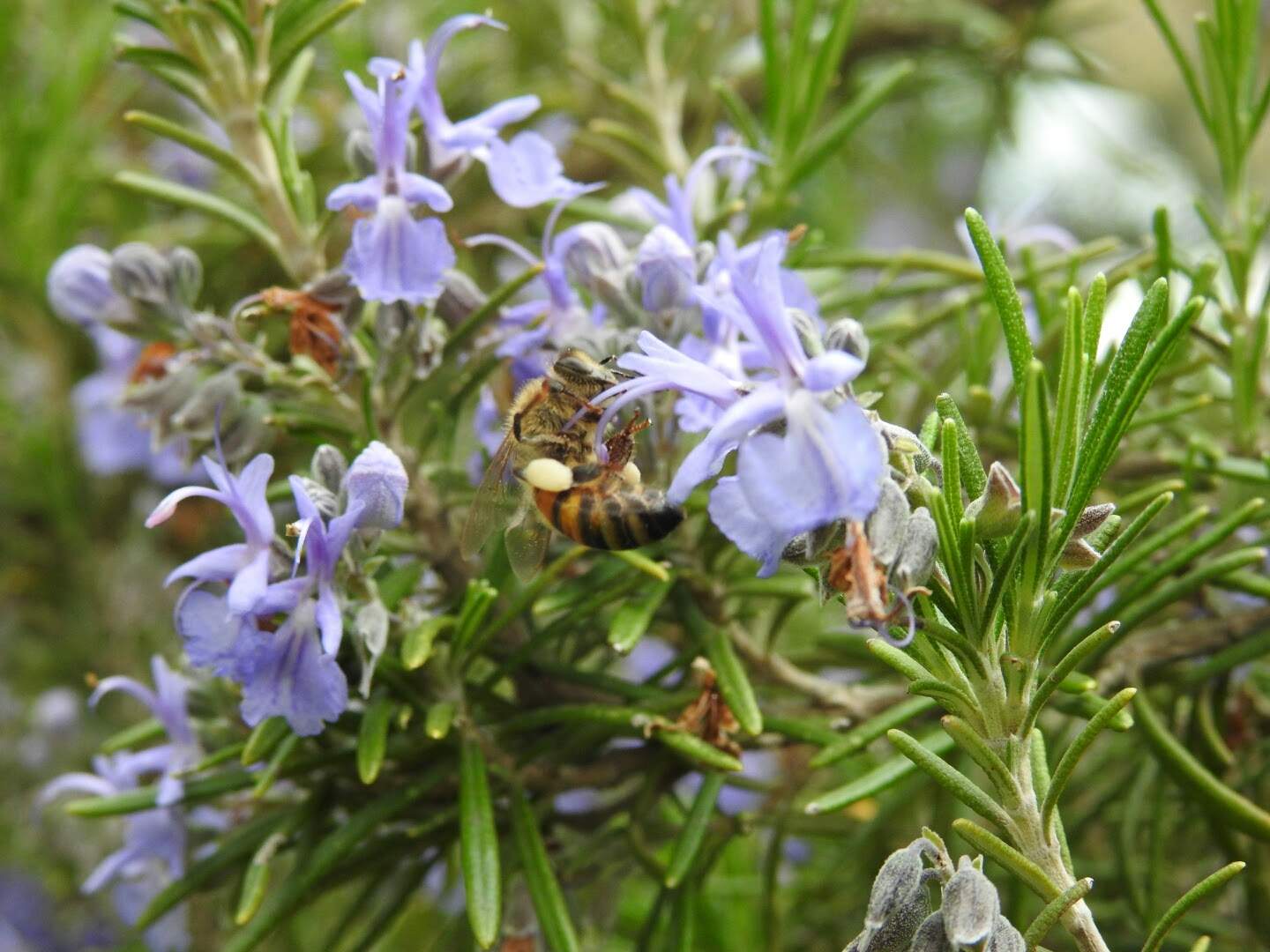
The flowers are gathered in short axillary racemes, generally located on the upper part of the branches, each composed of 4 to 16 flowers. The calyx is campanulate, bilabiate, tomentose, 5-6 mm long and divided up to about one third of its length. The corolla, 10-12 mm long, is also bilabiate with a protruding tube swollen at the base (throat); the upper lip is straight, formed by two connected lobes, while the lower lip is trifid, with the central lobe wider and concave and the two lateral lobes oblong and slightly revolute. The flower color varies from light blue to lilac, with occasional pink or white specimens. There are two ascending lower stamens that exceed the corolla, while the two upper stamens are absent. The style is simple with a bifid stigma.
The fruit is a schizocarp composed of four oblongo mericarps (achenes), light brown in color, smooth and hairless.
The root system is typical of hardy Mediterranean shrubs, with deep and branched roots that allow good anchorage in dry and calcareous soils.
Habitat and distribution
Rosemary is a typical species of Mediterranean maquis and garrigue, preferring dry and sunny habitats, often on calcareous substrates. It grows from sea level up to about 800 meters altitude. In Italy it is widespread along all the Tyrrhenian and Ionian coasts and on the Adriatic coasts up to Molise. It is present on all the major islands, including Sardinia and Sicily, where it also penetrates some distance from the sea, always in Mediterranean maquis contexts.
In northern Italy its spontaneous presence is more limited: it is native in Liguria and on the western coasts of Lake Garda, where some stations on the cliffs overlooking places such as Tignale, Campione and Limone are considered spontaneous and represent the northernmost outpost of the species in northern Italy. In other northern locations Rosemary is often cultivated or naturalized.
In the Mediterranean basin the species is widespread along all coasts, particularly in regions with a typically Mediterranean climate. It is often cultivated in gardens and vegetable gardens, where it can become semi-wild.
Flowering period
Rosemary flowers for most of the year, with flowering from January to December, although the highest flower production is observed in the spring and autumn months. The long flowering period is favored by the mild climate of Mediterranean regions, where the species grows spontaneously.
Ecology and pollination
Rosemary flowers are visited by numerous pollinating insects, especially bees, which find in the flowers an important source of nectar and pollen. The species is therefore an important melliferous plant, contributing to the production of high-quality honey.
Reproduction occurs through seeds contained in the achenes, which germinate after maturation. Dispersal is mainly barochorous (falling near the mother plant), but can also be facilitated by animals or external agents. The ability to live in arid environments and on poor soils is supported by the robustness of the roots and the leaf morphology that limits water loss.
Curiosities and traditional uses
Rosemary is one of the most well-known and used aromatic and medicinal plants since ancient times in the Mediterranean basin. The Greeks and Romans used it not only as a seasoning but also as a medicinal plant and in sacred rituals, where it was burned as incense. It has been historically associated with Aphrodite and symbolically linked to concepts of immortality, fidelity and protection against bad luck.
In the Middle Ages it was cultivated in monastery gardens, together with other beneficial plants, and used in numerous medicinal and cosmetic preparations. It is known for its aromatic, digestive, antispasmodic, diuretic, balsamic, antiseptic and stimulating properties. The essential oil extracted is used in perfumery, cosmetics, liqueur production and pharmacy.
In cooking it is a traditional seasoning for roasts, meats, fish and game, but also used in simple sweets such as chestnut cake. Its flowers attract bees, which produce a precious honey with a characteristic flavor.
Historical medicinal use included treatments for nervous disorders, digestive problems, and external applications for muscle and rheumatic pains. Today its therapeutic properties are mainly recognized in the aromatic and cosmetic fields, while pharmaceutical use is more limited and must be done with caution.
Etymology
The scientific name Salvia rosmarinus combines the genus Salvia, from Latin "salus" or "salveo" meaning "to be well" or "to save", recalling the therapeutic properties attributed to the plant, with the specific name rosmarinus, composed of “ros” (dew) and “marinus” (of the sea), poetically describing the delicate bluish tint of the flowers, similar to the ripple of sea waves.
The Italian common name "rosmarino" derives directly from the Latin rosmarinus, maintaining this same marine and freshness suggestion, which has been impressed in the denomination since ancient times.
Sources
- Prof. S. Pignatti, "Flora d'Italia"
- Acta Plantarum - Flora delle regioni italiane (scheda di Daniela Longo)
- Tela Botanica / H. Coste, "Flore descriptive et illustrée de la France"
Characteristics
Scheda botanica
| Famiglia | Lamiaceae |
|---|---|
| Fioritura | tutto l'anno |
| Forma biologica | Nano-Phanerophytes |
| Habitat | edible plant, with purple flowers, fragrant plant |
| Uso alimentare | Commestibile |
Domande frequenti
- Quando fiorisce Rosemary?
- Rosemary fiorisce tutto l'anno.
- È commestibile Rosemary?
- Rosemary è considerata commestibile. Verifica sempre le parti eduli e la preparazione corretta prima del consumo.
- Che tipo di pianta è Rosemary?
- Rosemary è una Phanerophytes (Nano-Phanerophytes) secondo la classificazione di Raunkiaer.
- A quale famiglia appartiene Rosemary?
- Rosemary appartiene alla famiglia botanica Lamiaceae.
Where I found it (2 sightings)
Classification
- Kingdom
- Plantae
- Family
- Lamiaceae
- Full name
- Salvia rosmarinus Spenn.
- Synonyms
- Rosmarinus officinalis L.; Salvia rosmarinus Schleid., isonym
- Life form
- Phanerophytes nano-phanerophytes
Similar species
Search for species with similar characteristicsFurther reading
Noticed an error in the identification? Write to me
Other species of the same family
Lamiaceae
Explore
Other species of Lamiaceae