Botanical species
Phyteuma orbiculare
L.
Round-Headed Rampion
Description
Morphological description
Perennial herbaceous plant generally 40 to 80 cm tall, with an erect habit and ascending stem, glabrous and longitudinally striated. The stem, often about 3.5 mm in diameter, may be slightly covered with fine hairs and has a smooth or slightly pubescent surface. The root system develops from a fusiform and branched rhizome, which allows the plant to overwinter and regenerate annually.
The basal leaves are gathered in a rosette and have a lanceolate or oblong shape, with a crenulate or dentate margin; the base of the blade is rounded, heart-shaped (cordate), or cuneate. Their length varies from 4 to 12 cm, while the slightly winged petiole can reach lengths between 0.5 and 11 cm. The lower cauline leaves are narrower, linear-oblong, petiolate, and have a crenulate margin; the upper ones, generally sessile and semi-clasping the stem, are thinner, linear, and with a dentate or obtusely dentate margin.
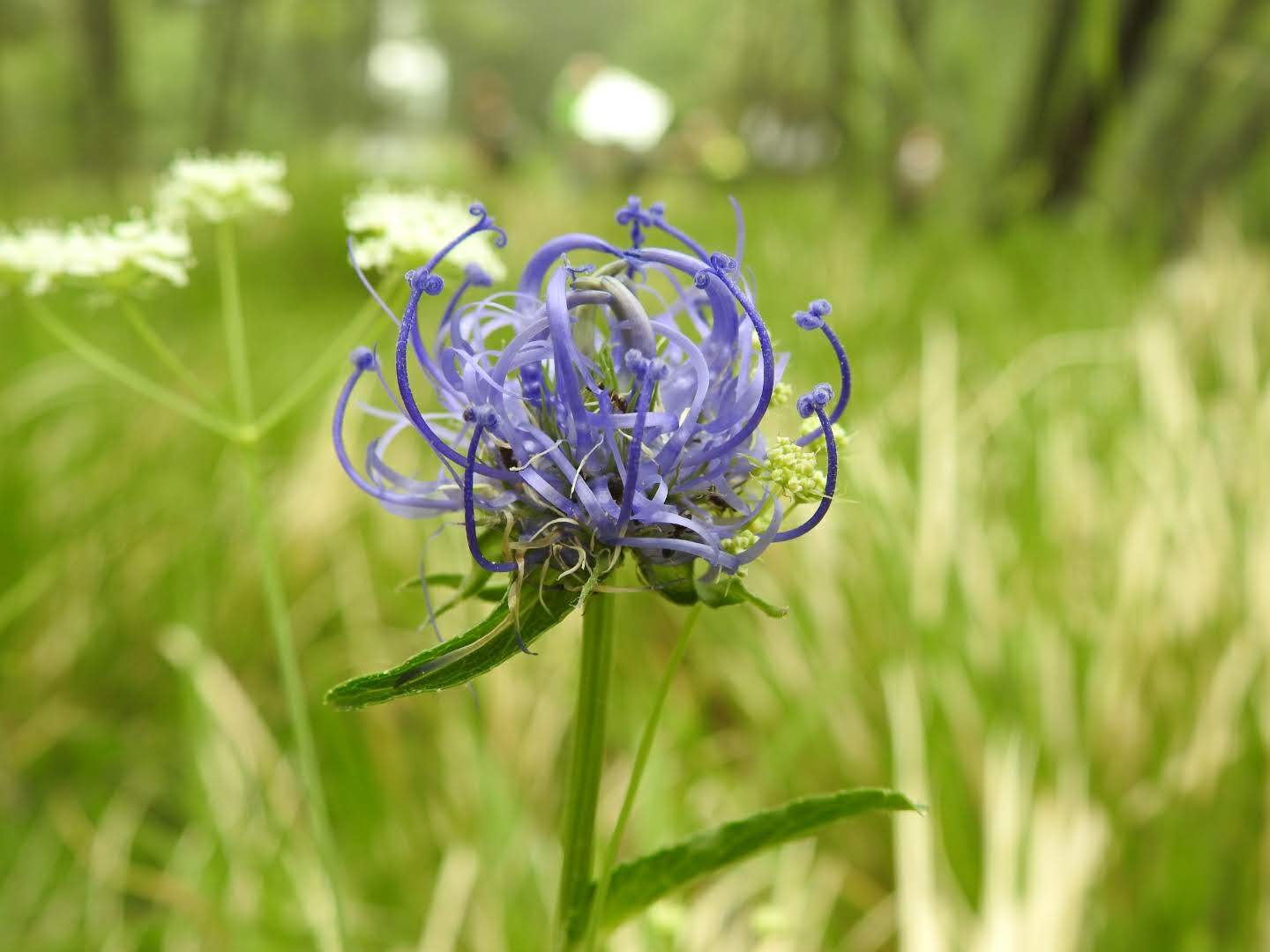
The inflorescence is characterized by hemispherical or globose capitula, with a diameter ranging from 1.3 to 3 cm, each composed of 20 to 40 flowers. The bracts surrounding the inflorescence have a triangular-lanceolate shape, tapering towards the apex and alternating with the flowers; the larger bracts measure about 6-10 mm in length and 16-21 mm in width, while the smaller ones are smaller (about 4 x 11-13 mm). During anthesis, the bracts are patent, then fold backward after flowering.
The flowers are violet or blue-violet in color, with a corolla 1.5-2 cm long. The corolla has a short tube curved inward before opening, with lobes fused at the tip and a narrow passage for the style, which measures between 12 and 18 mm. The stigmas are trifid, about 3 mm long. The calyx consists of linear-triangular teeth 1.5-3.5 mm long.
The fruit is an oblong capsule, about 3 x 4 mm in size, containing seeds that probably disperse through natural falling mechanisms or external agents.
Habitat and distribution
The Round-Headed Rampion is an orophilous species typical of the mountainous and subalpine regions of southern Europe, with a distribution extending from the Iberian Peninsula, through the Alps, to the Balkans and potentially towards the Caucasus and Anatolia. In Italy, it is mainly present in the Alps, the northern and central Apennines, and continues towards the Salerno reliefs in the south.
It prefers environments such as pastures and poor meadows, generally located at altitudes between 600 and 2400 meters above sea level. It grows on loose soils, preferably of calcareous-marly nature, with predominantly sunny exposure. The typical habitat includes mountain and subalpine meadows, where cool climatic conditions and good aeration are favorable for the species' development.
Flowering period
Flowering mainly occurs in the summer months, from June to August, with possible variations linked to altitude and latitude. In general, flowering is earlier in lower altitude areas and can extend until late summer in higher mountain areas.
Ecology and pollination
The Round-Headed Rampion is a mountain melliferous plant that attracts various pollinating insects, particularly bees and other hymenopterans, which favor entomophilous pollination. The flower structure, with a narrow corolla tube and trifid stigmas, is adapted to pollination by insects with a proboscis long enough to reach the internal nectar.
Seed dispersal occurs through natural falling from the capsule, although no specific dispersal mechanisms such as wind or animals are documented. Overwintering is ensured by the presence of rhizomes, which allow the plant to survive adverse winter conditions.
Curiosities and traditional uses
The Round-Headed Rampion is an edible species; the basal leaf rosettes can be consumed raw in salads or cooked with other vegetables. This characteristic makes it an alimurgic plant of interest for mountain populations.
Traditionally, the genus Phyteuma has been known since antiquity: Dioscorides and Pliny referred to a similar plant with this name, Reseda phyteuma, suggesting ancient knowledge and use. Although pharmaceutical applications are not well documented and should be considered with caution, the plant is also appreciated as a nectar source for pollinating insects.
In ornamental contexts, the Round-Headed Rampion is used to beautify rock and alpine gardens, as well as to create color effects in sunny flower beds with well-drained and preferably calcareous soils.
Etymology
The genus name “Phyteuma” derives from ancient Greek, composed of "phytòn" (πυτόν), meaning "plant," and "eu" (εὖ), meaning "well" or "vigorous," with the overall sense of "vigorous plant."
The specific epithet “orbiculare” comes from the Latin “orbiculatus,” meaning “circular-shaped,” referring to the globose shape of the inflorescence, which appears as a hemispherical or almost perfectly spherical capitulum.
The Italian common name “raponzolo orbicolare” directly recalls this characteristic shape of the inflorescence and distinguishes it from other rampion species present in the territory.
Sources
- Prof. S. Pignatti, Flora d'Italia
- Acta Plantarum - Flora delle regioni italiane (scheda di Marinella Zepigi)
- World Flora Online (WFO)
Characteristics
Scheda botanica
| Famiglia | Campanulaceae |
|---|---|
| Fioritura | giugno – agosto |
| Forma biologica | Scapose |
| Habitat | edible plant, with purple flowers, Perennial plant |
| Uso alimentare | Commestibile |
Domande frequenti
- Quando fiorisce Round-Headed Rampion?
- Round-Headed Rampion fiorisce giugno – agosto.
- È commestibile Round-Headed Rampion?
- Round-Headed Rampion è considerata commestibile. Verifica sempre le parti eduli e la preparazione corretta prima del consumo.
- Che tipo di pianta è Round-Headed Rampion?
- Round-Headed Rampion è una Hemicryptophytes (Scapose) secondo la classificazione di Raunkiaer.
- A quale famiglia appartiene Round-Headed Rampion?
- Round-Headed Rampion appartiene alla famiglia botanica Campanulaceae.
Classification
- Kingdom
- Plantae
- Family
- Campanulaceae
- Full name
- Phyteuma orbiculare L.
- Life form
- Hemicryptophytes scapose
Similar species
Search for species with similar characteristicsNoticed an error in the identification? Write to me
Other species of the same family
Campanulaceae
Explore
Other species of Campanulaceae