Botanical species
Campanula trachelium
L.
Nettle-leaved Bellflower
Description
Morphological description
Perennial herbaceous plant reaching a height between 40 and 100 cm, with an erect habit and angular stem, often reddish. The stem has five sharp edges or narrowly winged ridges, covered with dense, coarse, spreading hairs, giving the plant a rough and bristly surface. The robust root is taproot-like, sometimes woody at the base, and does not produce stolons.
The basal leaves are heart-shaped or ovate-triangular, with dimensions reaching 5-10 cm in length, equipped with a winged petiole 8-15 cm long. The blade is coarsely toothed, rough and harsh to the touch, with a strongly serrated margin. The cauline leaves are progressively smaller and lanceolate, almost sessile, with denticulate margins and herbaceous texture; the petiole is broadly winged and 5-10 mm long. These leaf characteristics, especially the shape and texture, resemble those of nettle, from which the common name "Nettle-leaved Bellflower" derives.
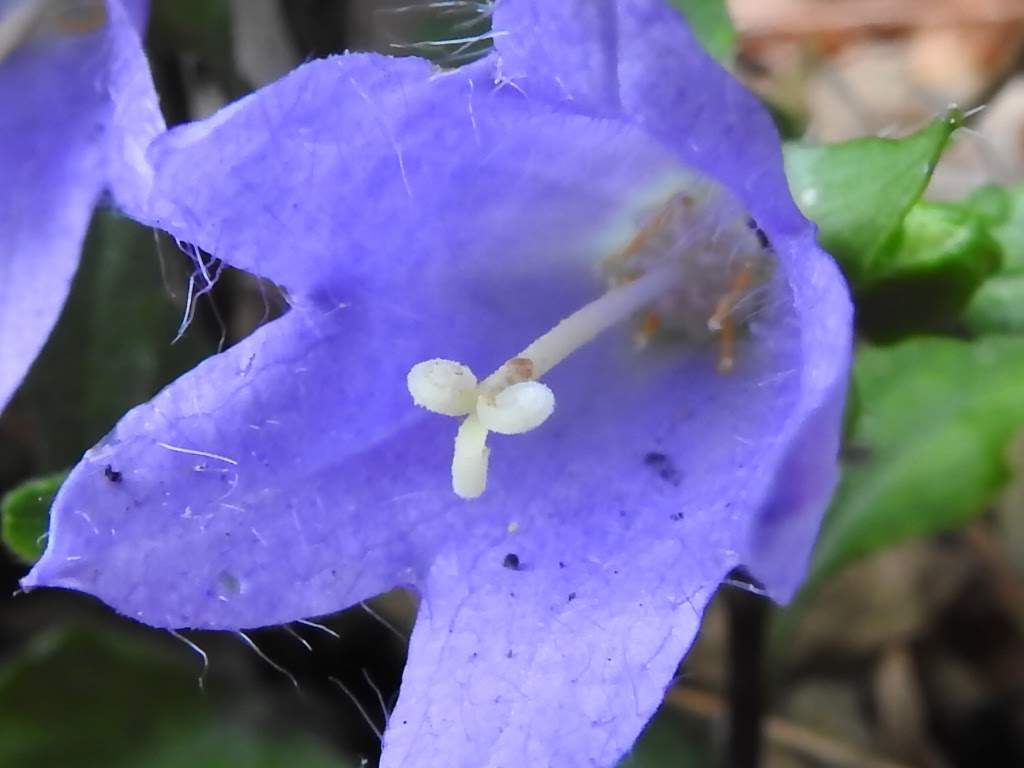
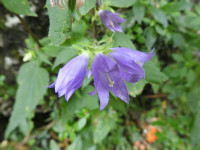
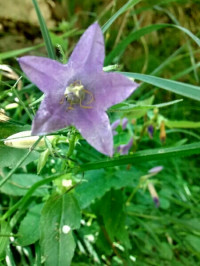
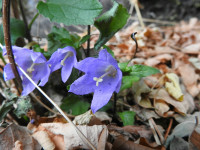
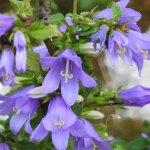
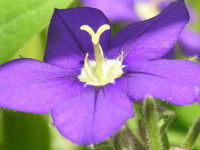
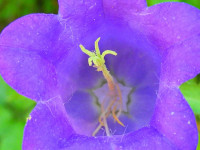
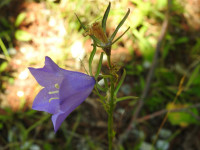
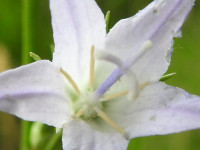
The inflorescence appears as a leafy raceme, simple or branched, bearing two to three flowers per peduncle, with leafy bracts at the base of each bifurcation. The flowers are bell-shaped, with a funnel-shaped corolla of bluish-purple or blue-violet color, sometimes white, measuring between 2.5 and 5 cm in length. The corolla is divided up to about one third into five erect triangular lobes, often mucronate, covered with hairs. The calyx is velvety, with five lanceolate and acute teeth about 7-8 mm long, reaching up to half the length of the corolla; it is also covered with spreading hairs, giving a rough surface. The ovary is superior, composed of three fused carpels, with five stamens and three stigmas.
The fruit is a pendulous ovoid capsule, about 2 cm long, covered with hairs, with an accrescent calyx that remains wrapped around it. Dehiscence occurs through subapical pores, facilitating seed dispersal.
The plant shows some variability in the density and position of the hairiness, which can differ even among individuals of the same population, influencing the general appearance of the stem, leaves, and calyx.
Habitat and distribution
This species is widespread throughout Europe and Western Asia, extending to North Africa. In Italy it is mainly present in mountainous and hilly regions, from the plains up to about 1500 meters altitude. It prefers thermophilous and cool woodland environments, shrubs, broadleaf clearings, and road margins, favoring well-drained soils rich in organic matter.
It grows in habitats characterized by open woods and shrublands, where light is moderate and soil moisture is sufficient to ensure its development. The plant is typical of Mediterranean and temperate mountainous and hilly environments, with exposures ranging from sunny to partially shaded.
Flowering period
Flowering extends from June to October, with possible variations related to latitude and altitude of the growth site. In milder climates and lowland areas, flowering can start as early as June, while in higher mountainous areas it continues until autumn.
Ecology and pollination
The Nettle-leaved Bellflower is mainly pollinated by pollinating insects such as bees, bumblebees, and butterflies, attracted by the vivid color and bell-shaped form of the flowers. The flower structure favors entomophilous pollination, with the corolla providing a suitable platform for pollinating insects to land on.
Seed dispersal occurs through dehiscence of the pendulous capsule which opens by small pores, allowing seeds to fall and disperse in the immediate vicinity of the mother plant, promoting colonization of the surrounding habitat. No particularly specific long-distance dispersal mechanisms are known.
Curiosities and traditional uses
The scientific name derives from the Greek "trachelos", meaning "throat" or "trachea", referring to the flower shape resembling a throat and the traditional use of the plant in treating throat ailments such as tracheitis and oral inflammations. In the past, the roots were used as a mouthwash to relieve sore throat.
The Nettle-leaved Bellflower is considered an edible and medicinal species, although its food uses are less documented compared to medicinal ones. Its use in traditional herbal medicine is limited and should be approached with caution.
From an ethnobotanical perspective, the plant has had a marginal but interesting role in folk practices, especially for its alleged soothing and anti-inflammatory properties.
Etymology
The generic name "Campanula" derives from Latin and means "little bell", referring to the bell-shaped form of the flowers. The specific name "trachelium" comes from the Greek "trachelos" (throat), recalling the flower shape and traditional medicinal use. The Italian common name "campanula selvatica" refers to its natural habitat, typically wooded and mountainous, and the similarity of its leaves to those of nettle.
Sources
- Prof. S. Pignatti, "Flora d'Italia"
- Acta Plantarum - Flora delle regioni italiane (scheda di Giuliano Salvai)
- Tela Botanica / H. Coste, "Flore descriptive et illustrée de la France"
- World Flora Online (WFO)
Characteristics
Scheda botanica
| Famiglia | Campanulaceae |
|---|---|
| Fioritura | giugno – ottobre |
| Forma biologica | Scapose |
| Habitat | with purple flowers, with purple flowers, Perennial plant |
| Uso officinale | Pianta officinale |
Domande frequenti
- Quando fiorisce Nettle-leaved Bellflower?
- Nettle-leaved Bellflower fiorisce giugno – ottobre.
- Che tipo di pianta è Nettle-leaved Bellflower?
- Nettle-leaved Bellflower è una Hemicryptophytes (Scapose) secondo la classificazione di Raunkiaer.
- A quale famiglia appartiene Nettle-leaved Bellflower?
- Nettle-leaved Bellflower appartiene alla famiglia botanica Campanulaceae.
Where I found it (7 sightings)
Classification
- Kingdom
- Plantae
- Family
- Campanulaceae
- Full name
- Campanula trachelium L.
- Life form
- Hemicryptophytes scapose
Similar species
Search for species with similar characteristicsFurther reading
Noticed an error in the identification? Write to me
Other species of the same family
Campanulaceae
Explore
Other species of Campanulaceae